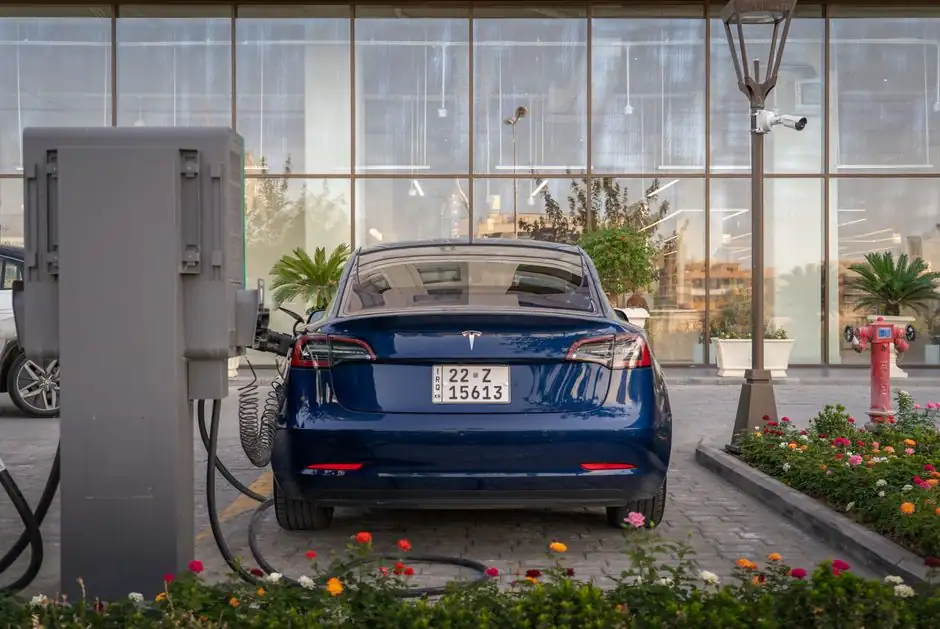
About 95% of EVs on the road rely on rare-earth permanent-magnet traction motors, while roughly 90% of processed rare-earth elements come from a single national supply base, keeping NdFeB magnets at the top of OEM magnet risk registers in 2026 [S1][S6].
The bottleneck is concentrated in a narrow chemistry: neodymium (Nd) and praseodymium (Pr), collectively NdPr, form the base alloy for NdFeB magnets, while dysprosium (Dy) and terbium (Tb) are added in small quantities to keep magnetic strength at the 150–200 °C temperatures seen inside an interior permanent magnet (IPM) rotor [S4]. Samarium-cobalt (SmCo) covers niche high-temperature and aerospace slots but is not a volume substitute [S4].
Where the chemistry is exposed: NdPr, Dy, Tb inside IPM rotors
NdFeB magnets allow a very strong magnetic field to be generated in a very small rotor volume, which is the core reason the IPM topology dominates EV traction motor design over induction or switched-reluctance alternatives [S3]. Automotive-grade magnets must survive continuous thermal, vibrational, and mechanical stress without losing flux, which is why heavy rare-earth additions such as dysprosium remain common in OEM-spec traction magnets [S2][S4].
General Motors' current production motor family uses interior permanent magnets arranged in a dual-V geometry to increase torque density and reduce noise and vibration, with the latest generation moving from solid to segmented magnets to cut heat buildup and energy loss [S2]. Each of those design refinements multiplies demand for qualified NdFeB stock, raising the stakes for any line stoppage at the sinter or grain-boundary-diffusion step.
Selection criteria: rare-earth, rare-earth-lean, and rare-earth-free motor topologies
Three motor families are now competing for the same EV platform slots, and the engineering trade-off is consistent across them: replacing rare-earth magnets with ferrite or with no magnets at all costs peak specific power unless the design compensates with higher inverter current, deeper field weakening, or active cooling [S1][S3].
ZF Friedrichshafen's experimental in-rotor inductive-excited synchronous motor dispenses with rare earths by using electromagnets on both stator and rotor, accepting added complexity in the rotor excitation supply in exchange for eliminating NdFeB content [S1]. Oak Ridge National Laboratory, NREL, Ames Laboratory, and the University of Wisconsin have been evaluating advanced motor concepts under the U.S. Drive Technologies Consortium, with Sandia, Purdue, and the Illinois Institute of Technology also participating [S1]. Permanent-magnet motor market sizing reflects how exposed the baseline design is: the global permanent-magnet motor market is forecast at USD 59.9 billion in 2026, rising to USD 161.2 billion by 2036 at a 10.4% CAGR, with absolute dollar growth of USD 101.3 billion over the decade [S5].
Who the magnet risk is for, and who it is not for

The risk is acute for OEMs and Tier 1 motor suppliers whose 2026 platforms still anchor on interior permanent magnet topology, where a single magnet line stoppage in the dominant processing region can halt vehicle assembly within weeks [S1][S6]. For volume passenger-EV programs targeting 200–300 kW peak per axle, the IPM torque-density advantage is hard to surrender without redesigning inverter, cooling, and gearbox ratios around it [S1][S3].
For low-volume commercial fleets, off-highway EVs, and two-wheeler programs that already accept heavier or larger motor housings, ferrite-magnet and externally excited topologies are commercially viable, and Niron Magnetics' rare-earth-free permanent magnet has been picked up jointly by General Motors and Stellantis for collaboration on EV motors using that material [S1]. Tesla has stated that its next drive unit will use a permanent magnet with no rare-earth elements at all, illustrating how the public commitment is being made even where the technical path remains under development [S1]. Industrial and factory-automation buyers who only need constant-torque pump, fan, or conveyor duty are less magnet-exposed because most factory AC drives are inverter-driven around ferrite or induction rotors, not NdFeB IPMs [S5].
Mitigation moves on the supply side: mining, refining, and magnet capacity in 2026
On the supply side, the 2026 picture is one of vertical-integration deals rather than spot-market relief. General Motors entered a long-term agreement with MP Materials in 2021 to anchor U.S. automotive-grade permanent-magnet supply, with GM acting as the foundational automotive customer for MP's Independence facility in Fort Worth, Texas [S2]. Mountain Pass remains North America's only active, large-scale rare-earth mining and refining site, and the GM–MP partnership is structured to take that refined feedstock all the way through to finished magnets for EV motors [S2].
European policy framing matches that direction: a 2021 European Raw Materials Alliance / EIT Raw Materials cluster report flagged the 95% rare-earth permanent-magnet share in EVs and the political-tension-driven supply risk as reasons to fund European mining, refining, and recycling capacity [S6]. The IEEE Spectrum engineering assessment of 2024 reinforced the same point, noting that roughly 90% of processed rare-earth elements come from a single supply base, and that government, university, and OEM consortia, including the European "Passenger" group of 20 industry and academic partners, are working on rare-earth-free permanent magnets in parallel [S1]. General Motors' framing of magnet procurement as a multi-year journey from investment to industrialization and scale is consistent with the 3–5 year lead time that sinter magnet plants typically require [S2].
Failure modes and limits of rare-earth-free alternatives
The honest engineering ceiling on rare-earth-free designs is performance: replacing NdFeB with ferrite or with no permanent magnet at all reduces specific power, and the gap is real, not cosmetic, even with redesigned rotor geometry and inverter control [S1][S3]. In-rotor inductive-excited synchronous designs add rotor excitation hardware, which costs efficiency and adds a maintenance surface compared with a sealed IPM rotor [S1].
Ferrite-magnet machines tolerate higher ambient temperatures chemically but lose torque density, so a 1:1 swap usually forces a larger motor envelope, heavier inverter, or both, eroding some of the range benefit the OEM was trying to protect [S1][S5]. Niron's iron-nitride rare-earth-free permanent magnet is at collaboration stage with General Motors and Stellantis but has not been confirmed in series production, and the broader rare-earth-free roadmap remains dependent on whether the magnet's energy product, thermal coefficient, and cost can match incumbent NdFeB once volume-sintered [S1].
Engineering sourcing signals to track in late 2026
Three concrete signals are worth tracking. First, output of finished NdFeB magnets from MP Materials' Independence facility at Fort Worth, Texas, and whether GM's 2026 model-year launches take the first qualified volumes [S2]. Second, any series-production confirmation of a rare-earth-free permanent magnet, whether iron-nitride from Niron or a ferrite-based IPM redesign from a passenger-EV program, since the technology has been a collaboration topic since at least November 2023 [S1]. Third, the Benchmark Minerals Rare Earths Index and the NdPr oxide price quoted on it, since NdPr oxide is the feedstock for NdFeB and the cleanest leading indicator of OEM magnet cost pressure [S4]. For related drive-side risk, see the EV charger power module supply 2026: SiC adoption, 30 kW stacks, capacity squeeze note on parallel SiC inverter constraints, and for the broader electrified drivetrain demand picture, the gearmotor market 2026: conveyor and material handling demand signals update.
Industrial buyers specifying motors outside traction duty, including AC motor selections for pumps, fans, and conveyors, do not face the same NdFeB exposure, because inverter-driven industrial AC platforms are dominated by ferrite-magnet and induction topologies rather than IPM [S5]. The same logic applies to drive motor packages in factory automation, where ferrite remains the volume-anchor magnetic material because cost and corrosion resistance outweigh peak torque density needs [S5]. For the small share of industrial applications that do need rare-earth magnet performance, planning around a switching power supply feed for the inverter and around a DC power supply for the control rack is the easier supply problem to solve than the magnet itself.