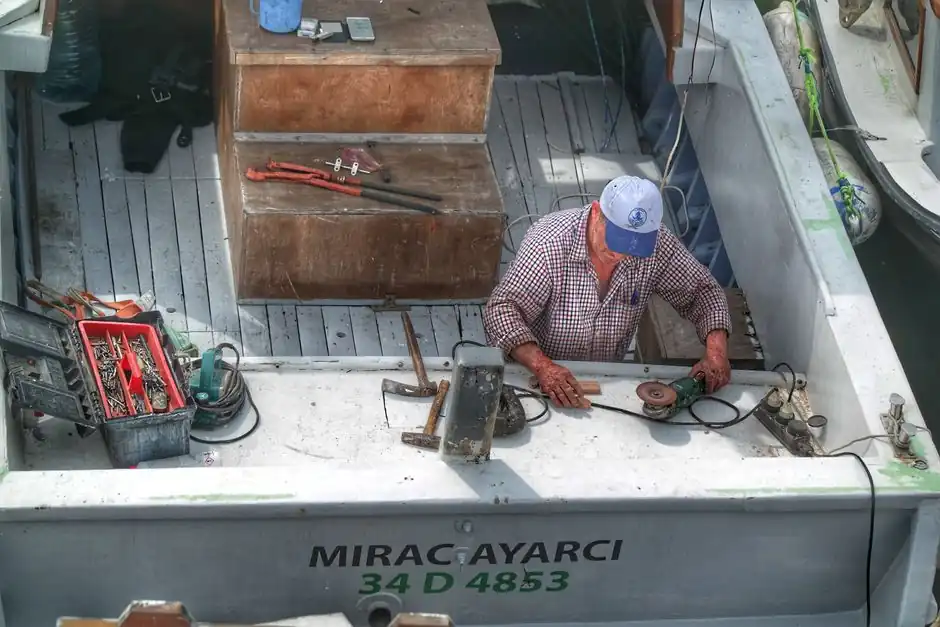
A professionally maintained 4.5 in corded angle grinder typically reaches 5–10 years of service life before armature or bearing failure forces retirement, provided carbon brushes are swapped every 100–200 hours and the gearbox is greased on schedule [S2][S3].
Cordless equivalents run 3–5 years in trade use, with the lithium-ion pack, not the motor, almost always the first component to die; the tool body commonly outlives two or three battery generations. A weekend DIY unit, by contrast, may sit on a shelf for a decade and still spin up [S1][S4].
Service Life Ranges by User Profile
Three operating regimes dominate the lifespan question. A hobbyist running a 4.5 in grinder a few hours per month on mild steel and tile can expect 8–12 years from a brushed corded model, because total armature hours stay well under 200 across the tool's life [S1][S4].
A tradesperson on a fabrication or masonry crew typically logs 800–1,200 hours per year, which puts a brushed corded tool at the 4–7 year mark; the same operator on a 18 V or 54 V brushless cordless platform usually retires the body at 3–5 years because batteries fade before the motor does [S2][S4]. Heavy industrial users, shipyards and structural steel fabs, push 1,500+ hours per year and commonly burn through two grinders in the time a DIYer uses one, with the gear set, not brushes, becoming the failure point around year two [S1][S3].
Replaceable Wear Parts and Their Intervals
Carbon brushes are the single most frequent service item, sized at roughly 100–200 hours of run time on a 4.5 in corded unit, and should be inspected whenever the tool shows visible sparking at the commutator or a sudden drop in no-load RPM [S3]. The two brushes on a typical 750–1,100 W motor cost a few dollars and slide out through external caps; replacement is the line that separates a 2-year tool from a 10-year tool [S2][S3].
Gearbox grease, usually a lithium or polyurea NLGI #2, should be refreshed every 6–12 months in trade use, or sooner if the head runs hot or the spindle develops radial play [S3]. Spindle bearings, both the drive end and the gear end, are sealed on most modern units and run for the life of the tool under normal loads, but continuous cut-off work on masonry accelerates wear and can fail in as little as 1,500 hours [S3][S6]. A summary of replacement intervals for a 4.5 in corded grinder in moderate trade use:
Component | Typical interval | Trigger to replace sooner Carbon brushes | 100–200 h | Visible sparking, low RPM Gearbox grease | 6–12 months | Hot gearbox, spindle play Cut-off wheel | Single use | Glazing, edge chipping Grinding disc | 5–20 hours of grinding | Diameter loss beyond maker's minimum Power cord | 1–3 years | Cuts, exposed conductor, hard splices
Repair vs Replace Decision Criteria
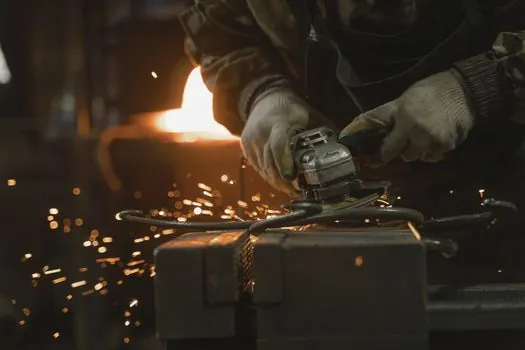
Repair makes sense when the failed component is a defined wear part, brushes, switches, bearings, power cords, and the replacement cost sits below roughly 40 percent of a comparable new tool. A new 4.5 in corded grinder enters the market at the entry-professional tier for around $70–$130, so a $25–$45 gearbox or brush service is clearly worth doing [S2][S5].
Replacement is the correct call when the armature shows burnt commutator segments, the field windings read open on a multimeter, the gearbox housing is cracked, or the tool has already had one major repair. A grinder that has had its armature replaced rarely delivers the run-out and balance of an OEM-built unit, and a cracked aluminum head is a safety issue regardless of motor health [S3][S5]. For cordless platforms, swap the battery one or two cycles, but once cells drop below roughly 70 percent of nameplate capacity and the pack is no longer in production, the tool should be recycled and replaced with the current generation [S4][S6].
Common Failure Modes and Warning Signs
The four failure patterns that dominate warranty data are: (1) armature burnout from stalled cuts, usually within the first 50 hours; (2) bearing failure from impact drops, typically after 1–3 years; (3) switch failure from dust ingress, 2–5 years; and (4) cord damage at the strain relief, 1–3 years on corded units. Each has a distinct early warning [S3][S6].
Armature failure announces itself with a burning smell, intermittent power under load, and visible sparking through the housing vents. Bearing failure starts as a high-pitched whine, then a radial grind, then seized spindle. Switch failure shows up as the tool only running with the trigger held in a specific position, a sign of carbon buildup on the contacts. Cord failure is visible: hardened jacket, exposed copper, or intermittent power when the cord is flexed. Any one of these on a tool older than 5 years with no service history is the cue to scrap, not repair [S3][S5][S6].
Maintenance Practices That Double Service Life
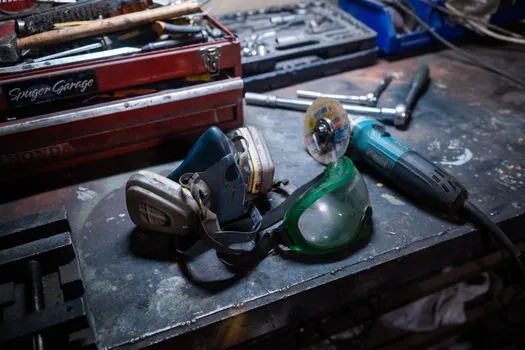
Three habits separate the 10-year grinder from the 4-year grinder. First, blow out the motor housing with compressed air after every shift in dusty environments, concrete, drywall, and paint work clog ventilation fast and push armature temperatures past 150 °C, the threshold where winding insulation starts to age rapidly [S3][S6].
Second, let the tool coast. Pressing hard enough to stall the disc or screaming through a cut generates heat that no amount of brushing can undo; the right pressure is roughly the weight of the tool plus a firm two-handed grip, with a 10–15 second cool-down after every minute of cut-off work [S3][S6]. Third, store corded tools with the cable loosely coiled, not kinked, and store cordless packs at 30–50 percent state of charge if they will sit for more than a month; storing lithium packs at full charge accelerates cell degradation measurably [S4][S6]. For other rotating equipment on the same shop floor, the same logic of scheduled brush-and-bearing service applies to the floor grinder class, which is essentially an angle grinder scaled up to a 10–20 in head. Abrasive selection matters too: a wrong-spec wheel on a 4.5 in body can unbalance the spindle and kill bearings in months, and the same principle holds for fettling grinder wheels in foundry service.
Safety and Regulatory Anchors
Guard retention, wheel speed rating, and side-handle fitment are non-negotiable regardless of tool age. A cut-off wheel rated below the tool's no-load RPM, usually stamped on the wheel hub, can shatter in use, and a guard that has been removed "just for this cut" is the most common precursor to a serious injury [S1][S6]. Operators in the EU should match the wheel's maximum peripheral speed to the grinder's rated RPM before each disc change; the same rule applies to abrasive mop and flap wheels.
For a fleet-level view, the same replace-versus-repair logic that drives construction machinery and equipment maintenance, hour-meter tracking, scheduled consumables, and end-of-life criteria when repair cost crosses a set threshold, scales down cleanly to a single 4.5 in corded grinder. Track run hours on a sticker, log every brush and grease change, and the tool will tell you, around year 6 to 8, whether it has another rebuild in it or whether it is time to send it to recycling.
Trackable signals for the next quarter: brushless 18 V and 54 V platforms continuing to push corded units out of trade catalogues, and the EU right-to-repair rules now requiring manufacturers to stock spares for 5–10 years after the last sale, both of which will keep the rebuild path open a little longer on current-generation tools [S4][S5].
This topic is covered further in FRL unit installation: site selection, mounting sequence, and ISO 4414 compliance.