Stainless-steel rings (AISI 440C or 304/316 inserts), solid-lubricant or food-grade H1 grease, and integral contact-lip or PBR shields are the three engineering moves that separate an angular contact bearing suitable for a filling line or mixer agitator from a general-purpose machine-tool spindle bearing.
Stainless ring material is the most consistent hygiene lever — suppliers such as ASMI, Changzhou Fenglin and Yuyao Xinfeng catalogue dedicated stainless 440C and 304-cage variants in 2026 alongside their chrome-steel 7200/7300 lines [S1][S5][S6]. Contact angle, cage choice and internal clearance decide the rest of the application fit, and food-zone specifications almost always need a paired-DB or DF arrangement to carry the combined radial-plus-axial load from a helical gearbox or pump shaft.
Why a 7200/7300 Chrome-Steel Unit Is the Wrong Default for F&B
Standard 7200-, 7300- and 7900-series ACBBs are dimensionally attractive — they are the LYC, CWL and ASMI catalogue workhorses with GCr15SiMn rings, nylon or pressed-steel cages, and 15°/25°/40° contact-angle options [S3][S4][S6] — yet the standard 2RS rubber contact-lip seal is not NSF H1-registered grease, the rings are through-hardened chrome steel, and the lubricant is a mineral-oil/EP package optimised for machine tools.
The base 5200/5300/3200/3300 metric double-row ACBBs, with contact angles typically at 15° or 25°, are optimised for combined loads at moderate speed [S3][S4]. Without a stainless upgrade, they are appropriate only for dry F&B peripheral areas: conveyor idlers, label-applicator shafts, cart wheel hubs, and non-contact gearbox supports that sit behind a hygienic enclosure.
Food-Grade Material and Lubricant Stack: 4 Decisions
First, ring and ball material. AISI 440C gives the highest hardness (~58 HRC) and load rating in a corrosion-resistant grade and is the default for F&B ACBBs; AISI 304 or 316 inserts (or full rings) trade hardness for cleaner corrosion resistance in high-chloride washdown. Hybrid Si3N4-ceramic balls in 440C rings drop wear, extend grease life and survive EDM-induced stray-current damage — and are stocked as a standard F&B option by ASMI and CWL in 2026 [S2][S6].
Second, cage. Nylon (PA66) cages are standard on 7200/5300-series ACBBs [S3] and are acceptable in low-temperature F&B zones, but they absorb water and chlorine during CIP and will creep above ~120 °C. 304-stamped metal or PEEK cages are the food-line upgrade for steam-cleaned or retort-zone mixer shafts. Third, lubricant. NSF H1-registered greases (Klüber, Molykote, SKF LGEP-equivalent food grades) are required where incidental food contact is possible; solid-PTFE or graphite lubrication is preferred above 200 °C or where steam sterilisation is continuous. Fourth, seals: 2RS nitrile contact-lip seals are stock on 7200/5300 series [S3][S4], but the seal material must be specified as H1-rated FKM or silicone for hot washdown; PBR-type axial contact seals from ASMI give better retention of H1 grease during high-pressure spray.
Contact Angle, Clearance and Pairing for F&B Loads
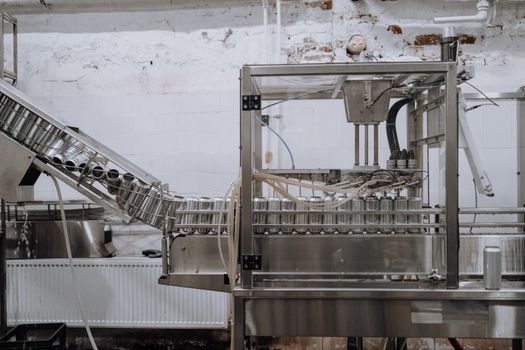
ACBB contact angle is the single largest design choice. A 15° angle (C designation in 7000-series) gives the highest permissible speed and is the right pick for filler-starwheel and bottle-conveyor spindles; 25° (AC) is the balanced default for mixer-agitator and pump-shaft loads; 40° (B) carries the heaviest axial load at the cost of speed and is used in helical-gear input shafts and screw-conveyor thrust positions [S3][S4][S6].
Pairing matters more than the single-bearing rating. A DB (back-to-back) pair resists tilting moment and is correct for the moment-loaded mixer shaft; a DF (face-to-face) pair tolerates misalignment and is the choice for long, slender pump shafts; a DT (tandem) pair only stacks axial capacity in one direction. For F&B mixer applications, the DB-DB matched pair with light preload is the most common spec, and high-precision ABEC-5/ABEC-7 P2/P4 matched pairs are stocked by Yuyao Xinfeng as a 2026 catalogue line [S5]. Internal clearance should be specified as C3 or C4 (not CN/normal) for shafts that run warm under steam sterilisation, because differential expansion closes the internal gap and can preload the pair to failure.
Decision Matrix: 4 Bearing Options Against F&B Criteria
The four practical ACBB options for a food-zone application, lined against four decision criteria: [S1]
• Chrome-steel 7200/7300 with 2RS nitrile, mineral grease — cost low (set $5–20 per unit in 2026 China B2B pricing), corrosion resistance low, max speed high (C/AC designation), FDA/H1 compliance none. Use only in non-washdown, non-contact zones.
• 440C stainless 7200/5300 with PTFE or H1 grease, FKM seals — cost medium ($20–60 per unit), corrosion resistance medium-high, max speed medium, FDA/H1 compliance yes (with H1 grease). Default pick for filler, conveyor, label-shaft, packaging-machine ACBB positions [S1][S6].
Pick for high-speed mixers, pump shafts, and where stray currents from VFD drives are present [S2][S6].
• Full 316 stainless insert ACBB with solid-PTFE lube — cost high ($80–200 per unit), corrosion resistance very high, max speed low-medium, FDA/H1 compliance yes. Pick for salt-brine, vinegar, dairy CIP and direct food-contact equipment.
Stainless rings and H1 grease can be combined freely, but pairing a high-precision P2/P4 ceramic-hybrid pair in a misaligned housing wastes the precision — keep ceramic hybrids on rigid, aligned seats.
Real F&B Use Cases and the Wrong Defaults to Avoid
Filler-starwheel spindles: 15° contact, DB or DF 7200-series 440C stainless pair with 2RS FKM seals and H1 grease, C3 clearance, ABEC-5 tolerance. LYC's standard 7000/7200 series with steel or nylon cages [S4] can be re-specified as a 440C-stainless DB pair against the same envelope. Screw-conveyor thrust ends: 40° contact-angle B-type 7300-series 440C stainless, solid-PTFE lubrication, DB-DB matched pair to carry the high axial load from the screw flights.
Common mis-specifications: (a) using a 2RS nitrile-sealed chrome-steel 7200 in a washdown zone and then re-greasing quarterly with H1 grease through the dust cap — the grease reaches the raceway but the corroded cage does not recover; (b) specifying a 40° B-type for a high-speed filler and losing 30–40% of permissible speed without gaining any useful axial capacity; (c) pairing an ACBB with a deep-groove ball bearing on the same shaft and forgetting the ACBB needs axial preload to function — the ACBB will skid and brinell the raceway under combined load. The 2026 bearing sourcing reality is that 440C-stainless 7200/5300 in standard tolerances is the most reliably stocked food-line ACBB in Chinese export channels, while full-ceramic and P2/P4 hybrid pairs are build-to-order with 6–10 week lead times.
Limits, Failure Modes and Procurement Reality
Stainless 440C ACBBs carry roughly 60–70% of the dynamic load rating of an equivalent chrome-steel GCr15SiMn unit, and the maximum permissible speed is typically derated 20–30% because 440C is softer. FKM seals survive steam and most CIP chemicals to ~200 °C; nitrile 2RS is limited to ~110 °C and chlorinated alkaline CIP. H1 grease life in continuous washdown is typically 3,000–5,000 hours; a relubrication plan is mandatory, not optional. [S2]
Procurement check on 2026-07-04: Changzhou Fenglin, ASMI, CWL and Yuyao Xinfeng all list 440C stainless ACBBs as active catalogue items, with nylon and metal cages, 15°/25°/40° angles and 2RS/ZZ options [S1][S2][S5][S6]. LYC's standard 7200/7300 line [S4] is the cheapest base platform to re-spec as a stainless/FKM/H1 unit if the envelope must match a machine-tool predecessor. For hygienic-frame equipment paired with stainless steel bearings, insist on a written H1 grease registration number and a material certificate for the rings — the difference between an AISI 304 cage and an AISI 316 cage is invisible on the outside of a sealed unit but matters once chlorine enters the IP66 enclosure.