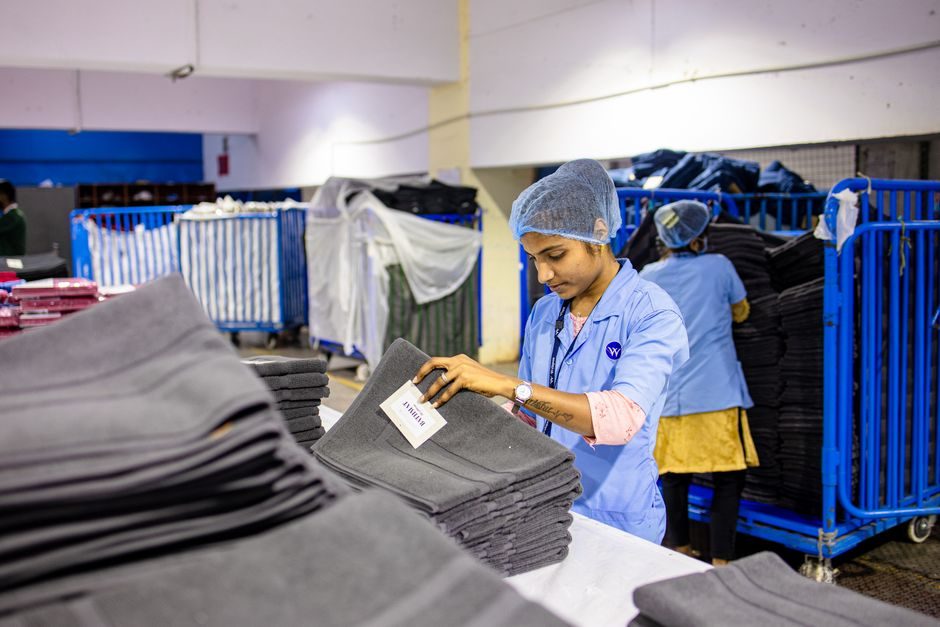
Apparel distribution centers running at 500–2,000 units/hour typically pair a flat PVC belt conveyor with 50 mm thermoplastic drive rollers, 0.3–0.8 m/s belt speed, and a 24 V brushless motorized pulley to move polybagged garments, totes, and 600×400 mm cartons between picking, sortation, and packing zones [S1][S2].
The build differs from a chemical-shipping belt conveyor mainly in belt compound, roller material, and guarding philosophy: garments are light, dry, and abrasion-sensitive, so the design focuses on gentle handling, low noise under 75 dB(A), and easy wash-down rather than chemical resistance [S1][S2].
Roller Diameter, Material, and Drive Choice
The Beta3 1PV (POLY-V) belt-driven roller from roll-ven spa uses a 50 mm (1.969 in) diameter steel tube with thermoplastic pulleys, offered in PVC, stainless steel, galvanized steel, or aluminum tube variants, sized from 200 mm (7.9 in) length upward — a geometry that fits standard 400–800 mm wide apparel handling frames [S1].
Poly-V elastic drive belts give higher torque transmission and lower electric consumption than flat belt or chain drives, while the ribbed pulley design protects the belt against slip damage at the sortation diverges common in hanging-garment and returns lanes [S1]. For heavier carton flows up to 50 kg/m, the same vendor's GAMMA 1R-1RD chain-drive roller and SIGMA 1R-1RD stainless-steel heavy-load roller (1.9–3.5 in diameter classes per ICC's accessory list) are typical alternates [S1][S2].
Stainless steel shafts and Rilsan-coated steel tubes are the right pick for any wash-down or humid apparel zone (steam finishing returns, dye-house overflow), because bare mild steel will pit and stain light-colored fabric within 12–18 months [S1].
Belt Type, Surface, and Width
Two belt families dominate apparel DC layouts: 2-ply PVC flat belts with a matte or fabric-impregnated top cover for carton and tote transport, and modular plastic belting (PP or acetal) for inclined shoes, accessories, and returns lines that need posi-pattern grip [S2].
ICC catalogs the plastic-belt family as PPF, 700PB, 700PBC, 700FFT, 700RR, 700RT, 700TRT, and HD1200PB, with widths stepping from 300 mm up to 1,200 mm for bulk carton takeaway [S2]. For a 600×400 mm standard ecommerce garment carton, a 400–600 mm belt width on a low-profile 125, 250, 300, or 400 series frame keeps the carton centered with 50–100 mm clearance each side, reducing side-load jam risk at 90° transfers.
Belt speed for picking and induction should sit at 0.3–0.5 m/s so pickers can match pace; for trunk and takeaway runs between zones, 0.6–0.8 m/s is the practical ceiling before garment-on-hanger hooks begin to swing and polybags scuff [S2].
Frame, Slider Bed, and Inline Drive Integration
Apparel DCs almost always run slider-bed frames (ICC 300 and 600 series) rather than troughed idler sets — the 600 mm-class slider supports a flat belt over its full width, lowers the product transfer height to 350–500 mm above floor, and keeps noise below 70 dB(A) compared with 78–82 dB(A) for impact-idler bulk frames [S2].
Inline drive choices split into three camps: (1) end-drum motor with gearmotor, (2) motorized pulley (drum motor) integrated into the tail or head pulley, and (3) line-shaft driven live roller (LDL) for accumulating runs. The Beta3 1PV Poly-V roller with an external 24 V BLDC drive fits option 1 or 2, while ICC's 138LR, 196CALR, and 251CALR series are the standard LDL references for zero-pressure accumulation upstream of a tilt-tray or cross-belt sorter [S1][S2].
Forced zero-pressure accumulation (ZPA) is the default for sorter infeeds: ICC's 138VP, 196VP, 196ZPA, and SZ-prefixed ZPA series use photo-eye zones to release each carton only when the downstream zone is clear, holding throughput at 1,500–2,000 cartons/hour without backpressure crushing the upstream polybags [S2].
Layout Geometry: Incline, Transfer, and Divert
Apparel layouts typically run flat or at very shallow inclines (under 8°), because modular plastic belts at 12°+ will deform soft-pack garments and PVC at 15°+ will let totes tip. Noseover transfers using a 50–100 mm diameter end pulley are standard; for high-speed 90° transfers to sortation, a CD280 or CT380 chain-driven transfer or a WT3/S60 wide-belt transfer is the established spec [S2].
Sorter exit conveyors for cross-belt, tilt-tray, or sliding-shoe sorters must be specified at the sorter OEM's rated exit velocity — usually 1.0–1.5 m/s for sliding-shoe and 0.8–1.2 m/s for cross-belt — and the induction conveyor must be capable of accelerating each carton to within ±5% of that velocity before the discharge point to prevent gap errors at the divert [S2].
For hanging-garment overhead conveyors (a separate but adjacent system), the spec diverges from belt conveyor entirely and is governed by chain pitch, hook spacing, and trolley drop spacing rather than belt width, so it should not be selected on the same belt conveyor spec sheet.
Power, Control, and Safety Guarding
Standard apparel DC control architecture uses a PLC with VFD-driven gearmotors, 24 V DC brake outputs, and e-stop safety relays meeting ISO 13849-1 PL d. ICC's electrical controls package — panels, consoles, HMI, variable speed drives, pushbutton stations, and PLC/robotics integration — covers the typical control scope for a 200–800 m conveyor loop [S2].
Pull-cord e-stops every 6 m along catwalks and perimeter fencing around all drives, take-ups, and head/tail pulleys are baseline. Belt conveyor guarding must cover all nip points, drive couplings, and the return run; OSHA 1910.219 machine guarding and ANSI/CEMA B20.1 are the typical compliance references, and field-cut guards with mesh panels to 12 mm aperture are the common build [S4].
Belt take-up systems are typically screw-type or gravity-weighted, sized for 1.5–2% of the belt length; the belt tensioner selection should be reviewed against the chosen drive geometry because a Poly-V elastic belt needs less take-up travel than a flat PVC belt of the same length [S1].
Spare Parts, Spares Pricing, and Vendor Selection
Spare rollers and idlers are the highest-turnover wear items, and pricing in the open market varies widely by bearing spec and tube material. Reference published ranges from Khodiyar Industrial Corporation (India) for benchmark only: conveyor idler rollers US$4–85 per piece at MOQ 50; HDPE idler rollers US$5–30; mining-grade conveyor idler US$4–25; 6206ZZ flat-top return rollers US$20–25 for 800 mm belt width down to US$20–22 for 1,200 mm; 6208ZZ flat-top return rollers US$18–20 — all FOB India and indicative only [S3].
For a 500 m apparel DC loop with 200 mm pitch carrying rollers and 600 mm pitch return rollers, expect 2,500–3,000 rollers installed; a 5–8% annual spare holding (125–240 rollers) is the typical reliability-engineering recommendation. European-made rollers in the Beta3 / SIGMA / GAMMA class sit 1.5–3× the Khodiyar price band but offer shorter lead times for replacement parts inside the EU [S1][S3].
Compare shortlisting criteria on four axes: (1) roller diameter and material suitability for the zone, (2) drive type (Poly-V vs chain vs O-ring) matching the speed and torque curve, (3) lead time and EU/US local stock for spares, (4) guarding and control integration package completeness [S1][S2][S3][S4].
Selection Criteria, Failure Modes, and Sourcing
Specify the conveyor in this order: belt type and width, drive type and speed, roller diameter and material, frame height and slider vs roller bed, control architecture, and guarding package — locking each before moving to the next. A typical failure mode in apparel DCs is polybag scuff from a worn matte-top belt cover, fixable by re-grounding or replacing the belt section at 1.5–2 year intervals. [S1]
Second common failure is roller bearing seizure in wash-down zones; stainless or Rilsan-coated rollers with sealed 6204/6206 bearings raise MTBF from roughly 18 months (mild steel) to 36+ months [S1][S3]. Third is drive-belt stretch on Poly-V systems under sustained 80%+ load, addressable by a mesh belt conveyor geometry only if the product is rigid — for soft-pack apparel, stick with the original Poly-V and re-tension on the schedule above [S1].