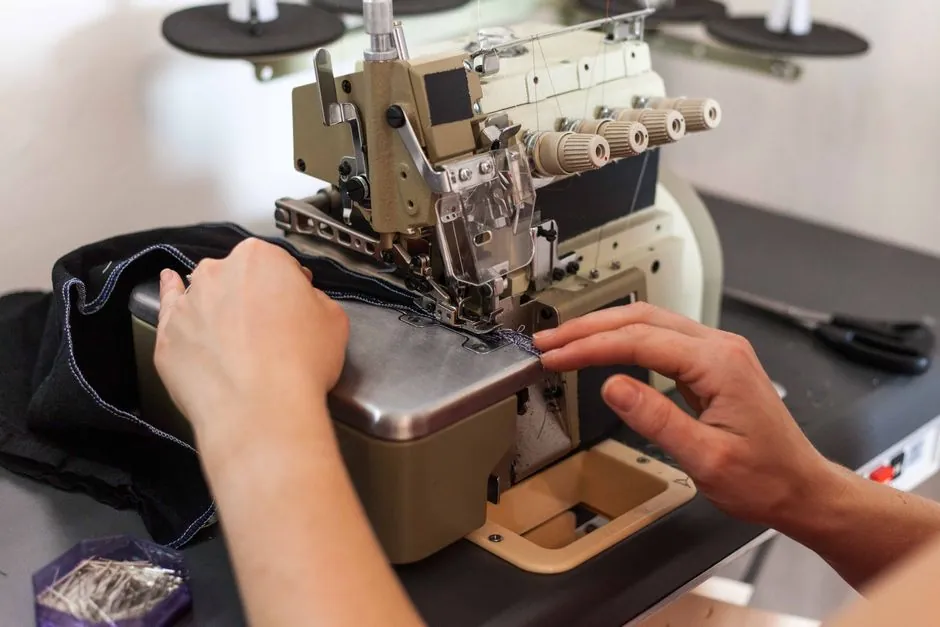
Garment filling machines for apparel distribution are pneumatic, CE/ISO 9001-certified units that dose 0.1-25 g of down, feather, or ball fiber per port at throughputs up to 200 sets/month per OEM line, with 2-4 weighing scales per nozzle driving 16-25 mm fill heads [S5][S6][S9].
Selection hinges on five technical axes: filling material (goose/duck down 70-90% fill power, ball fiber, or short polyester under 2.5 cm fiber length), garment gram range, nozzle count, scales-per-port, and downstream integration with mailers, boxes, and presentation materials used in apparel packaging [S1][S2].
Material compatibility: down, ball fiber, short polyester
Down-cluster fillers on the apparel market accept goose or duck down rated 70-90% fill power, ball fiber, and short polyester staple whose length stays under 2.5 cm; longer fibers tangle the weighing hopper and break the dosing tolerance [S2]. Generic apparel cotton fillers, by contrast, target combed cotton and polyester fiber at 2-head and 4-head configurations, with the weighing unit integrated into the main cabinet to shrink the line footprint [S3]. This is a real fork in the spec: a down-rated machine running cotton will under-due; a cotton-rated machine running 800-fill goose down will clog at the scale gate. For a full technical breakdown of weighing accuracy and load-cell behavior, see the filling weighing scale reference page.
For light-fabric down pieces, the BL-2301 platform uses 3 scales supporting 1 nozzle with a second nozzle option, aimed at small-gram pieces that would otherwise over-dose on a 25 g silo [S4]. The newest high-output DF-2403X coats filling machinery, by contrast, runs 4 scales per filling port and is positioned as a high-output line for heavier down coats [S10].
Gram range and silo sizing: 0.1-7 g vs 0.1-15 g vs 0.1-25 g
OEMs expose three silo specifications for garment filling: 0.1-7 g, 0.1-15 g, and 0.1-25 g [S2]. The 25 g silo holds 7 g and 15 g work, but if every fill on the line is under 7 g, e.g. a Uniqlo-style ultra-light down jacket program, a 7 g silo delivers better stability and efficiency than oversizing to 25 g [S2]. Picking the wrong silo is the most common cause of gram-variance failure audits, since the dosing algorithm is tuned to a fixed silo volume.
One apparel-specific example: the JDBL 9584RM20 high-accuracy automatic weighing down jacket filler runs on 220 V/50 Hz single phase, draws 2 kW, and uses 16/19/25 mm diameter nozzles to dose 50-90 fill-power down, feather, or fiber into UNIQLO and BOSIDENG-style jackets [S9]. The 16 mm nozzle is the small-gram choice; 25 mm covers the heavier coat panels.
Scales-per-port and nozzle count: throughput math
Scales-per-port is the direct lever on grams-per-minute throughput. The DF-2403X gives 4 scales per filling port and is the OEM's most-sold configuration [S5]. The DF-4403X, fourth-generation 828B-class machine, also runs 4 scales per filling port and is rated at 200 sets/month production capacity with 15-day delivery from FOB Shanghai [S6]. For very high-volume distribution centers, the 24-weighting-units and 8-weighting-units platforms are positioned above 4-port systems for parallel dosing [S4].
Nozzle count is the second lever: 1-nozzle single-port fillers target small-batch bespoke and sample runs; 2-nozzle and 4-nozzle systems target batch production where the operator needs to keep two stations fed. The super-high precision double filling station 828B, the same family as the 4403X, runs two filling stations and pneumatic drive, again at CE marking [S7].
Drive, power, certification, and packaging integration
Every garment filling machine in the current Chinese OEM catalog is pneumatically driven, CE-marked, and ships in plywood export crates by ocean, land, or air from Shanghai [S6][S7][S8]. Power is 220 V/50 Hz single phase at roughly 2 kW for the 16-25 mm nozzle class [S9]. This is a single-phase spec, so apparel distribution centers do not need three-phase service to install one. Acceptance typically requires an ISO 9001 quality-system certificate alongside the CE mark [S8].
Downstream, the filled garment enters the apparel packaging line, where right-sized corrugated shipping boxes, protective mailers, tissue inserts, and resealable return-friendly mailers keep the garment clean from the filling station to the customer's door [S1]. Clear barcode and shipping labels, plus organized packing stations, are the other half of the throughput math: a filler running 4 scales per port is wasted if downstream label printing becomes the bottleneck.
Comparison: 4 main platform families on 4 decision criteria
On a 4-criterion decision matrix, the BL-402D cotton/fiber 2-port platform is best for polyester staple under 2.5 cm on a tight floor footprint; the BL-2301 3-scales-per-port down platform is best for sub-7 g light-fabric down pieces; the DF-2403X / DF-4403X 4-scales-per-port down platform is the mainstream high-output coat and jacket choice at 200 sets/month; and the JDBL 9584RM20 220 V/2 kW single-phase platform is the fit for distribution centers that need 16/19/25 mm nozzle swap-ability on UNIQLO/BOSIDENG-style SKUs [S3][S4][S5][S6][S9].
For apparel distribution centers that already run automotive parts or general logistics, the Filling Machine Selection for Automotive Parts Logistics: 2026 Spec Map is a useful contrast: automotive parts lines prioritize oil-resistant pneumatics and heavier gram ranges, while apparel lines prioritize gram-range agility and fabric-safe nozzle tips.
Limitations and failure modes
Three failure modes dominate apparel filling line returns. First, gram-variance drift caused by oversizing the silo: a 25 g silo on a 7 g program adds dose-time noise that the scale algorithm cannot cancel [S2]. Second, fiber-length clogging: any staple over 2.5 cm wraps around the scale gate and forces a manual clean, which stops the line [S2]. Third, phase and air-supply issues: although the machines are single-phase 220 V/50 Hz, the pneumatic drive still needs clean, dry compressed air at stable pressure, and most apparel distribution centers do not have a dedicated air distribution cabinet at the filling station, which is the most common commissioning delay.
CE marking is consistent across the catalog, but ISO 9001 is not universal: buyers should confirm the certificate scope explicitly covers the model number being shipped, not just the OEM's parent company [S8].
Selection checklist and trackable signals

Run this gate before issuing a PO: (1) confirm fill material matches the machine's rated category, down 70-90% fill power or polyester staple under 2.5 cm [S2]; (2) size the silo to the heaviest single-piece gram on the line, 0.1-7 g, 0.1-15 g, or 0.1-25 g [S2]; (3) lock scales-per-port at 3-4 for sub-15 g down programs, where 4 scales at 16/19/25 mm nozzle swap is the most flexible spec [S5][S9]; (4) confirm single-phase 220 V/50 Hz at roughly 2 kW and verify compressed-air supply on the distribution cabinet side; (5) confirm CE marking plus an ISO 9001 certificate that names the model [S8].
Trackable next signals: monitor whether the OEM's published 200 sets/month production capacity holds at your gram range, since throughput claims are stated at a reference fill weight, and request a 15-day-delivery sample run from FOB Shanghai [S6]. Downstream, watch the cable distribution cabinet and explosion-proof distribution provisions if any portion of the line moves near a solvent-based finishing booth, since down-proofing sprays can re-classify the electrical zone.