
Pharmaceutical liquid filling machines are best specified as a stack: container format, dosing principle, containment class, accuracy band, and validation package, in that order, before the make/model shortlist is opened. The 2025 global filling-equipment market sits at USD 7.95 billion with a projected ~5% CAGR through 2031, and pharmaceutical/sterile applications take the most specification-heavy share of that base [S4].
For parenteral and biologic lines, cGMP under FDA 21 CFR 211 Subpart D, plus EU-GMP Annex 1 for sterile products, are non-negotiable; equipment must be "of appropriate design, adequate size, and suitably located to facilitate operations for its intended use and for its cleaning and maintenance", with sterile liquid filling tied to Class 100 / ISO 5 cleanroom environments and fill accuracy to 0.3% or better at validated speed [S4]. For distributors scoping prefilled syringe (PFS) lines, the global PFS market was valued above USD 8 billion in 2024 and continues to expand as biologics, vaccines, and self-administered therapies displace vial-and-syringe workflows [S3].
Filling Principle Comparison on Four Decision Criteria
Accuracy, shear, viscosity ceiling, and cleanability are the four criteria that actually pick a dosing principle for a pharma line, and the research aligns on a consistent ranking. Gravity filling lands around ±1–2% accuracy at low viscosity and is the cheapest path, but it is unsuitable for shear-sensitive biologics or foaming solutions; overflow and pump fillers cluster around ±0.5–1%, piston fillers around ±0.5%, and net-weigh fillers around ±0.1–0.25%, with net-weigh being density-immune but throughput-limited and capital-heavy [S9].
For sterile, low-viscosity injectables, peristaltic or sanitary-pump/flowmeter systems dominate because the product only touches the tubing or the sanitary train; for viscous peptide or hyaluronic-acid gels, servo ceramic or progressive-cavity pumps deliver the low-shear, micro-dose (±1% or tighter) performance that high-value APIs require [S1][S8]. Pharmaceutical solutions in the 1–100,000 cP window, across 10 mL to 50 L container sizes and 1–32 nozzle configurations, are now standardly served by PLC + HMI controlled rotary (up to ~400 bpm) or linear (easier retrofit) architectures on 304/316 stainless or PTFE/silicone contact parts [S2].
Containment, Cleanroom Class, and Validation
Containment choice is driven by the route of administration and the bioburden risk of the molecule, not by a marketing wishlist. The aseptic envelope scales as: Laminar Airflow (LAF) hood for less-critical aseptic work, open RABS (oRABS) and closed RABS (cRABS) for most sterile lines, and full Isolator (glove-box) technology for highest-potency or viral-vector fills [S1].
Stoppering integrity is a hidden yield killer: sub-surface vacuum stoppering is the technique that achieves zero-bubble sealing and protects oxygen-sensitive drugs from degradation, and it is now standard language in OEM selection guides [S1]. On the validation side, full DQ/IQ/OQ documentation is required for FDA and EU-GMP acceptance, and modular multi-format lines (PFS, cartridge, vial) on one platform with tool-less changeover at 1 mL / 3 mL / 5 mL / 10L sizes cut initial capital outlay by up to 60% while reducing ISO 5 cleanroom footprint cost, which is usually the largest recurring facility overhead [S1].
Format Selection: Vial, PFS, Cartridge, RTU Nest
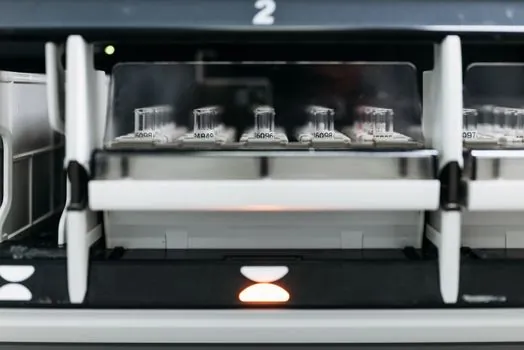
Container format is decided before nozzle count. Vials remain the workhorse for parenteral liquids where fill volume, headspace oxygen control, and existing lyophilizer integration dominate; prefilled syringes win on dosing accuracy, lower medication waste, and faster administration for biologics and vaccines; cartridges fit pen-injector and self-administration platforms; oral liquid bottles cover the 10–500 mL syrup/suspension range [S3][S6].
Supply format is a separate axis: conventional bulk vials require an integrated washing, sterilizing, drying, and depyrogenation tunnel ahead of the filler, while Ready-to-Use (RTU) nest/tub formats ship gamma-irradiated and pre-sterilized to skip the tunnel, at a higher unit cost but a much smaller line footprint [S1]. For distributors and CDMOs running multiple SKUs across PFS, cartridge, and vial on one platform, the modular 3-in-1 combo line concept has become a default shortlist item, since tool-less changeover at 1 mL / 3 mL / 5 mL / 10 mL sizes removes the three-machines-for-three-formats capital penalty [S1].
Throughput, Automation Level, and Batch-Size Match
Throughput and automation must be matched to real batch size; over-spec'ing is the most common capital mistake. Pilot/R&D and clinical-batch work (a few dozen to a few hundred units) is well served by manual or semi-automatic fillers, which change over and clean fastest; regular commercial production above 1,000 units shifts the economics toward fully automatic systems, where the labor savings and reproducibility outweigh higher CAPEX [S10].
Per-nozzle speeds of 20–200 bottles/min are typical, with rotary configurations reaching up to 400 bpm but demanding larger buffer tanks, more nozzles, and tighter downstream capper/labeler synchronization [S2]. On coding and marking, integration with inline coding machines is part of the same selection bundle; for a structured spec map on coding and marking hardware see coding machine selection for apparel distribution, and for the gearbox / indexer side of the line see RV reducer selection for packaging lines.
Materials, Hygienic Design, and CIP/SIP

Contact-parts material is set by the molecule and the cleaning regime, not by the OEM default. 316L stainless with surface finishes meeting sanitary design guidance is the pharma baseline; PTFE, EPDM, and silicone appear in seals, diaphragms, and peristaltic tubing; ceramic piston and servo pump heads are specified when metal-particle or leachables risk must be near zero for high-purity biologics [S2][S5].
CIP/SIP compatibility is the hard gate for any high-purity or sterile liquid line, and the OEM must document cycle recipes, rinse-water conductivity endpoints, and validated steam-in-place zones; this is where ROI is most often lost, because retrofitting CIP/SIP to a non-compatible machine after purchase is typically uneconomic [S5]. For a deeper dive into container-closure compatibility, dosing accuracy bands, and the core fill cycle (mass flow → metering → dispensing → indexing → sealing), the filling machine reference page and the filling weighing scale entry are the natural next stops. Where the line is driven from a controlled power and signal backbone, the distribution cabinet and power distribution references frame the utility-side spec; for lines destined into solvent or classified areas, the explosion-proof distribution and cable distribution cabinet pages cover the relevant hazardous-area requirements.
Limits, Failure Modes, and Common Specification Traps
Three failure modes recur in pharma filling qualification. First, the accuracy figure is quoted as a per-container band without the speed at which it was measured, and as a rule accuracy degrades as line speed rises, so the spec sheet should be tied to a bottle-per-minute number, not a best-case number [S9]. Second, piston and progressive-cavity pumps can trap air or string with viscous products, and the OEM should supply suck-back valves or diving nozzles as standard, not as options [S8]. Third, viscosity alone does not pick a pump: particle-loaded or shear-sensitive formulations rule out gear and lobe pumps regardless of viscosity, because particle size vs. valve-passage clearance and product damage, not centipoise, are the binding constraints [S8].
The other trap is scope creep. A line that is sized for a 1 mL PFS at 200 bpm is not the same line as one for a 100 mL infusion bottle at 60 bpm, and any quote that does not state the validated format, the validated accuracy at the validated speed, the containment class, the CIP/SIP recipe, and the IQ/OQ/PQ deliverable scope is incomplete. The next trackable signals to watch are Annex 1 enforcement actions against manual or poorly contained aseptic lines, the continued RTU-nest migration replacing conventional wash-tunnel depyrogenation, and further modular 3-in-1 platform launches that compress multi-format CAPEX by a stated 60% versus three dedicated lines [S1].