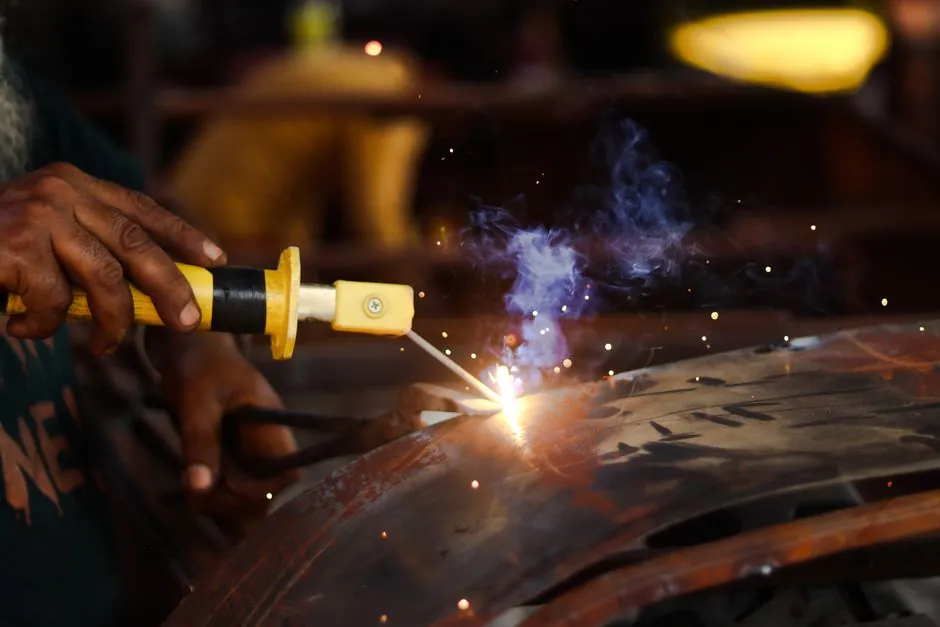
Shielded metal arc welding (SMAW) is a manual arc welding process in which a consumable, flux-coated electrode is struck against the workpiece, generating an arc that melts both the electrode core wire and the base metal into a common weld pool, while the disintegrating flux produces a shielding gas plus a slag cover that blocks atmospheric contamination [S1].
The process runs on either alternating current (AC) or direct current (DC), delivered from a constant-current power source, and is the formal name for what field trades call "stick welding," "manual metal arc welding (MMA / MMAW)," or "flux-shielded arc welding" [S1][S2]. The arc temperature routinely exceeds 9,000 °F, and the operator maintains a short arc length, typically about equal to the core-wire diameter, by hand [S2].
Process Anatomy: Electrode, Flux, Slag, and Power Curve
Each stick electrode is a steel or alloy core wire wrapped in a pressed flux coating whose chemistry is engineered for the weld: cellulosic, rutile, and basic (low-hydrogen) are the three principal families that the process relies on for arc stability, bead shape, and slag release [S3].
As the flux burns off, it liberates a CO/CO₂-rich gas envelope that displaces oxygen and nitrogen from the arc column, then freezes into a glassy slag that floats on the weld pool and must be chipped off between passes with a chipping hammer and wire brush [S1][S3]. A constant-current (CC) power source, not a constant-voltage (CV) unit, is the correct electrical match because the operator, not the machine, sets arc length by varying the stick-to-work gap [S2].
The electrode is consumed continuously, so SMAW is restricted to relatively short weld stints before the operator must stop, let the stub cool, and re-strike with a fresh stick, which sets a natural duty-cycle ceiling on long, uninterrupted seams [S3]. For the full mechanism shared with the GMAW/GTAW/FCAW family, see the arc welder reference and the dedicated shielded cable page for the welding leads that carry the welding current to the holder and ground clamp.
Electrode Selection Criteria and AWS/ISO Class Mapping
Electrode choice is governed by base-metal strength match, position capability, and the toughness/hydrogen control demanded by the service, with AWS A5.1 (carbon steel) and AWS A5.4 (stainless) being the two classification systems most often cited in procurement documents [S3].
Cellulosic electrodes (AWS E6010/E7010 family) are favored for root-pass pipe welding because the cellulose burns to give a deep, penetrating, fast-freezing arc suited to all-position work; rutile-coated E6012/E6013 types run on AC or DC with a softer arc and easier slag release for sheet metal and non-critical fabrication; basic low-hydrogen electrodes such as E7018 are mandatory where the service requires low diffusible hydrogen, for example thick-plate bridges, pressure vessels, and sour-service piping (NACE MR0175 environments) [S3].
What SMAW Is Best For, and Where It Loses to GMAW or FCAW
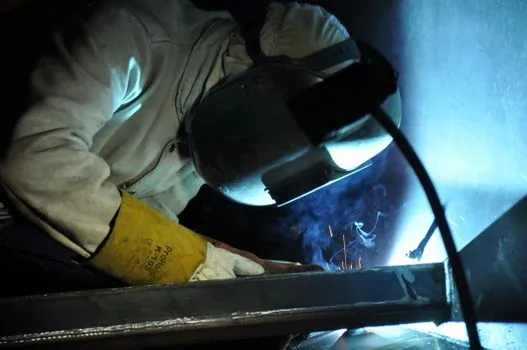
SMAW is the default choice for outdoor and field work because the flux provides its own shielding gas, so wind does not disperse the arc envelope the way it does with gas metal arc welding (GMAW/MIG), and the kit is portable enough to carry to a structure, a pipeline right-of-way, or a ship-repair dry dock [S1][S2].
It also handles dirty, rusty, or painted steel better than GMAW because the slag dissolves oxides that the arc would otherwise trap, which is why it still dominates maintenance-and-repair welding, heavy steel erection, and industrial fabrication despite the rise of flux-cored arc welding (FCAW) [S1]. Against thin sheet, aluminum, stainless cosmetic trim, or any high-deposition production seam, however, SMAW loses on travel speed, deposition rate, and operator skill-economy to metal powder-cored or solid-wire GMAW, where mechanized or robotic travel can out-deposit a hand-held stick electrode several-fold.
Operating Limits, Defect Modes, and Safety Envelope
The practical weld-current range for general-purpose stick electrodes runs roughly 30–300 A depending on electrode diameter (typically 2.0–6.4 mm), with open-circuit voltages of about 50–80 V from the power source and working arc voltages of 18–32 V at the holder, all of which place the process inside standard manual-arc safety envelopes for shock, UV eye protection, and fume extraction [S2][S3].
Slag inclusions, porosity, and cold lap are the three most frequent defects, driven by too long an arc, a wet electrode (basic coatings absorb moisture in storage), or insufficient slag removal between passes; the standard remedy for hydrogen-cracking-sensitive applications is to re-bake basic electrodes at roughly 300–370 °C for 1–2 hours before use and to keep them in a heated quiver on the job [S3]. For the abrasives and cutting tools that come into play during joint prep and slag knock-off, see the welding cutting tool reference.
Weldable Materials, Position Capability, and Code Acceptance
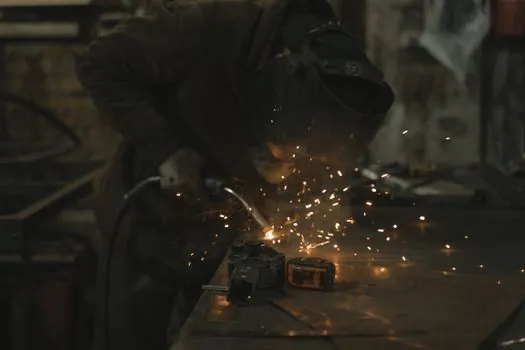
SMAW is used primarily to weld iron and carbon steel, including stainless steel, but nickel, copper, and selected aluminum alloys can also be joined with process-matched electrodes, and it is qualified in all positions (1G/1F through 4G/4F) under AWS D1.1 for structural steel and ASME Section IX for pressure equipment, which is why it remains on the WPS (welding procedure specification) lists of most EPC contractors [S1].
Code-acceptance details matter: when procurement asks for a "low-hydrogen" deposit, the WPS must call out an E7018 (or ISO 2560 equivalent E 42 4 B) electrode plus a documented bake-out and handling procedure; when the ask is "field-repairable root on a sour-service line," the WPS is more likely to specify an E6010/E7010 cellulosic root with a low-H fill-and-cap, all backed by ASME Section IX PQR and procedure qualification [S1][S3]. For the metallurgical side of which metal material grades accept a stick weld, the process is most forgiving on mild and low-alloy structural steels and most demanding on hardenable high-carbon or quenched-and-tempered grades, which must be preheated to roughly 150–250 °C to avoid hydrogen-assisted cracking.
Sourcing, Standards, and Buying Signals for Late 2026
Procurement teams should anchor an SMAW RFQ to AWS A5.1/A5.4 electrode classification, an AWS D1.1 or ASME Section IX WPS reference, and a documented electrode bake-and-handling log, rather than generic "low-hydrogen stick" wording that leaves room for substitution [S1][S3].
Trackable signals for the back half of 2026 include the gradual migration of basic-low-H electrode production toward low-dust, low-fume coatings driven by OSHA hexavalent chromium and welding-fume enforcement, and continued training-school throughput in SMAW, GMAW, GTAW, and FCAW as programs such as the Universal Technical Institute Welding Technology curriculum keep stick welding as a foundational module [S2].
Background reading: Case Packer vs Wrap-Around Packer: Line Integration Specs.