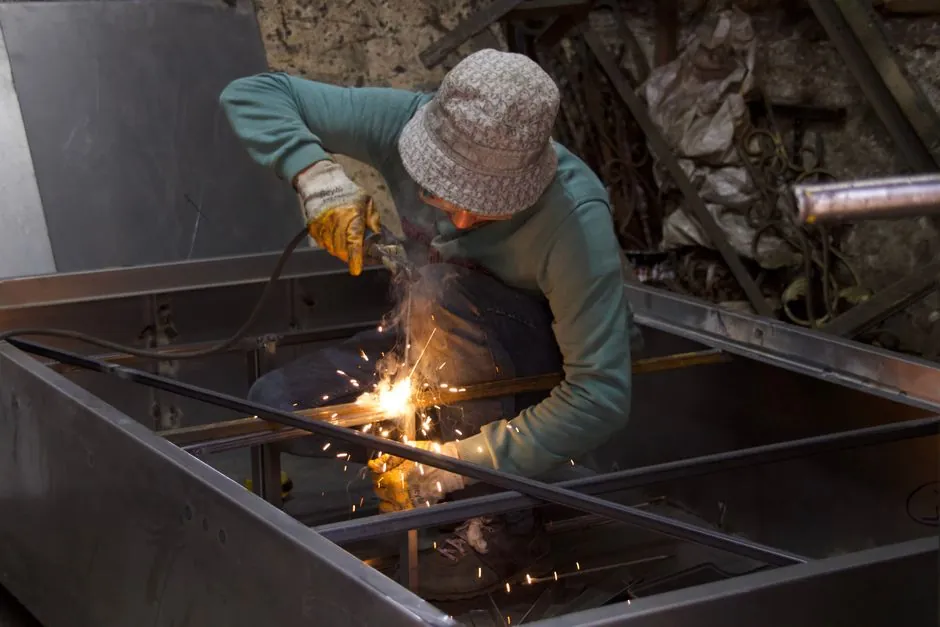
For plumbing pipe work, a 200–250 A DC inverter TIG or MMA (stick) machine covers most carbon-steel and stainless potable-water tie-ins, with a 130–150 A stick envelope reserved for thin-wall stainless branch welding per pipe-fitter field practice [S6].
Plumbing installations split cleanly into two process families: shop-fabricated stainless and copper-nickel tubing (TIG/GTAW dominant, AC for aluminum, DCEN for steel) and field tie-ins on carbon-steel risers (SMAW dominant, 6010/7018 electrodes). Pipe diameters typically run 0.5–4 in (12.7–101.6 mm), with wall thicknesses of 0.065–0.25 in (1.65–6.35 mm) for residential and light-commercial work [S5][S9].
Process Selection: TIG vs MMA vs MIG for Plumbing Pipe
TIG (GTAW) remains the dominant process for plumbing-grade stainless and copper-nickel because the non-consumable tungsten arc delivers a clean, oxide-controlled bead with no spatter, which is critical on potable-water and food-grade lines where slag inclusions are rejected at inspection [S1].
For plumbing carbon-steel risers above 4 in (101.6 mm) diameter, MMA (SMAW) with E6010 cellulose or E7018 low-hydrogen electrodes is the field default, because no shielding gas cylinder is needed and wind does not disturb the flux envelope. A 200 A class inverter stick machine covers 3.2–5.0 mm low-hydrogen rods at 60–240 A output, with hot-start and arc-force to stabilise cold starts on older steel [S3].
MIG (GMAW) is generally rejected for sanitary stainless plumbing because the spray-transfer arc and argon-CO₂ shielding gas are harder to control on out-of-position thin-wall tube, and the gas mixture (typically 75% Ar / 25% CO₂ for steel) is not approved for clean-service lines [S3][S4].
Amp Range, Thickness Envelope, and Polarity Boundaries
The practical amp envelope for plumbing pipe is 130–250 A: 130–150 A for thin-wall stainless (≤2 mm) using a DCEN tungsten, 150–200 A for 3–4 mm stainless tube, and 200–250 A for 3/8–1/2 in (9.5–12.7 mm) carbon-steel pipe using DCEP stick on cellulosic 6010 or low-hydrogen 7018 rods [S3][S6].
DCEP (DC electrode positive) gives higher deposition and is standard for SMAW with E6010/E7018 on plumbing carbon-steel risers; DCEN (DC electrode negative) gives deeper penetration and is the standard polarity for TIG on steel. Polarity reversal is a hard fault: running 7018 on DCEN produces a hard, porous bead that fails hydrostatic test, and running a tungsten on DCEP melts the electrode [S3][S7].
A common pipeline-welder minimum thickness capability of 0.25 in (6.35 mm) is the reference floor for plumbing tie-in work, so any candidate machine should be rated to 200 A at 60% duty cycle (or higher) before it is accepted onto a plumbing truck [S5].
Power Input, Portability, and Job-Site Constraints
Dual-voltage 110/220 V input is the practical default for plumbing jobs because the same machine must work in a basement mechanical room (120 V outlet) and a rooftop plant room (240 V three-phase or 240 V single-phase). Inverter-based MMA machines under 25 lb (11.3 kg) cover most service-truck routes [S2][S4].
For outdoor or wet trench work, a generator-rated inverter with a 20–25 A input at 120 V allows pairing with a 3–4 kW portable genset; the ARCCAPTAIN 200A MMA platform cited in pipe-fitter roundups targets exactly this 110/220 V dual-input niche with hot-start and arc-force, which are the two features that most directly reduce re-work on rusty black-steel pipe [S2].
Any plumbing truck running TIG should carry a flowmeter and a purge dam for backing gas on stainless, because oxygen ingress above 50 ppm inside the root pass tints the bead and fails pressure-test [S1][S3].
Comparison Table: Welding Processes for Plumbing Pipe
Stacked against four plumbing-relevant criteria, the three principal processes (TIG/GTAW, MMA/SMAW stick, MIG/GMAW) separate cleanly; the table below is the one to photograph and pin in the truck. [S3]
For plumbing-shop stainless and copper-nickel tube work, an AC/DC TIG inverter with pulse and adjustable AC balance (60–70% electrode negative) is the correct primary, because the AC cleaning action strips Al₂O₃ on aluminum transitions and DCEN gives clean root beads on stainless [S3]. For plumbing field tie-ins on carbon steel, a 200 A class MMA stick inverter with hot-start, arc-force, and DCEP output is the correct primary, because it runs on 120/240 V with no gas and tolerates wind, dirt, and rain [S2][S3]. MIG/GMAW is a third option only for thick carbon-steel pipe in a fab shop where out-of-position work is rare, because the spray arc is hard to control on thin-wall tube and the gas shielding fails in any breeze above 5 mph [S4].
For plumbing welders evaluating multiprocess units, the embedded arc-welder selection reference covers the platform differences between transformer, inverter, and engine-driven welders, and the coding-machine specs page is the right stop when permanent stainless trace marking is required after hydrostatic test.
Use-Case Scenarios for Plumbing Fitters
Residential water-service tie-ins: a 130–150 A MMA stick with 2.5 mm E6010 rods handles 3/4–2 in (19–50 mm) black-steel pipe above ground; budget machines in the $200–$1,500 band cover this envelope with 60% duty cycle at 150 A [S4][S6].
Commercial stainless-riser shop fabrication: a 200 A AC/DC TIG inverter with pulse, high-frequency arc start, and a foot pedal covers 0.065–0.125 in (1.65–3.18 mm) stainless tube; budget machines in the $400–$3,000 band cover the precision envelope required for sanitary and pharmaceutical plumbing [S3][S4].
Hospital and food-grade plumbing: orbital TIG is increasingly specified for hygienic tube because the closed weld head removes the human-arc-length variable and records every parameter, but the capital cost of an orbital head sits well above a manual TIG torch, so it only pays back on repeat diameter work [S1].
Field tie-ins on existing carbon-steel mains: a multiprocess MIG/TIG/stick inverter lets one truck carry one machine that can root-pass TIG, fill-pass MIG, and cap-pass stick, but the operator must hold all three qualifications and the truck must carry shielding gas for the MIG/TIG functions [S2][S5].
Failure Modes, Safety Limits, and When NOT to Weld
Symptom, root cause, corrective action: porosity on stainless root pass is caused by oxygen/moisture in the argon line; fix by purging the backing gas to 50 ppm O₂ or lower, fitting a flowmeter, and replacing the argon hose if it has been oil-contaminated [S1].
Symptom, root cause, corrective action: cold-cracking on carbon-steel tie-in is caused by hydrogen pickup from damp low-hydrogen rods; fix by re-baking 7018 rods at 250–300 °C for 1–2 hours and preheating the pipe to 75–150 °C per ASME B31.3 guidance for the material grade. If a hot-work permit cannot be issued (live gas line, unisolated fire system, oxygen-enriched atmosphere), do not weld; shut down, isolate, and re-evaluate before any arc is struck [S3][S4].
Symptom, root cause, corrective action: tungsten contamination on stainless TIG is caused by dipping the tungsten into the weld pool or by touching the filler to the hot tip; fix by regrinding the tungsten lengthwise on a dedicated wheel to a 15–30° point and re-arc on a copper purge block. If a plumbing line has previously been hydrostatically tested with untreated water, the line must be cleaned and dried before any orbital or autogenous weld is attempted, because residual chloride pitting at the HAZ will fail pressure-test within weeks [S1][S3].
For welder safety on the job site, the welding first aid kit spec sheet covers ANSI Z308.1-2024 Class A vs Class B requirements and CSA Type 2 small versus Type 3 large containers, which is the right reference for plumbing-truck compliance audits.
Standards, Sourcing, and Specification Discipline
For plumbing carbon-steel pipe, the governing fabrication codes are ASME B31.3 (process piping) and ASME B31.9 (building services piping), which set the qualification, WPS, and hydrostatic-test envelope; welding procedure specifications (WPS) must be qualified per ASME Section IX before any production weld [S3][S4].
For plumbing stainless sanitary tube, the reference codes are ASME B31.3 and ASTM A270 (sanitary stainless tubing) for food/dairy; orbital TIG is the process of record for pharmaceutical and semiconductor ultrapure-water (UPW) lines because the parameter-logging capability maps to ASME B31.3 traceability requirements [S1].
When evaluating a multiprocess welding platform for a plumbing fleet, cross-check the manufacturer's spec sheet against the arc welding machine selection reference to confirm the platform type (transformer vs inverter vs engine-driven), duty cycle at rated output, and IP rating for outdoor work. For plumbing fab shops also running pipe-end preparation, the cutting machine spec page covers beveling and cutoff tools sized to the same diameter envelope. The welding and cutting tool reference is the right stop for plumbing trucks that share consumables between cutting and welding tasks.
For plumbing contractors building out a 2026 specification pack, two trackable signals are: (1) the rising adoption of orbital TIG with parameter logging on pharmaceutical-grade stainless risers, driven by ASME B31.3 traceability audits; and (2) the continued dominance of 200 A class dual-voltage MMA stick inverters on residential and light-commercial service trucks, driven by hot-start/arc-force electronics and 120/240 V input flexibility [S1][S2].