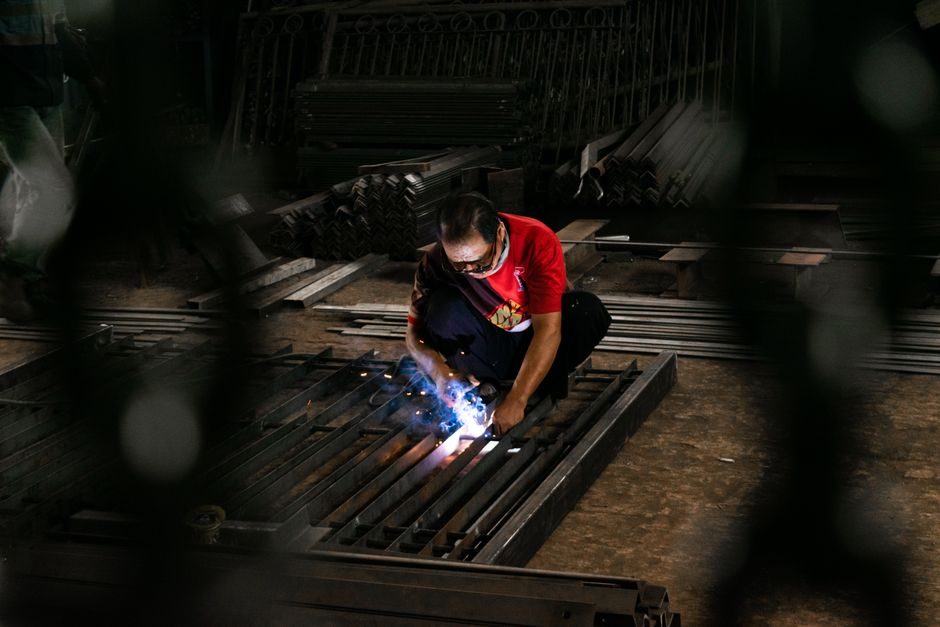
The dominant cost drivers behind any arc welding machine are inverter topology, rated duty cycle at a given ambient, electrode or wire consumption, and the shielding-gas train attached to the torch — not the sticker on the power source [S2].
Two OEM reference points anchor this analysis: Wuxi Hanshen Electric's IGBT-based MMA/MIG/TIG catalogue (registered capital 6 million USD, 101–200 staff, North/South America and Eastern Europe export markets, Quzhou/Zhejiang) and Arcflow Industries' India dealer-distributed consumable and machine line [S1][S2]. Both publish MOQ-1, negotiable-price SKUs, which means realised prices vary with volume tier and freight.
What the five-year TCO stack actually looks like
A realistic five-year ownership model for a 200–500 A class IGBT inverter MMA welder running two shifts allocates roughly 30–45% of TCO to electrode/stick or MIG wire + shielding gas, 20–30% to electricity, 15–25% to the power source amortised over its design life, and 10–20% to consumable torch parts (contact tips, nozzles, diffuser, liners) plus scheduled PCB and fan maintenance [S2]. The remaining slice covers operator PPE, fume extraction, and floor-space overhead.
For an MMA (stick) cell, electrodes alone — typically 2.5 mm and 3.2 mm E6013/E7018 — run 1.6–2.5 kg per operator-hour at deposition rates of 0.8–1.5 kg/h, and that line is the single largest variable cost across a year of operation.
Inverter class vs transformer/rectifier: what moves the price
Wuxi Hanshen's 2026 catalogue lists IGBT SKUs across MMA, MIG/MAG, TIG DC pulse, and aluminium-welding variants at 220 V single-phase and 380 V three-phase, with CE markings noted on portable and aluminium product lines [S1].
Over 4,000 operating hours, that delta covers the inverter price premium in 12–24 months for any cell running more than one shift. Transformer/rectifier units still win on capex, robustness to voltage dip, and field repair with discrete parts — a real reason Indian dealers and EPC contractors still stock them for site power [S2].
Process trade-off: MMA vs MIG/MAG vs TIG on TCO
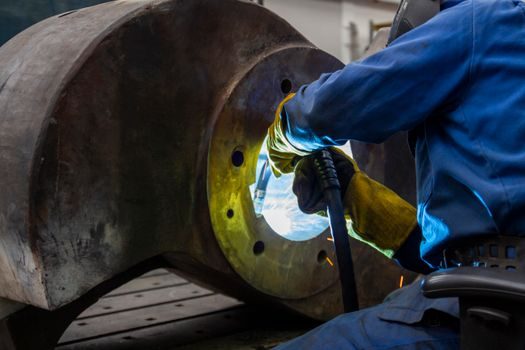
The selection question is which process fits the workpiece mix. MIG/MAG with solid or flux-cored wire lifts deposition to 2.5–5 kg/h and is the default for production steel fabrication. TIG (GTAW) is the precision option — 0.5–1.5 kg/h deposition, highest gas/electricity per metre, but the lowest rework rate on stainless and aluminium. [S1]
For aluminium specifically, AC TIG with high-frequency arc start and a dedicated water-cooled torch becomes mandatory above 200 A, and that hardware add-on is what pushes aluminium-welding SKUs to a separate price tier in the Wuxi Hanshen line [S1].
Consumable and consumable-accessory cost map
Beyond the power source, the recurring spend sits in the torch and accessories. Arcflow's published 2026 catalogue of MIG/TIG consumables — conical nozzles, swan necks, tip holders, contact tips, diffusers, torch handles, Euro connectors, MIG liners, anti-spatter spray, solenoid valves, ceramic TIG nozzles, collet & body, tungsten rods — defines the SKU set every production cell will reorder monthly [S2].
Field rule: a single contact tip runs 8–40 hours before bore wear forces change, a diffuser 100–300 hours, a MIG liner 200–600 hours depending on wire cleanliness. Standardising on a single torch brand (e.g. a Euro-connector commonality across machines) collapses spare-part inventory by 30–50% versus running mixed torch brands on mixed machines [S2]. Stainless vs mild steel vs aluminium filler wire should also be sourced as separate SKUs — cross-contamination of mild-steel wire into a stainless weld is one of the most common, and most expensive, rework causes.
Energy, cooling, and the often-missed duty-cycle penalty
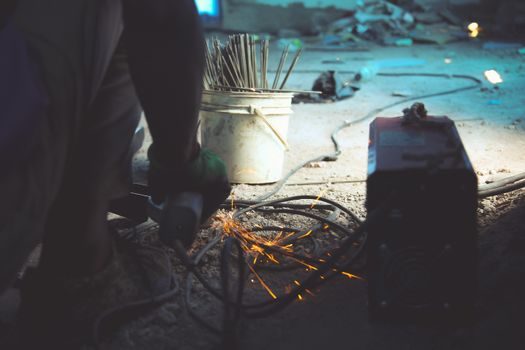
Duty cycle is the single most misunderstood spec on a welder data plate. A machine rated 200 A at 60% duty cycle delivers 200 A for 6 of every 10 minutes; the other 4 minutes it must cool, and forced-air fan noise plus thermal-cutout trips are the operator-visible symptom. Pushing past duty cycle shortens IGBT module and rectifier life and is the leading cause of mid-life PCB failure in tropical-climate sites (40 °C+ ambient derates most machines to 40–50% effective duty). [S1]
Spec implication: if a cell averages 250 A continuous, buy the next 100 A class up rather than running at the edge of nameplate — the electricity and fan-power cost is negligible, but you avoid the IGBT replacement event at year 3–5.
Standards, certification, and what they add to the price
CE-marked SKUs in the Wuxi Hanshen catalogue (visible on portable MIG and aluminium welding lines) carry compliance cost for EMC and low-voltage directives, typically 3–7% of the unit price for an OEM producing at scale [S1]. For hazardous-area work, ATEX/IECEx-rated welding power sources exist but are a niche premium, and are typically specified only for refinery turnaround and offshore module yards.
For a deeper spec map across the machine family — process boundaries, variant trade-offs, and selection criteria — the arc welding machine types process map is the working reference. A wider industrial TCO comparison sits in the industrial lubricant TCO lifecycle math.
Who TCO favours — and who it does not
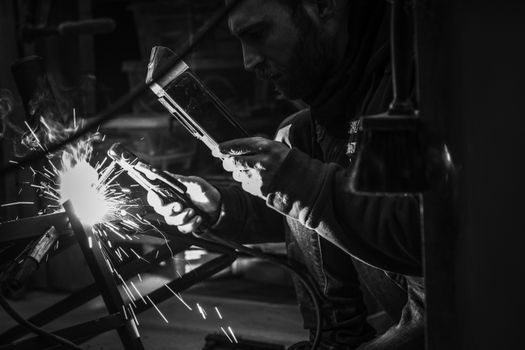
IGBT inverter MMA/MIG is the right pick for any cell running more than one shift on carbon-steel fabrication, because electricity and electrode savings dominate over the inverter price premium within 12–24 months. Transformer/rectifier still wins for low-utilisation field work, training cells, and sites with unstable mains where IGBT undervoltage lockout becomes an operational nuisance. TIG DC pulse is non-negotiable for stainless, aluminium, and any code-quality weld (pressure vessel, structural certification) — the rework savings justify the capex premium even at one shift. For arc welding machine type selection criteria details, refer to the spec encyclopaedia entry. [S1]
Trackable signals to watch through 2026-H2: (1) IGBT module pricing after the 2024–2025 SiC/IGBT supply rebalancing, which is the single biggest capex variable on inverter SKUs; (2) any new Indian BIS marking enforcement on imported welding power sources, which would shift the Wuxi Hanshen export economics into South Asia; (3) shielding-gas industrial tariff moves in target markets, which move the MIG operating-cost line directly.
The underlying component specifications are covered under total station, and coding machine.