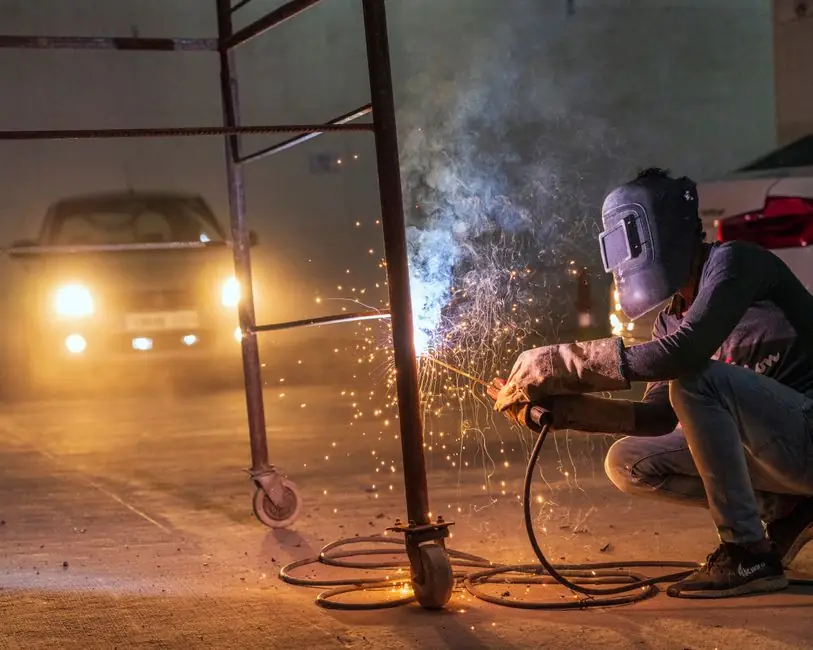
Arc welding power sources deliver either alternating current (AC) or direct current (DC) to strike and maintain the welding arc, and the two behave very differently at the electrode tip: AC reverses direction through each half-cycle (50 Hz in Australia, 60 Hz in the USA, per [S3] (2019-05)), while DC holds a fixed polarity, either electrode negative (DCEN) or electrode positive (DCEP).
Five basic power-source architectures underpin the choice, namely AC transformer, DC rectifier, AC/DC transformer-rectifier, DC generator, and inverter [S6]. TWI groups these into the canonical set that still maps to the welder label on the front panel, so an engineer's first selection filter is which topology the supply actually uses.
Heat Balance: Why DCEN and DCEP Behave Differently
With Direct Current Electrode Negative (DCEN), about 2/3 of the arc heat ends up in the workpiece and 1/3 in the electrode; with Direct Current Electrode Positive (DCEP) the ratio flips, putting roughly 2/3 of the heat into the electrode and 1/3 into the plate [S4]. That thermal split is the single most useful rule of thumb on a shop floor.
DCEN therefore gives deeper penetration into the base metal with less electrode burn-back, which is why it is the standard polarity for GMAW/MIG (constant-voltage DC) and for most DCEN stick welding on thin sheet [S3][S5]. DCEP concentrates heat on the electrode, which speeds deposition on heavy plate and is the polarity typically recommended for cellulose and iron-powder SMAW electrodes where deep plate fusion matters less than melt-off rate [S5].
Where AC Still Earns Its Slot: Aluminium GTAW and Arc-Blow Control
Gas Tungsten Arc Welding (GTAW/TIG) on aluminium and magnesium alloys is the canonical AC process: the continuously reversing polarity sweeps the oxide layer off the surface during the electrode-positive half-cycle while the electrode-negative half-cycle delivers penetration, a cleaning/penetration cycle that DC alone cannot replicate [S3][S4].
AC is also the practical fix for arc blow, the magnetic-field deflection of the arc that wrecks bead symmetry on long DC welds in magnetised steel [S1][S4][S5]. Because the current reverses tens of times per second, the net magnetic disturbance averages out, which is why shipbuilding seam welds and repair work on magnetised machinery still spec AC [S5]. TWI and YesWelder both list AC as the remedy whenever arc blow is the limiting defect mode [S4][S6].
Process-by-Process Power-Source Mapping
Shielded Metal Arc Welding (SMAW, stick) accepts either AC or DC with a constant-current (drooping) output, but most cellulosic, low-hydrogen and stainless electrodes are DCEN or DCEP specified because DC gives a more stable arc and less spatter [S3][S5]. Gas Metal Arc Welding (GMAW/MIG) is essentially a DC-only process in practice: it needs a constant-voltage DC source so arc length self-regulates as contact-tip-to-work distance changes [S3].
Flux Cored Arc Welding (FCAW) inherits the same DC, constant-voltage power architecture as GMAW because the wire feed and arc-length control logic are identical, the only real change being the tubular electrode and whether an external shielding gas is added [S3]. Submerged Arc Welding (SAW) and stud welding both accept either AC or DC depending on the application notes, with AC again favoured for high-current, deep-penetration seam welds where arc blow would otherwise limit productivity [S3][S5].
Side-by-Side Selection Criteria
On four decision criteria the AC and DC options line up as follows, drawn from the same reference set: weld smoothness and spatter, DC wins because the magnetic field and arc current are constant, producing a uniform bead and better wetting at low current [S5]. Equipment cost, AC transformer supplies are cheaper and lighter for a given output, while DC rectifier and inverter stacks add cost but deliver the stable arc that finish-critical work needs [S1][S6].
Aluminium and magnesium weldability, AC wins because only the reversing wave cleans the refractory oxide skin during TIG [S3][S4]. Magnetic-field tolerance, AC wins on magnetised base metal or long DC welds that develop arc blow; DC loses on this axis and is "difficult to control" in those conditions per the SSimder comparison table [S1]. For deeper background on related process power decisions, see this walkthrough of AC motor drive selection and the practical notes on welding cutting tool integration.
Limitations, Hazards and What Each Source Will Not Do
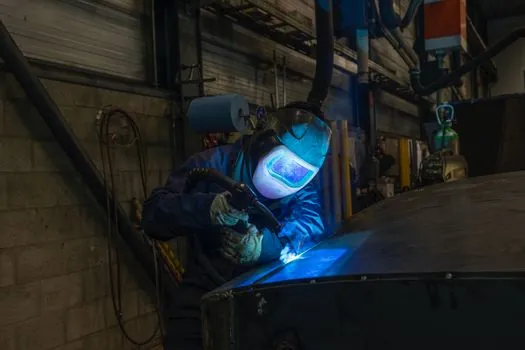
AC is rarely the first choice in modern production because the cyclic zero-crossing creates a higher electrocution hazard than DC at the same open-circuit voltage, and because stick and MIG productivity both drop on AC for the same amperage setting [S3]. DC's main failure mode is not electrical safety but arc blow on long joints, plus the rectifier or inverter front-end adds capital cost versus a plain AC transformer [S1][S6].
For inverter-based DC supplies, the additional constraint is harmonic content and input current draw on the plant network, which is why TWI lists inverter as a separate topology with its own filtering considerations rather than as a drop-in equivalent to a DC generator [S6]. Operators should also respect the safety note in [S5]: always cross-check the electrode manufacturer's recommended polarity, since a wrong DCEN/DCEP choice can overheat the electrode or starve the weld of penetration even on a perfectly sized power source.
Sourcing Notes and Standards Anchors
The five power-source architectures (AC transformer, DC rectifier, AC/DC transformer-rectifier, DC generator, inverter) are the canonical taxonomy used by TWI's welding engineering reference [S6]. The heat-distribution ratios (about 2/3 plate, 1/3 electrode on DCEN, reversed on DCEP) are documented by YesWelder's technical write-up [S4].
Grid frequencies cited (50 Hz AU, 60 Hz US) come from Technoweld's 2019 primer [S3] (2019-05); readers on 400 Hz aircraft or marine supplies should expect different arc-stability behaviour and verify against the equipment manual. The AC/DC application matrix (shipbuilding seams, heavy plate, magnetised machinery, aluminium TIG) traces to Muggy Weld's process notes [S5]. For process engineers weighing similar power-source trade-offs on the instrumentation side, the selection logic in AC motor sizing follows the same constant-current versus constant-voltage split that defines welding power supplies.
Trackable signals to watch: inverter-stack cost per amp continuing to fall, which keeps eroding the price gap that today still keeps transformer-only AC supplies attractive for budget work; and any move by electrode makers to publish explicit DCEP-only or DCEN-only data sheets, which would force shops to commit to a DC supply rather than running AC as a universal fallback. Spec-driven buyers comparing power-source topologies for adjacent processes can also reference the arc welder and welding cutting tool reference pages.
Background reading: Aerospace Investment Casting Capacity Shortage 2026.