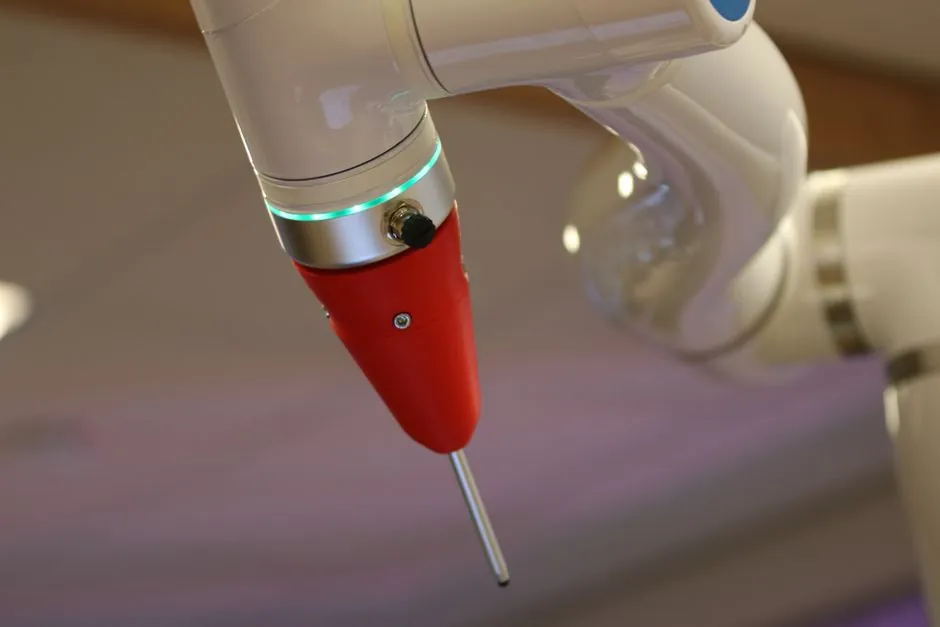
An articulated robot cell typically costs more than the arm because end-effectors, safety systems, vision modules, and PLC integration must be included in the investment case [S1].
The ownership calculation covers purchase, engineering, training, maintenance, software, downtime, and end-of-life value, while a standard 6-axis industrial arm can span US$50,000 and above [S3][S4].
What Articulated Robot TCO Actually Includes
The usable TCO boundary begins with the configured robot and ends with residual value, not the quotation for a bare arm. The calculation is: robot, end effector, sensing, compute, mounting, safety, integration and training, plus annual maintenance, software and downtime over the holding period, minus resale value [S3].
An articulated robot is only one component of the production asset. A handling cell may also require an end effector, sensing, compute, fixtures, guarding, emergency stops and production-line PLC connections [S3]. Software may add separate one-time licences and recurring subscriptions for simulation, fleet tools or cloud services [S3].
Two cost lines often determine the final result. Integration is measured in engineer-weeks multiplied by the loaded engineering rate, while downtime combines the number of blocked production hours with the labor and lost-output value of each hour [S3]. Data collection is another separate line when learned policies require teleoperation equipment and operator time [S3].
Cost Drivers That Move the Budget
Hardware configuration is the first price driver. A 6-axis arm can start near US$9,500 for one listed research platform, while other published prices range from US$3,500 for a 6-axis PiPER to US$21,500 for a G1 humanoid; these are platform examples, not complete production-cell quotations [S3].
End-of-arm tooling can move the budget more than the robot itself when the gripper, adapters and application-specific tooling are ordered separately [S3]. Sensing has the same structure: every camera, depth sensor, force-torque sensor, mount and cable belongs in the estimate [S3].
Integration engineering is a cost line in the supplied TCO framework, which addresses pricing the configured cell [S3]. The 2017 industrial-robot TCO model likewise treats the calculation as a conceptual lifecycle method rather than a simple equipment-price comparison [S2].
Safety is not an optional accessory. Guarding, emergency stops, risk assessment and certification work must be priced after the actual cell concept is defined, because the required protection depends on the machine, process and operator interaction [S3].
Buy, Lease or Rent: Comparing Ownership Routes

Buying places capital expenditure, integration risk and maintenance responsibility with the owner, while leasing or renting shifts some capital burden to the provider. The correct comparison is the full project cost over the same service period, including financing, integration, maintenance, software, downtime and end-of-life treatment [S3].
The main options differ across four decision criteria. Purchase offers asset control but exposes the buyer to integration and obsolescence risk. Leasing can convert capital spending into a periodic payment, although the contract must disclose integration, maintenance and downtime terms. Renting suits short or variable-duration work if the provider can deliver the required uptime and application support.
Specialized industrial robots are optimized for highly structured and repetitive environments [S4]. That payback range is not a universal specification: it depends on utilization, labor cost, cycle time, downtime and the number of engineering hours absorbed by the project [S4].
Maintenance, Downtime and Energy Over the Asset Life
Industrial robot maintenance commonly represents 5% to 15% of purchase price per year [S7]. The actual maintenance model should include consumables, wear parts, batteries, repairs, service contracts and labor, because a calendar percentage cannot capture different duty cycles or spare-part strategies.
Downtime should be modeled rather than treated as a contingency. For each failure mode, the calculation needs the repair duration, parts lead time, number of operators blocked, lost production and the labor value of the blocked team [S3]. Spare parts are a TCO consideration [S3].
Energy is usually smaller than engineering and downtime for many manufacturing cells, but it remains an operating cost rather than free capacity. It depends on payload, motion profile, cycle time, duty cycle and the electrical demand of controllers, computers, conveyors and auxiliary equipment. No defensible energy value can be assigned without the selected robot and production schedule.
The operating plan should separate scheduled preventive work from corrective repair, assign an owner to each task, and include response times for critical parts. Industrial robot maintenance costs range from 5% to 15% of purchase price per year [S7].
Which Robots and Which Buyers Fit the Case
An articulated arm is suitable for repeatable handling, welding, assembly, dispensing and processing tasks where the required reach, payload and repeatability match the application. Market segmentation divides units by payload into up to 16 kg, 16–60 kg, 60–225 kg and above 225 kg, and by axis count into 4-axis or less, 5-axis and 6-axis or more [S1].
The buyer should be comparing a repeatable, production-defined process with a stable operating plan. A buyer whose process changes every week, whose part mix is not yet frozen or whose utilization cannot support integration and training is poorly served by a conventional six-axis arm unless the expected productivity gain covers the full cell lifecycle.
For flexible production with human interaction, a collaborative robot may fit where the risk assessment permits collaborative operation and the payload and work envelope meet the task. A SCARA robot may be a lower-complexity option for high-speed, planar assembly or pick-and-place work, but it does not provide the same articulated reach and orientation flexibility [S1].
The comparison is practical: articulated motion supports more poses and directions than SCARA motion, while a collaborative architecture addresses a different risk-control and workspace concept. Neither label removes the need to price tooling, sensing, safety, PLC integration, training and downtime.
Building a Bankable TCO Case
A defensible business case needs a signed-off cell layout, cycle-time study, labor baseline, utilization forecast, risk assessment and support plan before purchase. The market research identifies handling, welding, assembly, dispensing and processing as the principal articulated-robot functions, each with different tooling and safety requirements [S1].
Cost and benefit should be calculated over the same period. Subtract avoided labor, increased throughput, lower scrap and other measurable contribution gains from acquisition, integration, training, maintenance, software, energy, downtime and financing costs. Then deduct resale value if the arm, controller, tooling and installed cell can be redeployed.
Acquisition volume affects price through equipment tier, while certification and safety scope affect installed cost. Lead time affects working capital and the exposure to parts delays. Installation and integration can exceed the arm price on research projects, and maintenance plus downtime can accumulate over every operating year [S3].
Track 4 operating signals after installation: actual cycle time against the approved assumption, scheduled versus unplanned downtime, maintenance cost as a percentage of purchase price, and engineering hours used for changes or troubleshooting. A target of 5% to 15% annual maintenance provides a review band, not a guaranteed result [S7]. The related assessment of articulated robot advantages and disadvantages is useful for confirming that the selected application genuinely benefits from articulated motion before the integration commitment is made.