An automated storage and retrieval system, abbreviated AS/RS in modern warehouse-engineering practice, is no longer a single product category: unit-load, mini-load, shuttle-based, and vertical-lift module (VLM) architectures each carry distinct throughput envelopes, footprint claims, and failure modes that determine whether a project clears payback or quietly bleeds money for a decade.
Process engineers who have watched a mis-specified stacker crane sit idle 70% of a shift because the SKU profile was wrong treat selection as a hard-engineering problem, not a software demo. This article walks the seven gates that consistently separate a defensible spec from a 2026 budget write-off, with concrete thresholds, named alternatives, and the failure modes each gate is built to prevent.
Gate 1 — SKU Velocity and Order Profile Drive the Architecture Choice
Throughput is the single non-negotiable input: unit-load AS/RS running a single-deep aisle S/R machine typically peaks around 30–50 double-cycles per hour per crane, while a multi-crane mini-load aisle handling totes can sustain 80–150 cycles/hour per crane and modern shuttle-system deployments claim 500–1000 tote presentations/hour per level when the rack face is short and the SKU pool is dense [S3].
Order-line count per pick is the second axis: a 30 000-SKU distribution centre with mostly 1- or 2-line orders is the textbook mini-load or shuttle case, whereas a 4 000-pallet FMCG buffer feeding production lines is the textbook unit-load case. Mixing the two on one stacker crane almost always underperforms a partitioned design where each crane type handles its native profile.
Gate 2 — Cube Height, Footprint, and Seismic Zone Set the Civil Brief
Height is the cheapest cubic-metre you will ever buy: most unit-load cranes in active 2026 specifications run 30–40 m tall, mini-load aisles commonly reach 12–18 m, and shuttle racking stacks vertically without a crane envelope at all, freeing the ceiling for sprinkler clearance and busbar routing. [S1]
Ground-bearing pressure and slab flatness (commonly ≤ 3 mm over 3 m for VNA aisles) are the next two sub-gates that are nearly impossible to fix in retrofit, so they belong on the civil brief before the first steel drawing is released.
Gate 3 — Load Unit, Container Standard, and Tote Geometry

Load unit dictates the extractor head, the conveyor interface, and the rack pitch. European DC projects most often run 600×400 mm or 400×300 mm stackable totes at 30–50 kg, North American unit-load work is dominated by the 1219×1016 mm (48×40 in) GMA pallet at 500–1500 kg, and pharmaceutical or electronics projects lean toward 600×400 mm or 400×400 mm trays with optional RFID tagging. [S2]
Mismatching tote pitch to rack pitch wastes 10–20% of vertical slots in a mini-load aisle; mismatching pallet footprint to extractor fork reach forces slower cycle times and adds fork-bounce risk at 30+ m lift heights. Locking the container standard on Gate 3 before the rack tender is the cheapest decision in the entire programme.
Gate 4 — Fire Code, Sprinkler Interface, and Insurance Carve-Out
A high-bay AS/RS is also a fire-engineering problem the moment it clears 12 m storage height. NFPA 13 / FM Global DS 8-9 (US) and EN 12845 / FM Global DS 2-0 (EU) define in-rack sprinkler density, ceiling-only vs in-rack layouts, and the maximum unsprinklered void that insurers will accept — typically 9.1 m (30 ft) under FM Data Sheet 8-9 for Class I–IV commodities, which is why most North American AS/RS roofs are designed in-rack from the bottom up rather than from the ceiling down. [S3]
The interaction with sprinkler-system riser layout, the smoke/heat vent pattern, and the high-expansion foam option for deep-piled stock is best resolved before the rack supplier is nominated, since retrofits after rack erection routinely run 3–5× the original install cost. One practical carve-out: when insurance carriers allow ESFR (Early Suppression Fast Response) ceiling-only protection at high K-factors, the rack can shed 1–2 in-rack levels and recover 8–12% usable cube.
Gate 5 — WCS/WMS Interface, Controls Stack, and Brownfield PLC Layer
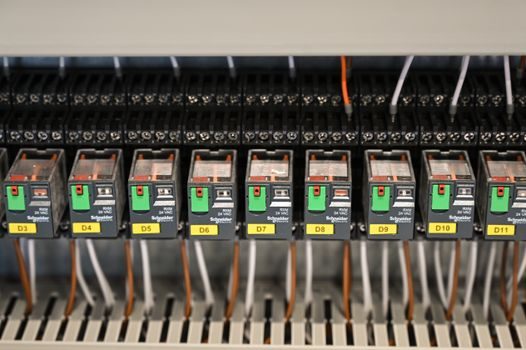
The controls stack is where the integrator margin hides, and where projects most often go sideways. A modern sorting-system or AS/RS tender needs an explicit answer to: which WMS is the host, which Warehouse Control System (WCS) is the integrator layer, and which PLC family (Siemens S7-1500, Rockwell ControlLogix, Beckhoff TwinCAT) owns the stacker crane, conveyor, and shuttle I/O. Locking the message protocol — OPC UA Pub/Sub vs REST vs the legacy SAP EWM MFS BAPI/XML interface — at the WCS boundary prevents the most common integration overruns. [S4]
Brownfield sites add the hard sub-gate of legacy PLC and fieldbus retention: retrofitting a 2010-vintage stacker crane onto a new WCS frequently forces a controls-cabinet replacement and a 4–6 week outage that is rarely on the project Gantt. An interface-freeze document, signed before PO, is the cheapest insurance in the controls package.
Gate 6 — Throughput Architecture: Single-Aisle vs Twin-Aisle vs Shuttle-Plus-Crane
Three architectures dominate 2026 capex briefs. (2) Shuttle + lift — a rack-face shuttle per level plus a single shared lift, scalable to 1000+ totes/hour/lane but limited to ~15 m lift height with most commercial lift designs. (3) Hybrid — a unit-load aisle feeding a shuttle-served picking face — useful when raw-goods pallet storage and piece-pick share a building but not a throughput profile. [S5]
For most mid-size European DC projects in 2026, the shuttle-plus-lift topology has displaced the classic mini-load on price per tote/hour because the shuttle I/O box is field-replaceable in 15 minutes and the lift is the only critical-recovery spare. The hidden cost is the fire-rating treatment of the rack-face cavities, which insurers increasingly classify as concealed-space and demand draft-stopping at 6 m intervals.
Gate 7 — Lifecycle Cost, Energy, and Serviceability Beyond the PO
The 20-year view is where most AS/RS business cases break: stacker-crane wire-rope replacement at 8–10 year intervals, busbar brush replacement, shuttle I/O box battery cycles (typically 500–800 charge cycles on Li-ion), and WCS software upgrade windows. Industry rule-of-thumb: maintenance + energy over a 20-year horizon runs 1.5–2.5× the original equipment CAPEX for unit-load, and 1.0–1.8× for shuttle, driven mostly by the absence of the lift-enclosed wire ropes and hoist motors in the shuttle case. [S6]
Serviceability — number of platforms required for crane roof-level access, mean-time-to-recover for a shuttle I/O box, and the service-contract response SLA at 4 h vs 8 h — should be priced into the tender, not added later, because the field data is the only honest signal of who actually owns the uptime risk.
Track the following nodes as the 2026 tender cycle progresses: the FEM 10.2.06 revision working-group outputs, ESFR ceiling-only approvals for high-bay commodity storage from major FM Global carriers, and OPC UA over TSN proof-of-concepts in live shuttle deployments — each will reset at least one of the seven gates above by 2027.
For related coverage, see Sprinkler System vs Fire Door: 2026 Inspection Interval Frame.