
A pre-shift asphalt paver inspection runs as a 3-person team in roughly 60-90 minutes, covering walk-around damage scan, hopper crack and rubber check, screed function, and hydraulic oil sight-glass verification before any mix hits the machine [S4].
Beyond the daily walk-around, contractors layer a 6-month full-component audit and, on Cold In-Place Recycling (CIR) jobs, an FHWA Construction Inspection Checklist (#12) document review that gates the project on mix design, core thickness, and recycling-agent compatibility [S1][S3]. The cost of skipping any of these layers shows up as screed misalignment defects, cooled mat, and idled delivery trucks during a short paving season [S5].
Pre-shift walk-around: 3-person, 60-90 minutes, PPE-up
Operators must don safety glasses, steel-toe shoes, protective gloves, hard hat, and vest before any cleaning or inspection step, and assemble a tool kit of water, brush, whisk broom, scraper, pry bar, rag, and pressure washer [S4]. The first 6-9 minutes go to whisking radiator and engine fins; battery cleaning runs at least once per week on the same shift [S4].
Walk-around items verified before the screed heats up: track or tire damage, hopper cracks and rubber flap condition, auger circumference and width with no cracked flights, fuel level topped with red-dye diesel, hydraulic oil visible in the sight glass, and external screed controls plus reverse alarm functionality [S4]. For rubber-track pavers, the Asphalt Pro maintenance guide specifies 1/4-inch maximum droop as the tension acceptance band; more droop and the machine is grounded until the track is re-tensioned [S4].
Component audit: the five wear systems on a paver
Paver wear concentrates in five predictable systems: screed, conveyor/feeder, auger, hydraulics, and screed burner/heating [S5]. A worn or warped screed plate, a sagged conveyor chain, or a pointed auger flight all show up directly as mat defects behind the machine, which is why screed operators describe a running paver as something that "talks to you" through mat texture [S5].
The Caterpillar Safety and Maintenance Checklist for asphalt pavers adds ground-level walk items many crews miss: steering cylinder ends, push-roller/truck hitch asphalt buildup, end-gate travel through full range, DEF fluid level, and the lock condition of raised hoppers and screed lifts before any service work [S2]. Under the hood, the engine-compartment list reads engine oil, coolant, hydraulic oil, pump-drive oil, ATTAC fin blockage, radiator/hydraulic-oil cooler fin blockage, hose cracks and wear spots, belt tension, and air-filter service indicator [S2].
6-month and seasonal intervals: 8-1/2 x 11 paper checklist, full-size

Commercial 6-month paver checklists are published in 8-1/2 x 11 full-size format to give inspectors room to log reading values for hopper, conveyor, screed, auger, and engine subsystems on the same page, and they are designed to be paired with pre-shift and pre-use inspection forms for the same asset [S3]. A typical 6-month pass audits minor and major control systems plus all wear components identified above, with the pre-shift form covering damage and leaks and the 6-month form covering tolerance drift and service intervals [S3].
Seasonal shutdown tasks layer on top: at least twice per month, a 45-60 minute full wash-down with water hose, standpipe, brush, whisk broom, scraper, and pry bar, repeated more often when abrasive granite mix volume is high, then an asphalt release agent pass on every surface in contact with mix [S4][S5]. Burner ignition and even heat across the screed are seasonal checkpoint items; uneven heat telegraphed across the mat means a burner element has failed and the screed must be rechecked before the next lift [S5].
Cold In-Place Recycling (CIR) inspection overlay: FHWA Checklist #12
On CIR projects, inspectors add a separate document-review gate before any construction activity: project specifications, mix design, structural pavement design, construction manual, traffic control plan, owner/agency requirements, additive manufacturer instructions, SDSs, and a Job Hazard Analysis must all be on file [S1]. The project-review step requires center and edge cores along the project length to confirm bituminous layer thickness is sufficient to recycle, and to identify weak subgrades, paving fabric layers, or appurtenance clearance (guardrail, curb, bridge) constraints that could limit grade variation [S1].
Materials checks on CIR demand cores sufficient for mix design, consistency evaluation along the project length, and confirmation that the recycling agent (emulsified asphalt or foamed/expanded asphalt) is compatible with the existing materials and processes, with optional recycling additives per mix design [S1]. Where CIR projects run adjacent to live plant work, the asphalt paver encyclopedia entry maps these CIR gates back to standard paver pre-shift and 6-month inspection duties.
Acceptance criteria and the "do not repair" line
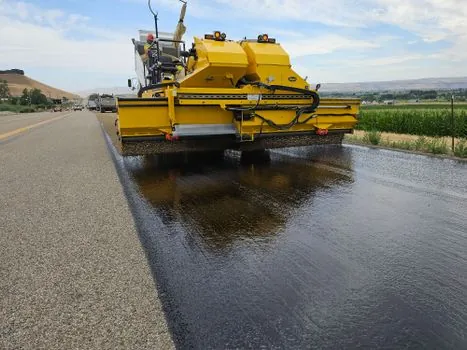
Acceptance bands published in the field guides are concrete: rubber-track droop at or under 1/4 in., hydraulic oil visible in the sight glass, no asphalt buildup on the push-roller/hitch, all end gates cycling through full range, and screed burner even-heating verified by a hand-pass across plate length [S2][S4]. Lock-out items the Caterpillar checklist lists as must-stop conditions include raised hoppers not locked, raised screed lifts not locked during service, and missing reflective safety markings on the chassis [S2][S4].
The replacement-versus-repair line is straightforward: a cracked or broken auger flight, a warped screed plate, a sagged conveyor chain past tension-adjustment range, or a failed burner element are not field-repairable during a shift and the affected component should be swapped out before production resumes [S4][S5]. Continued operation with any of these defects shows up in the mat as profile error, aggregate segregation, or low-density zones that have to be milled and repaved, a repair cost orders of magnitude above the part itself [S5].
Standards, documentation, and the digital overlay
Pre-operation checks are run against the SP-036 pre-operation inspection report, with project-level work on US federal-aid projects also referencing the FHWA Pavement Preservation Checklist Series, of which #12 covers CIR [S1][S4]. The Caterpillar safety and maintenance checklist (form V0611.2) is the field-level safety layer that travels with the machine, with operator/inspector name, date, and time fields filled in for every shift [S2].
Digital platforms (free template-based systems, paid fleet maintenance suites) wrap the same paper logic into offline pre-shift walkarounds that turn every defect into a work order and log per-machine wear on screed, conveyor, auger, and burner components, so small adjustments never escalate into season-stopping rebuilds [S5][S6][S7]. For a related safety-side checklist on heavy equipment pre-op routines, the pile driver pre-op protocol walks the same PPE-up and ground-walk sequence. For on-site repair work that cuts into pavers, the rebar cutter maintenance protocol shares the lock-out, hydraulic-pressure-down, and sight-glass verification logic. One trackable signal: FHWA's Pavement Preservation Checklist Series (#12) is the only inspection overlay that gates a project on bituminous core thickness and recycling-agent compatibility before any paver rolls. Second signal: the rubber-track 1/4-in. maximum droop tolerance and 6-month full-component form remain the most-cited pass/fail thresholds in field guides dated August 2026 [S4].
Spec-level background on the components involved: pressure transmitter, and flow meter.