
On-farm paving jobs, including feedlot lanes, dairy yards, greenhouse access roads, grain-bin aprons and silage-pad bases, sit in the 2.5-6 m width band at 50-300 t/h laydown rate, well below the 8-14 m / 400-900 t/h envelope of a Class-1 highway paver, which means a compact wheel-type or mini-tracked machine is the economic centre of gravity [S1][S2].
Caterpillar, Komatsu, Volvo, Sany, XCMG, Zoomlion, Shantui, Vögele, Dynapac and Bomag all hold active product lines; the global aftermarket covers parts for Komatsu, Caterpillar, John Deere, Volvo, Liebherr, Atlas, Demag, Ingersoll-Rand, Sany, Zoomlion, XCMG, JCB, Shantui and Changlin [S3]. Rental fleets on major OEM portals list current 2026 stock of wheel and tracked pavers in the 4.5-9 m paving-width class [S2].
On-Farm vs Highway: Where an Agricultural Paver Job Actually Sits
Agricultural paving is structurally a thin-lift, low-volume discipline: feedlot lanes are typically paved 50-75 mm thick over 150-200 mm of compacted sub-base, silage pads run 75-100 mm over a 200-300 mm free-draining granular layer, and grain-bin apron slabs run 75-100 mm on a cement- or lime-stabilised subgrade, none of which demands the 200-300 mm deep-lift structural mats laid by a Class-1 highway paver [S1].
Where asphalt beats concrete on the farm: rapid cure (traffic in 2-4 hours vs 7 days for concrete), seamless paving around slatted floors and manure-scrape alleys (no joint spalling under tractor scraping), and lower install cost at sub-100 mm thickness where a concrete slab would still need mesh and curing compound. Where concrete wins: heavy static loads from loaded forage wagons and silage trucks parked for days, repeated point loads from bucketed loader tyres, and chemical exposure to silage effluent and urea runoff. Laydown rate matters: a 6 m wide, 60 mm thick feedlot lane is 0.36 m3 per linear metre, so a 100 t/h machine clears ~280 m of lane per hour, while a 25 t/h mini-paver clears only ~70 m/h, which directly sets the daily production target [S1].
Selection Criteria: Width, Mobility, Screed, Drive
Paving width: on-farm work concentrates in the 2.5-6 m band, the same width envelope that dominates Chinese export catalogues for compact wheel- and mini-tracked pavers; mainstream export 2026 listings show wheel-type machines in the 4.5-9 m class as the volume sweet spot, with mini-tracked units covering 2.5-4.5 m [S1]. Tracked vs wheel: tracked pavers (8-14 m class) carry continuous ground contact for soft silage-pad subgrades and steep 6-10% dairy-yard ramps where a wheel machine would rut; wheeled pavers (4.5-9 m class) offer 30-40 km/h road-transit speed so a contractor can move between the dairy, the feedlot and the grain site in one shift, and dominate the Chinese export catalogue for that reason [S1][S2].
Screed type: vibratory screeds (Caterpillar AS-series, Vögele AB-series, Dynapac Vario) give the highest pre-compaction density (typically 92-95% Marshall before rolling) and are the default for asphalt; tamper-bar screeds add a low-frequency (1-2 Hz) tamping stroke that improves cold-mix and high-clay-stone matrixes commonly used in farm-lane mixes; front-extension screeds (Vögele VF-series pattern) cover 2.5-4 m variable widths for patch and apron work without a bolt-on extension. Engine and driveline: Tier 4 Final / EU Stage V diesel in the 55-130 kW bracket covers most compact pavers; below 55 kW you are in mini-paver territory with limited material throughput. Automation: modern compact pavers run CAN-bus-controlled grade and slope with sonic or ski sensors, the same physical-layer principle used by a pressure transmitter in a closed-loop mat-depth control, and high-end machines add 3D stringless paving via total-station or GNSS, which on a 6 m wide, 200 m long silage pad saves 2-3 stringline setups [S1][S2][S4].
Comparison Table: Compact Wheel vs Mini-Tracked vs Heavy Tracked
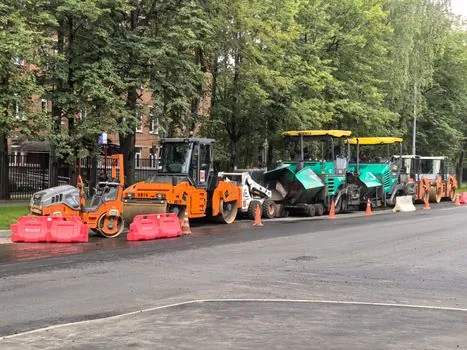
Three machine classes cover essentially all on-farm asphalt work; here is a criteria-based comparison a procurement engineer can act on [S1][S2]:
Compact wheel-type paver (4.5-9 m width, 100-300 t/h): laydown rate 100-300 t/h, paving width 4.5-9 m, weight 13-19 t, road-transit speed 30-40 km/h, best for feedlot lanes, grain-bin aprons, greenhouse access roads, multiple-site daily moves; weak on steep silage-pad ramps above 8% grade. Mini-tracked paver (2.5-4.5 m width, 25-100 t/h): laydown 25-100 t/h, paving width 2.5-4.5 m, weight 6-12 t, road-transit 4-6 km/h on a low-boy trailer, best for tight greenhouse passages, narrow scrape alleys between free-stall barns, small dairy yard patches; limited throughput for any job over 1,000 m2/day. Heavy tracked paver (8-14 m width, 400-900 t/h): laydown 400-900 t/h, paving width 8-14 m, weight 19-28 t, road-transit 4-6 km/h, best for large silage-pad builds above 5,000 m2 and major cooperative-scale dairy-yard slabs; over-spec for everything smaller and burns 18-22 L/h of diesel at idle. For a 2,000-5,000 m2 silage pad at 75 mm thickness, a 100-300 t/h compact wheel machine is the lowest-total-cost choice because the heavier tracked unit's 19-28 t footprint also demands thicker sub-base prep to avoid subgrade pumping [S1][S2].
Real Use Cases: Feedlot, Silage Pad, Greenhouse Access
Feedlot lane (3.5 m wide, 60 mm thick, 800 m long, total 168 m3 of mix): at 100 t/h laydown and 2.3 t/m3 mix density, a compact wheel paver clears this in roughly 3.7 paving hours plus 1.5 hours of setup and screed-warmup, a single-shift job; choose a wheel machine because the contractor will likely move to a second farm site the same week [S1][S2].
Silage pad (40 m x 60 m, 100 mm thick, 240 m3, total 552 t of mix): at 200 t/h, this is a 2.7-hour paving run, but the work shifts to a heavy tracked paver if the pad is on a soft clay subgrade where a 13-19 t wheel machine would rut, or to a compact tracked if the pad is on a stabilised granular subgrade; a tamping-bar screed is preferred for the high-fines silage-pad mix that resists vibration-only compaction. Greenhouse access road (4 m wide, 50 mm thick, 300 m long, 60 m3, 138 t): a mini-tracked 25-100 t/h class machine on a lowboy trailer handles this efficiently, and the contractor can roll a second site the same day at low mobilisation cost [S1][S2].
Limitations, Failure Modes, and What Paver Choice Cannot Fix
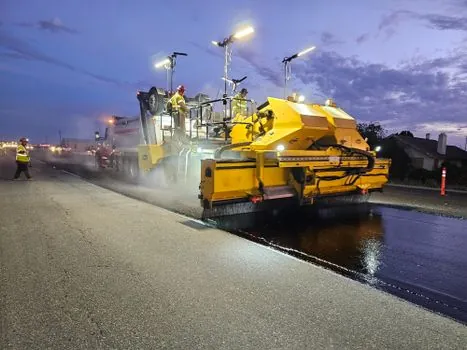
Asphalt paver selection cannot rescue a bad subgrade: silage-pad failures on farm almost always trace to organic subsoil (old manure stack, buried hay) decomposing under the mat, not to the paver's screed or screed-extension choice, and a heavier tracked machine on a weak organic subgrade will simply pump more aggressively than a lighter wheel unit. [S1]
Asphalt paver selection cannot fix a wrong mix: feedlot and silage-pad mixes typically need 5-7% binder (vs 4.5-5% on highways) and a 9.5-12.5 mm nominal aggregate to resist manure-scraper scratching, and the screed's pre-compaction is the same regardless of binder content. Operator skill dominates mat quality: a 100 t/h compact wheel paver run by a trained screed operator routinely hits 94-96% Marshall density before rolling, while the same machine in untrained hands drops to 88-91%, regardless of automation, so budget for 40-80 hours of supervised first-job time. Automation caveat: 3D stringless paving depends on GNSS or total-station accuracy of ±5-10 mm, and on a silage pad with overhead power lines or dense tree windbreaks, GNSS multipath forces a fallback to sonic-ski 2D control, which is what an entry-level industrial valve loop is to a precision proportional valve: it works, but you give up the tight tolerance [S1][S2][S4].
Sourcing, Standards, and Aftermarket Coverage
Chinese export catalogues in 2026 carry the broadest low-end selection, with wheel-type pavers in the 4.5-9 m class, mini-tracked units at 2.5-4.5 m, and full BOM documentation for export markets; the mainstream product mix on these platforms is dominated by compact wheel and mini-tracked machines that fit the agricultural job envelope directly [S1].
Western OEM rental fleets in 2026 carry current-stock tracked and wheel pavers in the 4.5-9 m paving-width class with vibratory screeds, available on daily, weekly and monthly rental terms across North American dealer networks, and Bomag, Vögele and Caterpillar continue to release new paver and screed models (the BOMAG CR 820 T-2 paver with Versa 16 screed was launched at CONEXPO-CON/AGG 2026) for the highway and heavy-infrastructure side of the market [S2][S4]. Aftermarket and spare-parts coverage is broad for the major brands, with suppliers stocking air filters, augers, bearings, charging pumps, connecting rods, conveyor chains, engine parts, floor plates, hydraulic filters, paver wear parts, radiators and undercarriage parts for Komatsu, Caterpillar, John Deere, Volvo, Liebherr, Atlas, Demag, Ingersoll-Rand, Sany, Zoomlion, XCMG, JCB, Shantui and Changlin machines, which materially lowers 10-year total cost of ownership on Chinese-made pavers [S3]. Quality verification checklist for any new paver purchase: confirm Tier 4 Final or EU Stage V emissions certification with serial-number documentation, verify screed plate material is wear-resistant 400-500 HB steel, confirm hydraulic system runs at 21-35 MPa with 5-micron filtration, and require the OEM to provide a CAN-bus interface document for the grade-control system so a third-party flow meter or mat-temperature sensor can be integrated without voiding warranty [S1][S2][S3][S4].
For equipment pairing on related feeding and processing lines, the spec logic for vibrating conveyors in air-cargo terminals shares the same throughput-versus-footprint trade-off pattern that drives compact wheel vs mini-tracked paver choice on a farm site.