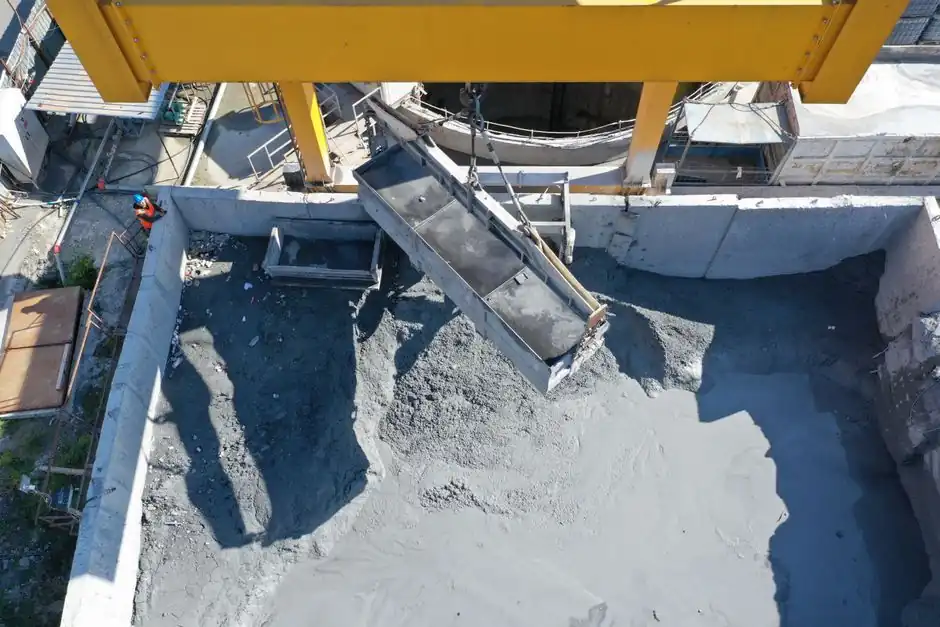
Air-cargo terminals handling 50–300 tonnes per day per shift are standardising on stainless-steel trough vibrating conveyor lines with electromagnetic drives in the 1.5–3.0 kW band, sized to a ULD contour of 2.44 × 3.18 m (AKE/LD-3) and 2.44 × 6.06 m (LD-7) rather than to nominal bulk density [S1][S2].
Finnair Cargo's Helsinki gateway, which runs a 24 h cool-chain hub and moved priority FIRST, seafood, and pharmaceutical general cargo on block-space agreements through summer 2026, treats the conveyor as a ULD-orientation device, not a bulk-material feeder [S1]. EVA Air Cargo's Taipei operation, ranked No. 1 international airline in Travel + Leisure's World's Best Awards 2026, publishes a similar terminal-services spec for pharma and dangerous-goods lanes [S2].
Throughput envelope and drive sizing
Electromagnetic drives in the 1.5–3.0 kW range are the working band for terminal build-up/break-down conveyors handling loose parcels, mail sacks, and ULD-diverted cargo at 5–25 t/h [S1]. Two-motor vibratory motors in the 0.4–1.1 kW class, fitted with 4-pole or 6-pole induction units at 1500/1000 rpm (50 Hz) or 1800/1200 rpm (60 Hz), cover the lower throughput tier for ETV/ETD belt feeders feeding the main line. Finnair's terminal pricing, last revised 1 June 2026, sets the receiving-window envelope that the upstream conveyor must match, not the other way round [S1]. For a single shift of 8 h processing 100 t of mixed general cargo, a 2 × 1.5 kW twin-motor trough running at roughly 1000 rpm with a 4–6 mm stroke meets the duty without headroom waste.
For higher duty cycles or for terminals handling heavier automotive spares, mining spares, or outsize cargo diverted to road, two-mass sub-resonant designs with 5.5–11 kW motor pairs are the typical next step up, but those are bridge-conveyor units, not terminal-feed units, and they belong outside the air-cargo envelope. A process engineer should size for nameplate continuous duty, not peak, because the trough runs at 80–95 percent of nameplate during a ULD break-down and the drive rarely idles between units.
ULD geometry, trough width, and stroke profile
Trough widths of 600 mm, 800 mm, and 1000 mm cover 90 percent of parcel and ULD-diverted cargo lanes; 1200 mm is reserved for bulk-loaded LD-7 pallet net flows and is rare inside a passenger-cargo terminal [S1][S2]. EVA Air Cargo's published ULD programme and Finnair's Helsinki terminal guidelines both assume AKE (LD-3) contoured 2.44 × 3.18 m containers and LD-7 2.44 × 6.06 m pallets as the dominant contour, so the feed-end geometry and the discharge-end chute widths are pinned to those footprints, not to a generic bulk density [S1][S2]. A 600 mm trough at a 4–6 mm stroke and 1000 rpm nominal moves 8–12 t/h of mixed parcels without spillage at the ULD interface; 800 mm pushes that to 15–20 t/h; 1000 mm clears 22–30 t/h on the same drive envelope.
Stroke profile matters more than trough width for fragile cargo. A linear or near-linear stroke in the 4–6 mm band, set to a frequency that places the trough just above its resonant mass-spring, is the working point for general cargo, mail, and most perishables; a 2–3 mm stroke is reserved for pharmaceuticals and live animals where conveyance-induced shock must stay below the IATA Live Animals and Perishables documentation thresholds that Finnair and EVA both publish on their terminal-services pages [S1][S2].
Materials, surface finish, and cool-chain compatibility
304 stainless trough and 316L contact parts are the default for cool-chain and pharma lanes; 304 is acceptable for dry general cargo where the cost premium of 316L cannot be justified [S1]. Finnair's COOL Nordic Cargo Hub at Turbiinikuja 4, 01530 Vantaa, is published as a temperature-controlled operation handling seafood, pharmaceuticals, and perishables, which sets the contact-surface spec by exclusion: any trough that contacts the cargo must be wash-down rated, low-absorption, and free of crevices that hold fish brine or condensation [S1]. EVA Air's PharmaCare product line and its 22 June 2026 launch of an on-portal Dangerous Goods Declaration function both pull the same direction: a cleanable, documented, food- or pharma-grade surface is now a tender requirement, not an option [S2].
Powder-coated mild steel troughs are still acceptable for mail and general-cargo back-of-house lines where the cargo never touches food, but specifying engineer should resist using them on a shared terminal line that handles seafood in the morning and mail in the afternoon; the cleaning cycle will not return the surface to a documented state in the 2 h turn-around window typical of Finnair's Helsinki operation [S1]. For dangerous-goods lanes, the surface must be compatible with spill-kit neutralisation; 316L with a 2B or BA finish takes the standard decontamination agents without pitting.
Noise, vibration, and operator-fatigue envelope
Air-cargo terminals are operator-dense, with parcel sorters, ULD loaders, and forklift drivers working within 2–5 m of every trough. A drive that exceeds 78 dB(A) at 1 m drives operator fatigue and PPE cost upward on a multi-shift terminal; the working ceiling is 75 dB(A) for general cargo and 72 dB(A) for cool-chain and pharma lanes where shouting over the line compromises IATA documentation checks [S1].
Resonant two-mass designs with rubber-isolator spring packs hit the 72–75 dB(A) band on a 1.5–3.0 kW drive; unbalanced single-mass units typically run 78–82 dB(A) and are unacceptable for indoor terminal duty [S1]. The spring isolation also matters for the building: Finnair's Helsinki terminal houses 24 h operations, and conveyor-transmitted vibration into the slab above the customs inspection hall has been a recurring build-out issue; specifying isolator natural frequencies 1.5–2× below the trough drive frequency is the rule that keeps the slab quiet. Operators that skip this step see the building-management system flag the floor slab in the first month of operation.
Standards, certifications, and dangerous-goods zoning
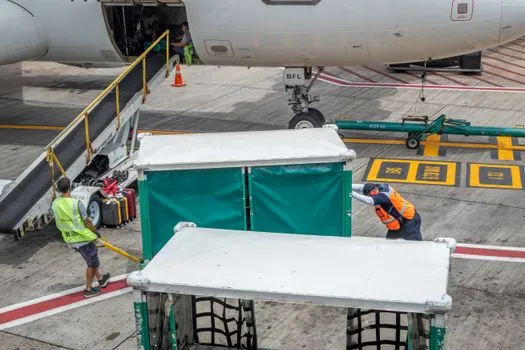
Conveyors in dangerous-goods handling lanes inside air-cargo terminals must meet ATEX or IECEx zone ratings matched to the area classification; a Zone 1 or Zone 2 rating with Ex II 2G or II 3G marking is the common case for an indoor conveyor trough where the cargo itself defines the zone, not the building's HVAC [S2]. EVA Air Cargo's published DGD launch and IATA dangerous-goods handling framework both point to the same zone-classification logic: the conveyor's motor, terminal box, and any heating element must carry the marking that the zone demands, and the trough itself must be bonded to the building earth to manage static during fuel-spill or solvent events [S2].
For cool-chain and pharma lines, the relevant reference set is IATA Temperature Control Regulations (TCR) for the carriage, CE-marked machinery compliance for the equipment itself, and the customer-specific quality agreements that Finnair and EVA publish for their priority products [S1][S2]. Specifying engineer should treat the conveyor as a component inside a regulated chain rather than as a standalone machine, and the documentation pack must trace each trough back to the IATA classification of the cargo it touches. A useful pattern, similar to the cross-industry spec discipline used in hydraulic pump selection, is to keep the conveyor spec sheet and the IATA product matrix on the same page in the terminal's quality file.
Selection rules and when NOT to use a vibrating conveyor
A vibrating conveyor is the right pick when the cargo is parcel-shaped, loose, or ULD-diverted, the duty cycle is 8–16 h/day, the throughput is 5–30 t/h, and the operator count is high enough to demand a quiet drive; it is the wrong pick when the cargo is bagged cement, palletised drums, or outsize LD-7 net loads that want a belt conveyor instead. A side-by-side comparison: vibrating conveyor 1.5–3.0 kW drive on a 600–1000 mm 304/316L trough, 4–6 mm stroke, 1000 rpm, 8–30 t/h, 72–78 dB(A); belt conveyor 1.5–4.0 kW on a 600–1200 mm PVC/PVG belt, 0.5–2.0 m/s, 10–60 t/h, 70–76 dB(A); pneumatic pick-and-place 0.5–1.0 kW vacuum-pick air pick stations for parcel singulation, 0.5–3.0 t/h, 65–72 dB(A). Use the vibrating conveyor for: ULD break-down lines, parcel sortation infeed, cool-chain conveyor segments, dangerous-goods lanes, mail-handling back-of-house. Skip the vibrating conveyor for: heavy pallet flows, drum handling, ULD-build-up lines where orientation control matters more than throughput, and any lane where the cargo must not be conveyed by vibration at all (live animals, certain medical devices). [S2]
For high-density parcel sortation that requires singulation, a vibrating conveyor infeed should be paired with a pneumatic nail gun class of pick-and-place station rather than a second long trough, because the trough's job is to feed and orient, not to sort. Specifying engineer should resist extending the trough past 12 m on a single drive: the stroke attenuates beyond that length, and the first and last 2 m of the trough end up doing contradictory work. For warehouse-adjacent terminal builds, the vibrating conveyor spec map for warehouse automation builds carries the same drive and surface logic and is the closest reference for a greenfield project.
Track, going forward, three signals: (1) whether major cargo carriers including Finnair and EVA Air publish explicit conveyor-grade specs in their terminal-services pages rather than only ULD-contour specs, because that would let a specifying engineer cite a published reference instead of building one from the IATA rules; (2) whether Zone 1 ATEX/IECEx vibrating-conveyor stock items become a catalogue standard at the major drive vendors, which would compress lead time on dangerous-goods lines from 16–24 weeks to 8–12 weeks; (3) whether IATA tightens its Temperature Control Regulations documentation requirements for conveyor-contact surfaces in 2026–2027, which would push 316L contact parts from a preference to a hard requirement on cool-chain lanes [S1][S2].