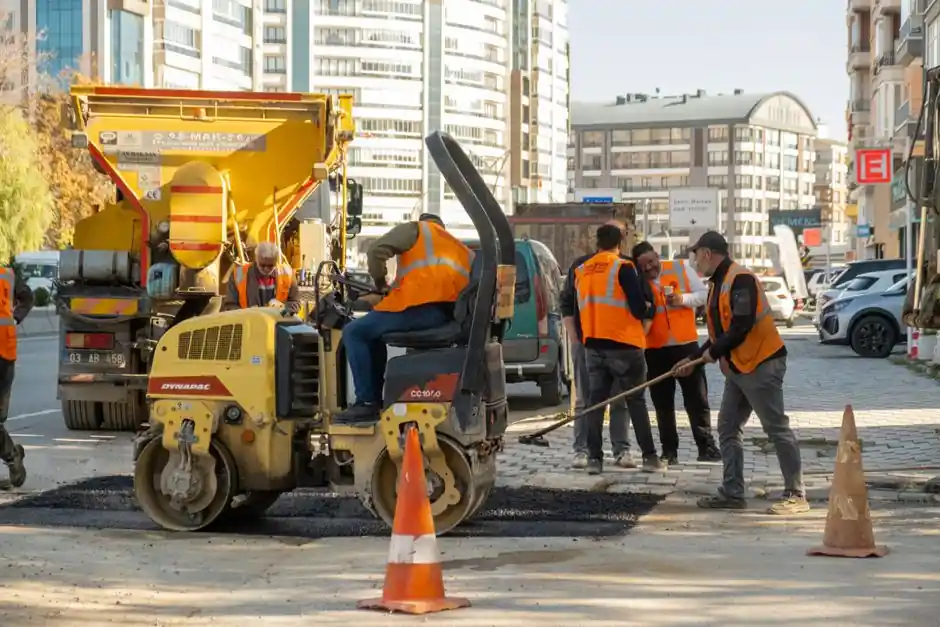
Wheel asphalt pavers in the 4.5–9.0 m pave-width band and 8–14 t hopper capacity are the typical specification for pipeline right-of-way and access-road reinstatement, with tracked units held back for soft subgrade or conveyor-fed high-output spreads [S2][S4].
The dominant sizing drivers are mat width, ground-bearing pressure on the trench backfill, and the need to relocate the paver between discrete tie-in stations without a low-boy every move. Caterpillar's tracked and wheel asphalt paver lines documented on 2026-07 listings span the small-wheel AP300 class through large tracked AP-series machines used on highway and airport runway paving [S2], and that same envelope is the one pipeline paving planners work from.
Where the paver sits in a pipeline spread
Pipeline construction is a linear, multi-station activity: ditch, lower-in, backfill, hydrostatic test, then reinstate the right-of-way surface. Paving is therefore a discontinuous, mobile operation, not a continuous highway-paving train [S3]. Wheel pavers with 4.5–9.0 m pave width and 8–14 t hopper suit this duty because they self-propel between bell holes at 8–16 km/h road speed without a heavy transport permit, and they accept haul trucks directly from the front or via a flow meter-controlled transfer hopper for binder-rich mixes used at valve stations.
Tracked pavers of the heavier AP-series class are reserved for two cases: very soft, recently re-compacted subgrade where wheel rutting would telegraph through the mat, and continuous high-output paving at compressor or pump stations where a dedicated shuttle buggy feeds the asphalt paver hopper from end-dumps running a steady cycle [S2]. Outside those two cases, tracked units over-spec the job and add 8–12 t of transport weight per move.
Selection criteria tied to the pipeline work face
Four criteria govern spec, and the data points behind each are concrete. (1) Pave width: most right-of-way reinstatement lanes sit in the 2.4–4.2 m range, but permanent access roads to pipeline pump stations and mainline valve assemblies are normally 6.0–7.5 m wide, so a paver must be able to extend its screed to at least 7.5 m without bolt-on extensions to avoid cold-jointed mats. (2) Hopper capacity: an 8–14 t hopper cycles cleanly with 20–25 t end-dumps at the 90–120 t/h placement rates common on small wheel pavers, while tracked AP-series machines running 300+ t/h need 14–18 t hoppers and a feed conveyor [S2][S4]. (3) Ground bearing pressure: wheel pavers exert roughly 30–50 kPa on the contact patch through pneumatic tyres, well above most compacted subgrade limits, so a tracked machine at 15–25 kPa is the safer call on freshly re-compacted trench backfill. (4) Auger and screed heating: electric screed heaters reach 160–180 °C in 20–30 min, which matters when the paver is cold-started at a remote tie-in and the haul distance is long.
For pipeline spreads that include bridge or river-crossing sections, pavement thickness is typically specified 15% thicker than baseline per the methodology described in orthotropic-steel-deck bridge deck work, a 15% bump that interacts directly with the paver's layer-lift capability and the number of compaction passes [S3].
Wheel vs tracked, side by side
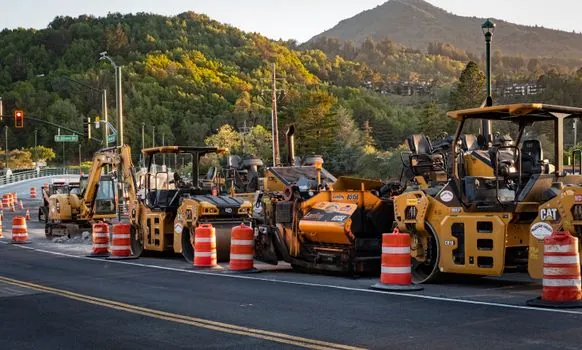
Wheel and tracked pavers are not interchangeable on a pipeline job, and the trade-off is sharp. Wheel pavers win on mobility (8–16 km/h self-propelled roading, no low-boy between most stations), on lower acquisition and freight cost (typically 30–40% lighter than a comparable tracked unit), and on simpler daily maintenance; they lose on soft-subgrade rutting, on maximum pave width above 9 m without bolt-on extensions, and on sustained high tonnage because tyre thermal limits cap continuous placement near 120 t/h on most small-wheel machines [S2]. Tracked pavers win on ground-bearing pressure (15–25 kPa typical), on pave width (most tracked AP-class units lay 2.5–9.0 m hydraulically extending), and on steady-state mat quality under a shuttle-buggy feed; they lose on inter-station moves (each relocation is a low-boy job, roughly 2–4 h of permit, load, secure, and unload per shift), on first-cost, and on the logistics of staging them at remote valve assemblies where a pressure transmitter skid and a flow meter manifold already crowd the work pad.
Matching the paver to the haul truck and the mat
The paver's receiving hopper, the end-dump cycle, and the screed extension all have to be matched, or the mat suffers. Standard 20–25 t end-dumps empty in 60–90 s into an 8–14 t paver hopper when the paver is pushing the truck; with a windrow elevator or a shuttle buggy in front of the paver, the same trucks feed a 14–18 t hopper on a tracked unit at 300+ t/h without surge [S2]. Mix temperature window matters: polymer-modified binder used at valve-station hardstands is typically placed at 150–165 °C, so the paver's screed plate must hold 160–180 °C under laydown, and the remixing auger must run at 30–60 rpm to avoid segregation in the 25–40 mm nominal aggregate common on pipeline access roads.
Layer lift thickness ties back to pipeline-cover depth: where the pipe is shallow and the right-of-way is being restored to a farm-grade surface, a single 50–80 mm lift from a wheel paver is enough; where the access road to a pump station is being built up to a finished profile, two 60–100 mm lifts from a tracked paver with a vibratory screed are normal, and the 15% over-thickness rule for bridge deck crossings published in 2021 remains the working figure for steel-deck sections [S3].
Standards, certifications, and crew competence
Paving work on federally aided US projects typically requires an NCDOT-certified or equivalent state-DOT paving crew and an asphalt plant conforming to state DOT mix-design specs, and small pipeline general contractors frequently list the relevant state SBE and HUBZone certifications alongside the work [S1]. For measurement control on large pipeline and hydro-plant jobs, the Chinese standard DL/T 5173 (English edition) sets the content and accuracy class for construction surveying on medium and large hydropower and water-conservancy projects, which is the closest direct cross-reference for long linear pipeline spreads in similar terrain [S5]. Screed performance, mat density, and longitudinal joint density are typically verified against the project-specific mix-design spec rather than a single paver standard, with 92–96% of theoretical maximum density as the usual target for pipeline access-road binder and base courses.
Limits and failure modes to plan around
Three failure modes dominate. (1) Segregation in the auger chamber when a wheel paver is fed by a single end-dump without a material transfer vehicle, the most common defect on small pipeline reinstatement jobs and the cause of most raveled edges within the first winter. (2) Cold joints from stopping the paver at a tie-in without a heated longitudinal joint cut, which the Wirtgen SP 33-class pavers launched in the 2026-07 press cycle specifically address with extended screed heating and joint-matching shoe geometry [S4]. (3) Rutting of the freshly re-compacted trench cap under a wheel paver loaded with 14 t of mix, which is why the tracked-vs-wheel decision must be made off the subgrade CBR, not off the pave-width spec alone. On the equipment-supply side, used Caterpillar asphalt pavers tracked on 2026-07 listings include both small-wheel and tracked AP-series units, so a pipeline contractor can usually match a paver to the 4.5–9.0 m width band and 8–14 t hopper envelope without a factory order [S2].
For a detailed width-band and track-vs-wheel breakdown specific to haul-road and high-tonnage paving, see Asphalt Paver Selection for Mining Haul Roads, which extends the same width-band logic into a heavier tonnage envelope. Where the pipeline spread also includes valve-station and pressure sensor skid foundations, concrete work usually pairs with a paver choice, and the steel section gauge for those pads is covered in Steel section selection for residential construction for the light-duty case.