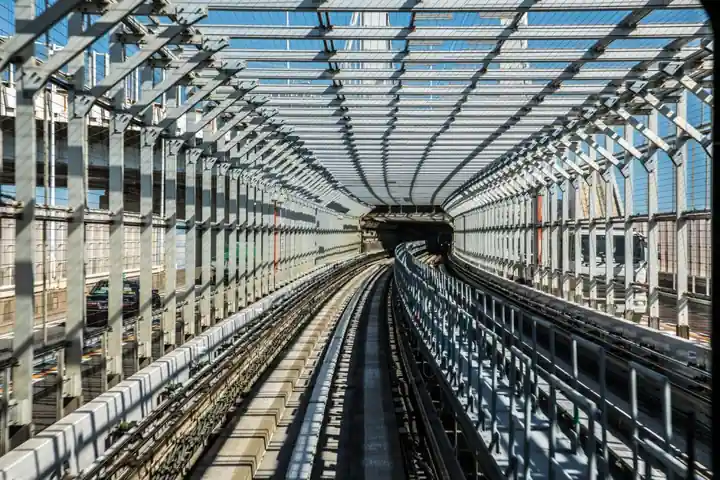
Automatic levels paired with TBM auto-targeting total stations and machine-learning water-inflow models are reshaping tunnel grade control in 2026, with the TBM market valued at 7.50 billion USD in 2024 and projected to reach 12.41 billion USD by 2032 at a 6.5% CAGR [S4].
Traffic tunnels represent 79% of TBM applications in a global 270-record database analysis, with Europe accounting for 45% of records and medium-diameter 6–10 m machines dominating the fleet [S4]. TBM diameters span under 1 m for utility microtunnels to over 17 m for highway mega-shields, a spread that dictates the levelling instrument's working range, robustness and mounting scheme [S4].
Why a Conventional Automatic Level Still Matters in TBM Drives
Total stations mounted on the shield backup trailer auto-resect by sighting two or more known prisms fixed to the segment lining, then feed deviation data back to the guidance system, a workflow that depends on a co-mounted automatic level for vertical reference transfer between ring set-outs [S3]. Grout density below that of surrounding soil exerts a persistent upward buoyant force on the segment, so segment uplift frequently exceeds code-permissible limits in complex strata, and the automatic level becomes the instrument that catches the vertical drift ring by ring [S3]. In grout-rich and water-bearing ground, the level's compensator range and damping determine whether vertical readings survive the cure window of synchronous grout injection [S3]. An automatic level built around a magnetically damped compensator with 0.5 arc-second setting accuracy resolves sub-millimetre height transfer across a 200 m TBM back-up, the geometry that matters on a 6 m diameter metro drive [S2].
For drill-and-blast (NATM) headings, a self-leveling instrument with a 30x telescope and IP66 housing survives the wash-down cycle between mucking shifts, and 1.5–3.0 km working range to a single prism covers a typical 2 km pilot heading without re-occupation [S2]. The instrument's role is not glamorous, but it is the redundant vertical check that keeps laser-guided jumbos honest in fractured rock.
Core Specs: Compensator, Range, Sealing, Power
Compensator accuracy is the single number that separates survey-grade automatic levels from contractor-grade units: look for 0.3–0.5 arc-second setting accuracy and a working range of at least ±15 arc-minutes so the instrument self-levels on a TBM gantry that flexes 50 mm under segment load [S2]. Working range to a single glass prism should reach 1.5–3.0 km, which covers a typical metro tunnel drive between shafts and removes one re-setup per shift [S2]. IP66 sealing against dust and powerful water jets is mandatory in NATM headings where muck trucks pass within a metre of the instrument and wash-down is daily [S2].
Power budget matters underground: alkaline battery life of 60–100 hours, or rechargeable NiMH delivering 40+ hours, keeps a unit running a full 12-day excavation cycle between surface charges, a small detail that prevents a missed shot on day 11 [S2]. An infrared level shares the compensator physics but adds a non-visible beam that reads cleanly in dim heading conditions where the human eye loses contrast on a thin crosshair, useful for steering checks between laser-jumbo set-ups.
TBM Segment Alignment: The Level as Vertical Backbone
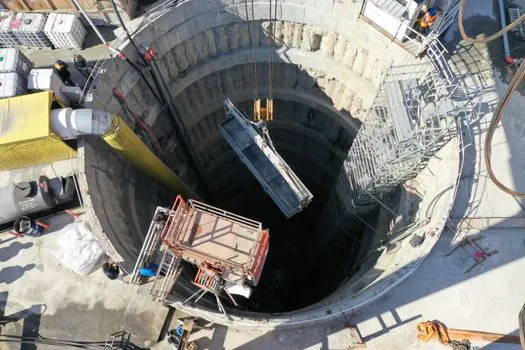
Segment uplift under combined grout and groundwater pressure is a controlling serviceability limit, and the automatic level is the reference against which total-station-derived settlement is differenced, a chain that only works if the level's collimation error stays below 0.5 mm over 100 m [S3]. The instrument should be mounted on a shock-isolated plate fixed to the trailing gear, never to the segment stack directly, because the static weight of stacked rings biases the reading by 1–2 mm over a 12-hour shift [S3].
For a 6 m diameter TBM, the working profile is a 5.4 m ID clear opening after segment thickness; the level's minimum focus distance of 0.5 m lets the operator read a staff held against the crown without leaning into the cutterhead shadow [S2]. Surveyors typically re-occupy the heading every 50 m, so the level's compensator must hold calibration across thermal swings of 5–10 K that occur when a fresh air blast hits the instrument after a blast cycle [S2]. A laser level with self-levelling to ±5 arc-seconds and a 635 nm red diode delivers a continuous reference plane that the segment erector can use to crown-set the next ring without waiting for the surveyor to walk forward.
NATM and Cross-Passage Work: Where the Level Earns Its Keep
In drill-and-blast headings, the automatic level is the primary grade control during the top-heading bench, with profile tolerance typically ±50 mm on the invert and ±30 mm on the crown, numbers the level's 0.5 arc-second compensator easily resolves over a 30 m sight [S2]. A sudden water-inflow event is one of the most common and hazardous geological problems during tunnel excavation, capable of causing serious casualties and economic losses, and water-inflow accidents are now being predicted with two-stage ensemble learning models that fuse GPR, LSTM, DNN, KNN and SVR for higher generalisation on multi-source hydrogeological inputs [S1].
Cross-passages between twin tubes are the classic weak link for vertical control, because the survey must transfer through a short, congested window often under 2 m wide, and the level's short focus and quick-settle compensator handle the geometry faster than a robotic total station in that confined space [S2]. For utility-sized microtunnels under 1 m diameter, a compact automatic level with 28x magnification and 0.7 kg mass rides on the pipe-jacking laser frame and serves as the redundant check on the steering laser's pitch reading.
Selection Comparison: Automatic Level vs. Total Station vs. Laser Level
On vertical-transfer accuracy, an automatic level with a 0.5 arc-second compensator delivers roughly ±1.0 mm at 100 m, beating a rotary laser level detector setup at ±2.0 mm and matching a 1 arc-second total station at the same distance, but at a fraction of the operator-skill burden [S2]. On TBM back-up shock tolerance, the level's magnetically damped compensator survives 2–5 g transient events where a total station's liquid compensator drifts and must be re-collimated, giving the automatic level an edge in continuous-shift operations [S2].
For a more direct cross-reference on plumbing-grade vertical work, see Automatic level for plumbing install: 2026 spec map and selection rules, which covers the same compensator physics on a smaller scale. For guidance across broader heavy-equipment selection in infrastructure, the construction machinery and equipment page maps instrument classes to plant duty cycles. Tying it back to the broader tooling chain, an automatic molding line for segment production is a separate spec domain, but it shares the same quality-control logic of closed-loop measurement feeding the next process step.
Who the Tunnel Automatic Level Is For, and Where It Is Not
The instrument is the right tool for metro and rail TBM drives between 4 and 12 m diameter, NATM headings in fractured rock where profile tolerance is ±50 mm, cross-passage vertical transfer, and microtunnel pipe-jacking surveys under 1 m, all of which exploit the level's robustness and short-form operator workflow [S2]. It is not the right primary tool for long subsea highway drives over 15 m diameter where a 1 arc-second motorized total station with auto-targeting prisms is the production instrument, and the level is relegated to a check role [S3].
Buoyant uplift from grout density differential is greatest in water-rich sand strata, and the level's compensator accuracy must be combined with grout-pressure and density logging, because the level alone does not see the early-stage buoyant displacement before it exceeds code limits, and that is where total-station and machine-learning inflow prediction models pick up the rest of the safety margin [S1][S3]. An automatic level specified for tunnel work should never be picked from a general contractor's surveying kit without checking the IP rating, the minimum focus distance and the power budget against the heading conditions on the specific drive.
Track the next nodes: peer-reviewed inflow-prediction models for tunnel water management based on GPR and SVR fusion (Engineering Applications of Artificial Intelligence, 2026) and the update cycle for TBM grout mixing and annulus grouting equipment under high-pressure water-rich ground [S1][S4]. Verify on a site acceptance test that the compensator setting accuracy remains inside 0.5 arc-seconds after a 1 g drop test, a check that catches damaged wire-hung compensators before they cost a shift of re-survey.