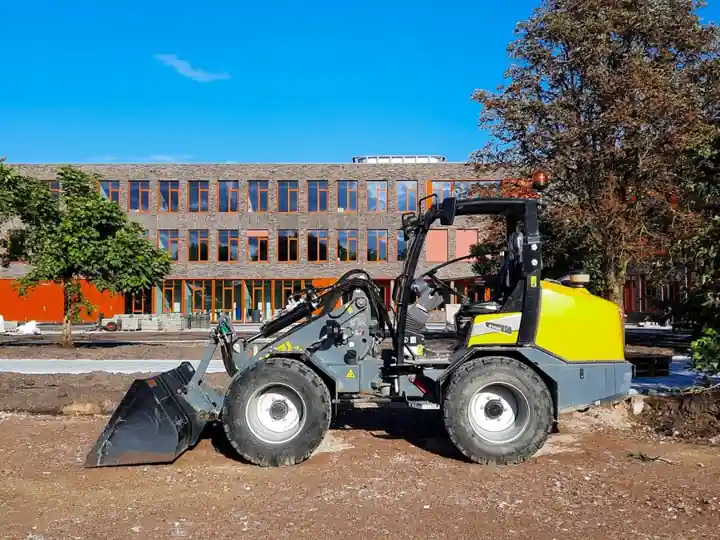
A backhoe loader and an asphalt paver are not competitors, they are sequential machines on most road projects, and the spec ranges confirm it: backhoe loaders typically weigh 9,000-20,000 lb with 50-150 hp, while wheeled asphalt pavers are sized by paving width and laydown rate rather than engine power [S3][S7].
The backhoe loader handles subgrade prep, trenching, utility cuts, and backfilling, and it can drive on public roads between sites at speeds a paver cannot match. The backhoe loader is a tractor-loader-backhoe (TLB) platform with a front loader bucket plus a rear excavator boom, and that dual-end layout is exactly what a small paving crew needs for shoulder work, patch digs, and base material handling before the paver arrives [S1][S6].
Operating Weight, Power, and Mobility Compared
Backhoe loaders cluster in a 9,000-20,000 lb operating weight window, with a 50-150 hp engine and a maximum digging depth of 13-20 ft depending on model [S3]. Wheel loaders span a much wider 9,000-250,000 lb range and 40 hp to over 500 hp, but they are not paving machines either, and the broader point is that both loaders sit in a different class from a track- or wheel-mounted paver, which is selected by throughput and screed width, not by raw engine output [S3].
Mobility is the first hard separator. A backhoe loader drives itself between jobs on the road at typical roading speeds, which matters on rural paving runs and on scattered patch work where trailering a paver would burn hours [S4]. Pavers are slow, tracked or heavy-wheeled specialty machines that almost always arrive on a lowboy, and the same wheel loader class used to feed mix to the paver is too large and too wide to operate as a substitute paver, a point contractors confirm when they spec machines for asphalt feed [S2][S5].
Where a Backhoe Loader Fits on a Paving Job
On a paving project, the backhoe loader earns its place in three roles: subgrade prep, utility trenching, and base handling. The rear boom digs 13-20 ft, enough for storm and utility lines under a typical pavement section, and the front loader bucket backfills, spreads aggregate, and loads trucks, all without a second machine on site [S1][S3].
For shoulder work and small patches, the backhoe often replaces a dedicated excavator because the operator can dig, swing, and load without repositioning, and the front bucket handles grading in the same pass. On a related earthmoving comparison, the wheel loader vs road roller spec match discussion lays out the same logic: each machine owns one phase of the work and should not be forced into another.
Where an Asphalt Paver Owns the Job
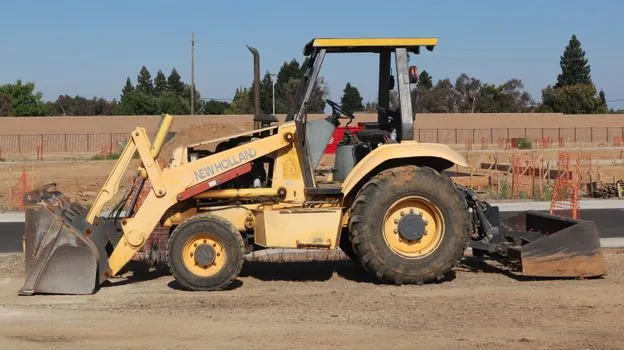
An asphalt paver's job is placing and pre-compacting hot-mix asphalt to a target mat thickness and cross-slope, and nothing else. Paver output is rated in tons per hour and paving width in feet, not in engine horsepower, and the operator role is distinct: the asphalt loader operator feeds mix from the haul truck into the paver hopper, while the asphalt paver operator controls the screed and steering [S7].
A backhoe cannot lay a quality mat. Its front bucket is a digging/loading tool with no screed, no tamping or vibratory pre-compaction, and no automatic grade control, so even at 150 hp the backhoe's hydraulic flow and bucket geometry are wrong for placing a 1.5-3 in. lift at 200+ tons/hr. The two machines are not interchangeable, they are sequenced: backhoe digs and preps, then paver lays, and the right tool for the feed hoppers in between is a wheel loader, not the backhoe itself [S2][S7].
Decision Matrix: Backhoe vs Paver by Job Phase
Across four criteria, the backhoe and paver separate cleanly. The backhoe wins on digging depth (13-20 ft) and self-transport (drives on the road), the paver wins on mat quality (screed + pre-compaction) and throughput (tons/hr at target lift), and on mobility and ground pressure the two are roughly inverted: wheeled backhoes handle firm subgrade, while pavers ride on tracks or wide balloon tires designed for the fresh mat [S3][S4].
Spec by job phase, not by machine class. For subgrade work, utility trenching, and base handling, a backhoe loader in the 14,000-18,000 lb class with a 14-18 ft dig depth covers the prep. For mat placement at any volume, a wheeled or tracked paver is the only correct answer, and the asphalt paver category page lists the screed-width and hopper-capacity ranges that drive the selection [S3][S4].
Limitations and Common Mismatches
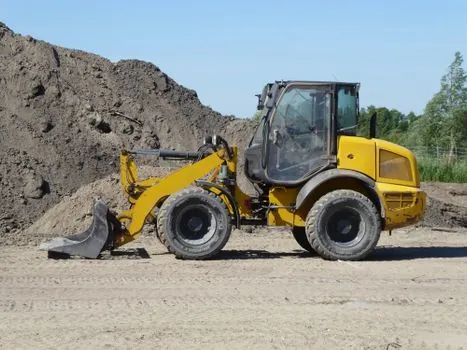
The most common spec mistake is treating a backhoe as a paver or as a long-haul loader. Backhoes consume more fuel than mini excavators and dedicated loaders because they run larger engines to power dual hydraulic systems, so on jobs where the paver is the bottleneck, putting a backhoe on the feed chain wastes fuel and adds a second operator [S2][S5].
Conversely, mini excavators have largely taken over residential digging because they swing 360 degrees and work in tighter spaces than a backhoe, so on dense urban paving the backhoe's rear-arc limitation is a real constraint, not a marketing footnote [S4][S5]. For long rural driveways and scattered patch work, the backhoe's self-transport and two-tool layout still beat a mini ex plus a separate loader on mobilization cost alone, which is why the TLB persists in rural road work despite the excavator's rise elsewhere [S4][S6].
Track a concrete batching plant selection for forestry roads and an updated excavator-vs-backhoe spec sheet from a major rental fleet, since both move in the same direction as the asphalt side of the market: specialization is winning over the do-everything machine. The next signal to watch is whether mid-size paver manufacturers publish a 2026 model with integrated grade control, because that would push the prep-machine question even further toward the backhoe or mini ex.