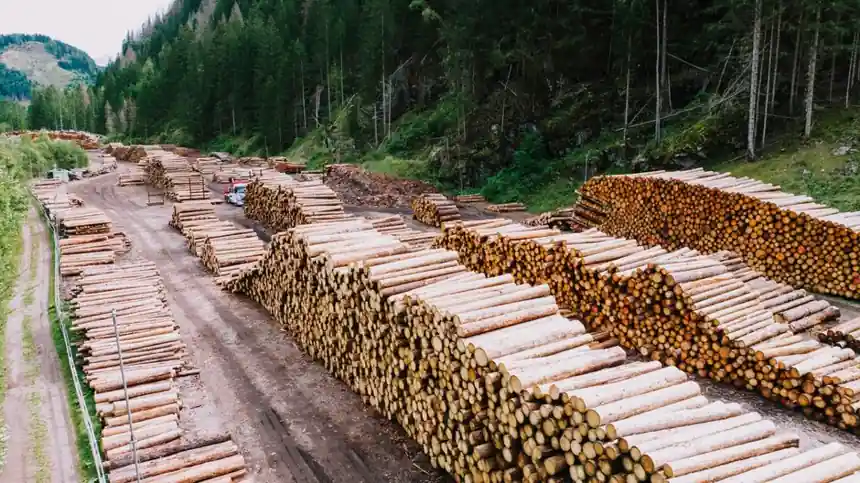
Forestry concrete work is split between two very different demand profiles: low-volume, scattered pours on haul-road bridges, culverts, and landing-pad slabs, and steady, higher-volume supply for permanent sawmill or log-yard foundations. Mobile wet-mix plants in the 20-80 m³/h output band suit the first; stationary 80-200 m³/h units suit the second [S1].
For remote sites beyond 100 km from a ready-mix source, a dry-mix or mobile wet-mix setup is the only way to keep cement quality and water-cement ratio under control without a transit mixer fleet [S1][S2].
Match Output Class to Annual Forestry Pour Volume
Mobile plants typically deliver 20-80 m³/h and can be erected in 1-3 days, which lines up with forestry culvert pours, small bridge decks, and equipment-shed slabs that rarely exceed 30-50 m³/day [S1]. A common industry rule of thumb is that self-production starts to pay once a contractor pours more than 2,000 cubic yards (about 1,530 m³) on a project, and that threshold is often hit within a single multi-structure forestry road contract [S2].
Stationary plants running 80-200 m³/h are specified where a permanent log yard, kiln foundation, or treatment-plant slab keeps the mixer fed for years; they require fixed foundations, larger aggregate bins, and at least one sealed cement silo of 50-100 t capacity to ride out supply gaps [S1][S3]. The trade-off is real: a 100 m³/h stationary plant idled below roughly 40% utilisation burns cash faster than buying ready-mix, so forestry operators with seasonal work should benchmark annual pour volume before committing [S2].
Wet-Mix vs Dry-Mix for Remote Haul-Road Sites
Wet-mix plants add all water and admixtures at the plant, which is why transit time is normally capped at 30 km from the pour to keep slump loss manageable [S1]. On a forestry spur that distance is often impractical, so the dry-mix configuration, where water is dosed at the chute into the truck or into the paver, becomes the default for sites beyond the 100 km mark [S1].
Dry-mix hardware is also lighter per m³ of output, which matters on soft forest subgrade where a fully loaded 30 t cement tanker would rut a haul road. A concrete batching plant specified for forestry should pair the dry-mix drum with a sealed screw conveyor for cement, weather-protected aggregate bins, and vibrators on the bin discharge to stop cold-wet aggregate bridging in shoulder-season work [S1][S3]. For admixture handling, an onboard concrete admixture tank with a calibrated flow meter is now standard on mid-range mobile units, and it gives the operator a way to dose air-entrainer for freeze-thaw durability on exposed bridge decks.
Stockpile Layout, Calibration, and Water-Cement Control on Forest Sites
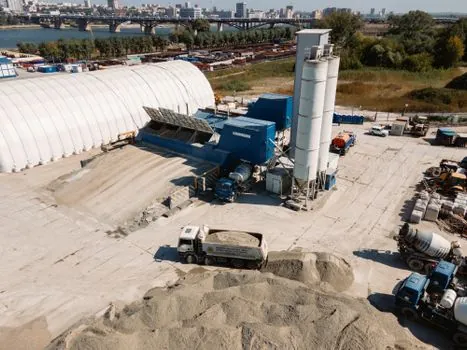
Plant layout drives batch consistency more than brand choice. The Minnesota DOT concrete manual is explicit: the most uniform concrete is produced when the plant is favoured by adequate space for large stockpiles, with timber bulkheads used only when built properly to keep separate gradations from bleeding into one another [S3]. On a cramped landing pad that rule is often broken, and the symptom is aggregate segregation plus a water demand that drifts 5-10 kg/m³ batch to batch.
Two calibration points are non-negotiable on any forestry plant: weigh-hopper scales checked against test masses at install and after every move, and cement weighed independently of aggregates either on a separate scale or in a separate hopper compartment [S3]. The batching gates must close tightly with operating interlocks, and the charging device has to be able to stop material flow inside the specified weighing tolerance, with vibrators on the bin set so they do not distort the scale reading [S3]. Water meters on a concrete tool skid need the same treatment, and a simple plant-side slump cone plus a 1 L cylinder for air content catches most w/c ratio problems before the truck leaves the yard.
Power, Dust, and Noise: Site Constraints That Decide the Build
Forestry sites rarely have three-phase grid power within reach, so engine-driven plants dominate. Mid-size mobile wet-mix units in the 60 m³/h class typically run a 100-150 kWe diesel-gen set, while 100 m³/h stationary plants step up to a 200-300 kWe set or a site substation if mains is available. The fuel line item is roughly 1.5-3.0 kWh per m³ mixed for a modern compulsory mixer, and that is the number a forestry contractor should plug into ROI before signing [S2].
Dust is the second hard constraint. Sealed cement silos fitted with reverse-pulse dust collectors and level sensors keep particulate below the typical 20 mg/m³ benchmark cited for general plant operation, and aggregate handling under a covered conveyor or a wet suppression ring at the discharge is the cheapest way to stay neighbourly with adjacent timber stands and any nearby residential dwellings [S1][S6]. For noise, placing the mixer and gen set behind an earth bund or a sawdust bale wall can cut received noise at 30 m by roughly 6-10 dB, which is usually enough to keep daytime operations inside a 70 dB(A) boundary at the forest edge.
Permitting, Mobility, and Match with Other Forestry Plant

Permitting for a permanent or semi-permanent forestry batching plant commonly covers air emissions, dust, stormwater, and visual screening; a portable dry-mix plant on a construction site is often exempt from the same air permit but still needs a noise and traffic plan [S2]. Site selection should prioritise proximity to aggregate source, a hardstand for truck turning, and a stormwater path that does not discharge sediment-laden runoff into a fish-bearing stream, with at least 30 m of separation from any standing water to keep turbidity controls simple [S6].
For aerial work on log-yard or bridge sites, the boom reach and ground-pressure limits of an aerial work platform feed back into the plant choice: a soft-ground site with low ground-pressure access favours a mobile dry-mix plant, while a hardstand yard can take a stationary wet-mix unit fed by a steady dump truck shuttle. Aggregate storage at the plant also interacts with cantilever forestry storage rack footprints in the yard, since the same traffic lane often serves both, and rutting under loaded trucks becomes the limiting factor on weak subgrade.
Decision Snapshot: Which Plant Fits Which Forestry Job
Match plant type to job pattern, not to headline price. A 25-40 m³/h mobile dry-mix plant is the right call for culvert replacements, small bridge decks, and shed pads where annual pour volume stays below roughly 5,000 m³ and sites change every 1-2 years. A 60-80 m³/h mobile wet-mix plant suits multi-structure haul-road packages with steady 30-50 m³ daily demand within 30 km of the pour. A 100-200 m³/h stationary wet-mix plant is justified only for a permanent sawmill, treatment plant, or log-yard complex running above roughly 40,000 m³/year with on-site aggregate supply and grid or large diesel power [S1][S2].
Track the next decision points on the project, not the catalogue: confirm the local air permit threshold for the chosen county, lock the stockpile layout and drainage plan before the silos are ordered, and pin the calibration schedule (initial install, post-move, and quarterly) into the contractor quality plan [S2][S3][S6].