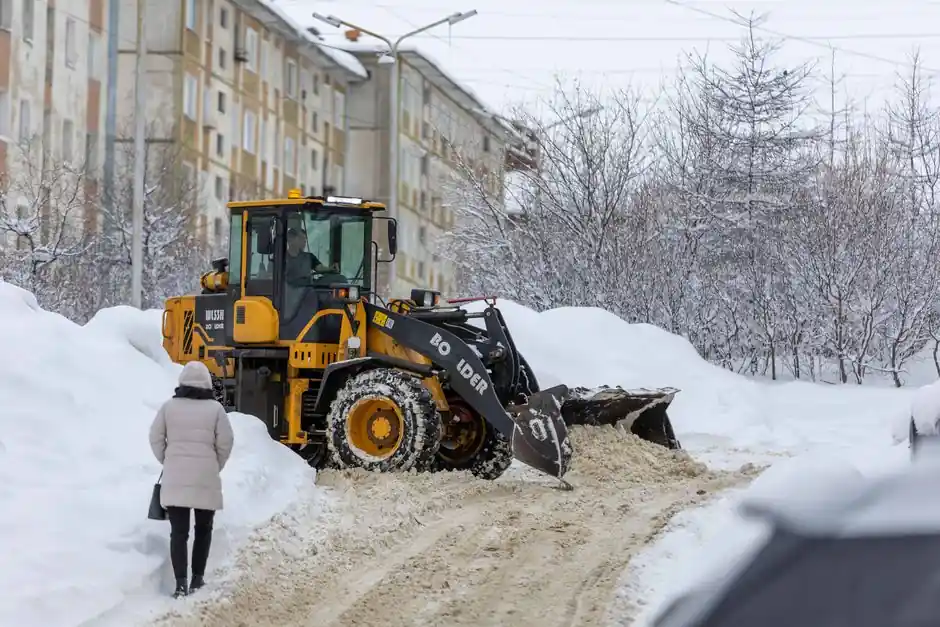
For municipal and contractor snow and ice operations, a 20 ft dry storage container (8 ft x 8 ft x 20 ft, ISO 1496-1) is the field default for parking plows, spreaders, and palletized salt indoors, and 40 ft units are specified only when a yard hosts more than 4 plow rigs or 80+ tons of bagged deicer [S2][S3].
ISO liquid tank containers (T11, T14, T75) are a different tool entirely: 20 ft framed units with roughly 4,000 gallon capacity, used on highways and rail where brine or magnesium chloride solution is hauled in bulk, not parked as a shed [S4]. Selection for snow work means choosing between these two families on volume, weather sealing, and the equipment being stored.
What the equipment actually needs from a container
Plow trucks, snow pushers, and salt spreaders degrade quickly when stored outside: moisture and dust attack the harness connectors on the plow, freeze-thaw seizes the truck-mount pins, and rust pits develop on lift cylinders, all of which hit resale value within one unprotected winter [S3]. The minimum enclosure is a weather-resistant steel box with a lockable door and a floor rated for the rolling load of a truck-mounted plow being dropped off the hitch.
An 8 ft x 20 ft dry storage container is normally large enough to accommodate several plows plus shovels, salt, and plow accessories, with the operator able to drive right up and drop the plow inside the open-side unit [S2][S5]. At 1,360 cu ft, the 20 ft unit parks 2 to 3 pickup-mounted plows or 1 full-size truck plow plus a stacked pallet of bagged treatment.
Salt and calcium chloride bags that claim to be watertight often are not; storing pallets of deicer in a sealed dry container keeps them dry for the next season and avoids a multi-thousand-dollar replacement loss over a few bad months [S3].
Dry storage vs ISO tank: which one for which job
Dry storage containers are built to ISO 1496-1 dimensions for intermodal handling and weather-tight cargo, with corner castings that let cranes and forklifts move them empty, and they are the right answer for equipment that must be kept dry and accessible between storms [S2][S4].
ISO tank containers are built to a different ISO standard for liquid bulk: a stainless-steel cylinder inside an ISO frame, 20 ft long, with a working capacity of roughly 26,000 to 30,000 liters (about 4,000 US gallons), pressure-relief, and stackability two-high on rail well cars [S4]. For a winter maintenance fleet, the use case is hauling brine or pre-mixed liquid deicer from a mixing plant to a brine distributor truck, not parking a plow.
A 4-step field test decides which unit a yard actually needs: (1) if the load is solid equipment and bagged chemical, specify a dry container; (2) if the load is bulk liquid deicer and the volume is below 300 gallons per move, use IBC totes, not an ISO tank; (3) if the load is bulk liquid at roughly 4,000 gallons per move, specify a 20 ft ISO tank with the correct lining for chloride corrosivity [S4]; (4) if the unit is going to sit for months and only be opened between storms, a dry storage unit is cheaper to own and easier to site.
Size, layout, and the 20 ft vs 40 ft call
Standard ISO dry containers come in 20 ft (about 33 cu m) and 40 ft (about 67 cu m) lengths, both 8 ft wide and either 8 ft 6 in (standard) or 9 ft 6 in (high cube) tall, and snow equipment storage almost always lands on the 20 ft because a single truck plow is the longest item to park [S2][S4].
Open-side 20 ft containers are the operator-preferred option where space allows: the user reports being able to drive directly up to the side of the container, drop the plow inside, and keep shovels, salt, and accessories in the same unit [S5]. A 40 ft unit is justified only when the operator has more than 3 rigs or is parking a full-size pusher box plus a salter chassis, or when the unit doubles as covered deicer warehouse space for 80+ tons.
Mobile portable storage containers bring another flexibility point: they can be relocated around the yard or hauled to a climate-controlled facility between seasons, which matters for operators running mixed summer and winter fleets [S3]. Smaller poly storage containers (such as SnowEx brand weather-resistant units in 4 sizes) are useful for granular salt and small parts staging at the depot edge, not for primary equipment parking [S6].
Material, lining, and corrosion risk for liquid deicer service
ISO tank shells are normally stainless steel, with a useful life of at least two years carrying corrosive chemicals, though thinner modern shells are trending toward shorter service intervals and chloride-rich brine accelerates that curve [S4]. For winter service where the cargo is sodium chloride brine, magnesium chloride, or calcium chloride solution, a rubber or PTFE lining inside the tank is the standard answer, and the lining choice is what protects the shell from pitting during a multi-year service life.
Most ISO tanks in service are made in China or Germany, and the liquid chemicals carried in them often move from the EU or China to the US, with much less going the other direction [S4]. For North American municipal buyers this means lead time and not domestic stock typically set the procurement clock, and the operator should plan around a 6 to 12 week delivery window rather than a just-in-time order.
Standards, codes, and the parts a buyer must verify

Dry storage containers are dimensioned to ISO 1496-1 for intermodal handling, and any new unit purchased for equipment storage should carry the CSC (Container Safety Convention) approval plate, with the inspection date still valid for the intended service life [S4].
For liquid bulk deicer service, the tank must be one of the coded IMO portable tank types (T11 for low-hazard liquids, T14 for higher-hazard chemicals, T75 for refrigerated liquefied gases), and the frame must meet ISO standards for intermodal lifting and stacking so it can be handled by the same cranes and forklifts that move dry containers [S4]. The user specifying an ISO tank for brine should also confirm the design pressure and the lining compatibility with chloride chemistry before acceptance, not after the first load.
Limitations and failure modes a snow operator should plan for
Dry storage containers are not heated and are not designed for continuous human occupancy; storing fuel, hydraulic oil, or a charged battery bank inside a sealed dry container creates a confined-space hazard that requires ventilation, fire-rated storage cabinets, and a written entry procedure. [S5]
ISO tank containers for brine must be cleaned between incompatible cargoes, and the cleaning cycle is the operational cost that the spec sheet never shows; routing a brine ISO tank to a road tanker and back requires the same cleaning discipline as a food-grade unit, or the next load picks up residue and corrosion starts. On a 4,000-gallon ISO tank the residual plus rinse volume is non-trivial, and the wastewater cannot simply be dumped on the yard, which is why a fleet that runs brine continuously usually owns cleaning infrastructure or a service contract rather than running ad hoc rinses.
A 20 ft dry container is also a single point of failure: lose the door, lose access to everything inside. Operators running more than 4 units should plan at least one open-side unit to keep the spreader truck moving when a swing door is iced shut.
Cost, lead time, and the procurement decision
Used 20 ft dry storage containers in operating condition are widely available from North American container dealers, with new units typically a 4 to 8 week order and used units often deliverable inside 1 to 2 weeks; pricing varies by region and steel market, so a regional quote is the only honest number [S5].
For ISO tanks, the global market was valued at $790m in 2018 and was forecast to reach $1,580m by the end of 2025, growing at a 9.0 percent CAGR over 2019-2025, which is a useful proxy for supply availability rather than a snow-specific number [S4]. Lead time on a new 20 ft stainless ISO tank is typically quoted in months, not weeks, and most snow operations that need liquid bulk capacity rent or lease rather than buy.
For most municipal and contractor fleets the cheapest correct answer is still a used 20 ft dry container for the plow shed and a service agreement with a brine hauler for the liquid deicer, with an ISO tank purchase only considered when the fleet runs its own brine plant at multi-thousand-gallon-per-storm scale. For a look at how plow truck chassis and blade choices are matched to the same duty cycle, see the dump truck spec for snow plowing reference. On the tank side, the tank container and IBC tank encyclopedia pages give the intermodal envelope details that drive the above comparisons.
Spec-level background on the components involved: tank cleaning machine.