
Hydraulically-piloted balancing valves such as the Duplomatic Oleodinamica ZC2 series move proportionally to a control signal, while spring-loaded safety relief valves open in a snap action once the inlet pressure crosses the certified set pressure [S1][S5].
The two devices sit on opposite ends of the response-time spectrum: a balancing industrial valve trades milliseconds of lag for stable flow, and a safety relief valve trades proportional accuracy for guaranteed full-lift opening under overpressure.
Actuation physics: why a balancing valve is slow and a relief valve is fast
Hydraulic balancing valves use a two-stage pilot-and-spool architecture, where the pilot stage meters control pressure to position the main spool proportionally to the command signal, and the resulting speed is bound by the pilot orifices and the compressibility of the working fluid [S1].
Spring-loaded safety relief valves store energy in a compressed spring that holds the disc against the nozzle; once the system pressure overcomes the spring force, the disc lifts and the over-pressure fluid accelerates the disc toward full lift, the snap-action behaviour that defines a code-rated overpressure protection device [S5].
Balancing valve: applicable duties and the duties it should not be given
A balancing valve's proportional output is required in circuits that need a defined flow distribution between branches, and a flow-meter typically closes the loop through a pressure sensor feedback path on a hydronic or oil network [S4].
Do not specify a balancing valve where the only acceptable response to over-pressure is immediate full-bore discharge, because the pilot stage will be too slow to prevent pipe rupture, and the unit will not carry the third-party certification required for a code-defined overpressure protection device [S5].
Safety relief valve: applicable duties and the duties it should not be given
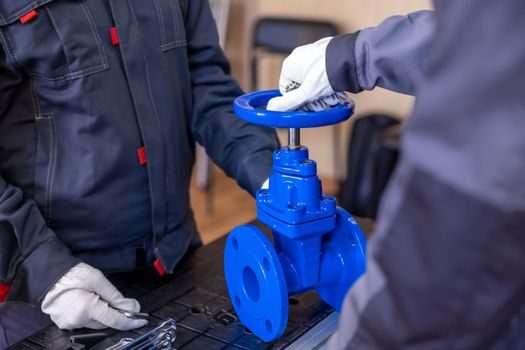
A safety relief valve's binary open-or-closed behaviour is required for code-mandated overpressure protection on pressure vessels, steam boilers, compressed-gas receivers, and the discharge side of positive-displacement pumps, where the device must open fully at the certified set pressure regardless of any external command [S5].
Do not specify a safety relief valve as a flow regulator, because its blowdown and reseat pressures are designed for binary on/off behaviour, not for trimming a flow rate; installing one in place of a balancing valve gives a system that is either fully closed or fully discharging, with no stable middle position [S5].
Four-criteria decision grid for specification reviews
Selection between the two device classes comes down to four decision criteria: response time, control input, fail-safe mode, and the certification basis the protected system requires [S1][S4][S5].
Response time to rated duty: balancing valves sub-second to multi-second, proportional; safety relief valves full lift within tens of milliseconds, binary [S1][S5].
Control input: balancing valves accept an external pilot or pressure transmitter signal for continuous trim; safety relief valves take no external signal and react only to the process pressure on the inlet [S1][S5].
Fail-safe behaviour: balancing valves default to last position, spring-centered, or hydraulic lock on signal loss; safety relief valves default to closed until set pressure is reached, then open and stay open until pressure drops below reseat [S5].
Certification basis: balancing valves are typically sized to vendor characteristic curves and EN 558/1 face-to-face length, e.g. the KSB BOA-Control IMS flanged family [S4]; safety relief valves are sized to ISO 4126 and the ASME BPVC Section I or Section VIII rule that applies to the protected equipment, with PED 2014/68/EU category determination on the EU side [S5].
Real configurations seen in mid-2026 catalogs
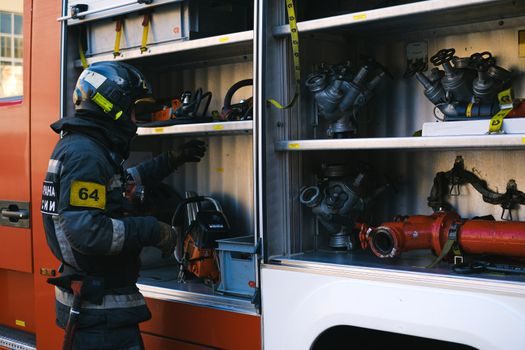
Mid-2026 catalog snapshots show hydraulic balancing valves built around external pilot signals and flanged bodies, while safety relief valve ranges span spring-loaded, pilot-operated, and rupture-disc combinations [S1][S2][S4].
The Duplomatic Oleodinamica ZC2 family ships as a hydraulically-operated, two-stage valve aimed at oil-balancing circuits where a PLC outputs a proportional command and a remote pressure sensor closes the loop, listed on DirectIndustry in December 2025 [S1].
The KSB BOA-Control IMS is a flanged balancing and shut-off valve in EN 558/1 face-to-face length, marketed for continuous differential-pressure-independent flow measurement in heating and cooling networks and refreshed in May 2026 [S4].
The water-service safety relief valve catalog snapshot for 2026 lists 18 manufacturers with 59 distinct products, including spring-loaded, pilot-operated, and rupture-disc combinations for potable water, fire-line, and process water duties [S2]; CENS supplier listings add further cast and forged body variants from Asian foundries [S3].
Limits, failure modes, and common misapplications
Both device classes have characteristic failure modes that should be checked at every maintenance interval, and substituting one for the other is the single most common misapplication seen in retrofits [S5].
Balancing valves lose accuracy when the differential pressure across them falls below the manufacturer-specified minimum, and pilot lines can plug with debris, which stalls the spool and forces manual override [S4].
Safety relief valves chatter when the operating pressure sits too close to set pressure, leak when the seat is damaged by scale or thermal cycling, and fail to open at all when the inlet line is restricted; the vendor sizing curve, not the line size, governs whether the valve actually delivers its rated capacity at the certified overpressure [S5].
Sourcing and standards discipline

Safety relief valve sizing follows ISO 4126 for the device and the ASME BPVC Section I (power boilers) or Section VIII (pressure vessels) rule for the protected equipment, with PED 2014/68/EU category determination for EU installations [S5].
Balancing valve sizing follows the manufacturer's characteristic curve and the EN 558/1 face-to-face dimension that matches the pipe spacer, as published on the KSB BOA-Control IMS datasheet [S4].
Catalog sources to cross-check during selection: DirectIndustry water safety valve index with 18 manufacturers and 59 products (2026-06) [S2], DirectIndustry Duplomatic ZC2 product page (2025-12) [S1], KSB BOA-Control IMS datasheet (2026-05) [S4], and Baker Hughes / Masoneilan spring-loaded relief valve reference (2023-11) [S5].
Two trackable signals: the next DirectIndustry catalog refresh for water safety valves, which historically adds pilot-operated variants when European water utilities migrate to smart district networks, and the next KSB BOA-Control IMS firmware update, which in past releases has added differential-pressure-independent flow readouts usable as a pressure sensor feedback for closed-loop balancing [S2][S4].