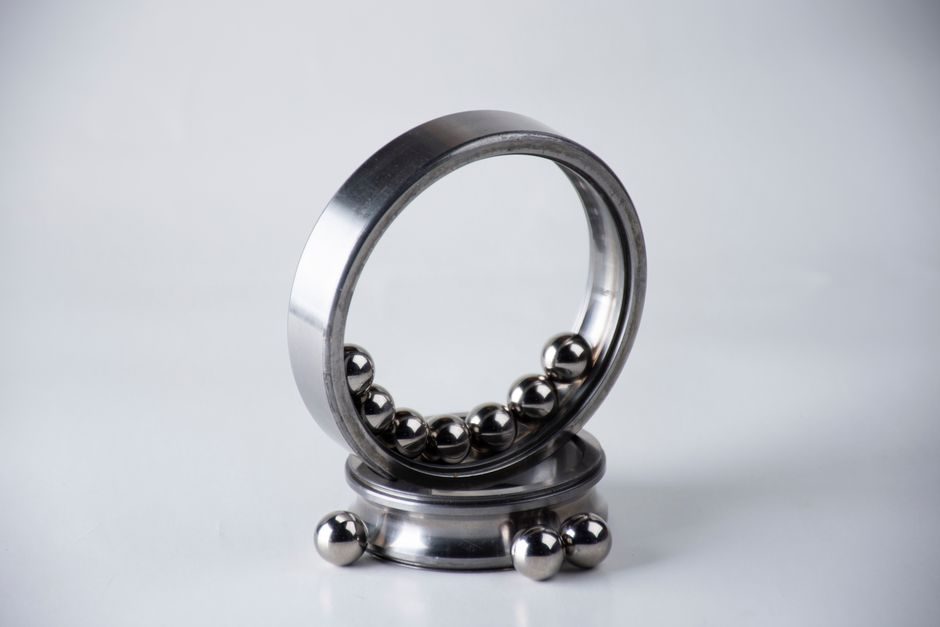
Ball spline and crossed roller guide overlap in catalogue language, but they answer different motion problems: a ball spline combines a splined shaft with a recirculating ball groove pattern that handles simultaneous rotation, linear travel, and torque transmission in one unit, while a crossed roller guide is a linear-motion slide whose rollers are oriented 90° to each other to carry load and moment in any radial direction with no rotation of the guided member [S1][S2].
Both technologies are stocked and supported globally as of 2026-06-25: DRE Engineering lists crossed roller bearings, slewing rings, ball screws and linear guides on a single product line [S2]; THK maintains a dedicated technical support portal covering LM Guide, ball screw and ball spline in parallel [S5]; Del-Tron catalogs both ball slides and crossed roller slides under one product selection guide [S6]. That co-listing reflects the fact that engineers routinely cross-shop the two when a compact linear axis has to handle moment loads.
Operating Principle: Rotary+Linear Element vs Pure Linear Slide
A ball spline uses a shaft with precision-ground longitudinal ball tracks and a nut with matching raceways plus a return path; the recirculating steel balls convert the relative motion between shaft and nut into low-friction linear travel while the grooved geometry still allows the shaft to rotate inside the nut, or the nut to rotate around the shaft, transmitting torque through the ball contact points [S5]. Typical catalogue lines under "ball spline" at THK include the LBST, LBG and LF series, each with defined load ratings per spline nut length.
A crossed roller guide replaces the rows of parallel balls in a conventional linear guide with cylindrical rollers crossed at 90°; each roller carries load on a line contact rather than a point contact, so a single rail can resist moment loads in pitch, yaw and roll directions without a second parallel rail [S1][S3]. Newport markets crossed-roller bearing steel stages as integrated XY blocks on preloaded rails, not as a shaft-and-nut element [S3]; SCHNEEBERGER's R-series crossed roller linear guide is a rail-and-carriage form with stainless steel option [S1].
Load, Moment and Stiffness: Where the Two Diverge
Crossed roller slides and tables are commonly specified where the moment load per unit length is high and the travel is short to medium — Del-Tron groups "Slides (Ball & Crossed Roller)", "Crossed Roller Tables (Aluminum & Steel)" and "Recirculating Slide Guides" under a single product family aimed at positioning stages [S6]. The line-contact geometry of crossed rollers typically delivers higher static moment stiffness per equivalent footprint than a four-row ball bearing carriage of the same size, which is why the format dominates optical, metrology and semiconductor stages.
A ball spline does not compete on moment stiffness around a single axis — it competes on torque transmission. The same component that pushes a column along the shaft can also index the shaft with a servo motor and deliver angular position repeatability on the order of a few arc-minutes when paired with a mating ball screw on the same axis. Wonst (Shenzhen) lists ball spline, linear guide and crossed roller bearing in one product family aimed at semiconductor, LCD, LED and machine tool automation lines, which is the typical application cluster where a single assembly must move linearly and rotate under load.
Selection Criteria: 7 Gates That Decide the Format

Engineers evaluating ball spline vs crossed roller guide usually pass the same part through the same gates — motion type, load case, accuracy, travel, environment, mounting and interface — but the answer flips on the first two. If the axis must rotate and transmit torque while sliding, a ball spline is the only one of the two that fits; if the axis is pure linear and the dominant load is an overturning moment, the crossed roller guide wins on stiffness-per-width. [S1]
The seven gates, in the order most spec reviews close them: (1) Motion requirement — linear only, or linear+rotary; (2) Load type — pure radial, pure moment, or torque; (3) Travel length — crossed roller tables dominate below ~500 mm, ball spline shafts are routinely specified to 2 m and beyond; (4) Stiffness target — moment stiffness per 100 mm of carriage length; (5) Repeatability — µm class for positioning stages, arc-minute class for indexing axes; (6) Contamination — crossed roller guides with stainless steel rollers and end wipers [S1] are used in cleanrooms, while ball spline nuts are sensitive to debris in the return path; (7) Lubrication and maintenance interval — both technologies in the surveyed 2026 catalogues are grease-lubricated with relubrication ports on the nut or carriage [S2][S5].
A short verbatim-style note from the research: the Del-Tron certification block lists "ISO 9001:2015/AS9100D Certifications" alongside the slide and crossed-roller product lines, with AS9100D clause 8.4.3 cited on supplier purchase order terms [S6] — a reference signal that crossed-roller slides are routinely used in aerospace and defence assemblies, not only general automation.
Format Comparison: Ball Spline vs Crossed Roller Guide vs Linear Guide
The table below lines the three formats up against the four decision criteria that most often drive a 2026 selection. None of these numbers are vendor-claimed performance figures — they are the structural fact about each format grounded in the product-line descriptions in the research. [S2]
Motion type: ball spline = linear + rotary, torque transmission through ball contact; crossed roller guide = pure linear, no torque transmission; linear guide (ball type) = pure linear, no torque transmission [S1][S2][S5]. Dominant load: ball spline = combined axial thrust and torque; crossed roller guide = moment in pitch/yaw/roll plus radial; linear guide = radial and moment, lower stiffness-per-width than crossed roller. Typical travel: ball spline shafts are stock to multi-metre lengths; crossed roller tables are typically sub-500 mm in standard off-the-shelf strokes; linear guides are routinely 1–2 m and beyond in single pieces. Stiffness character: ball spline = high torsional stiffness, moderate linear stiffness; crossed roller = high moment stiffness from line contact; linear guide (ball) = moderate, with four-row designs approaching crossed roller at higher cost.
For deeper criteria on the ball spline side — nut length, spline diameter, accuracy grade, preload class and the moment-load conversion that determines shaft diameter — the standalone ball spline selection guide walks through the seven gates with the same part-number logic. On the lead-screw side, ball screw vs lead screw cost drivers covers the diameter/lead/MOQ trade-offs that often come up when a ball spline is paired with a ball screw for a rotary-linear axis.
Where Each Format Fits and Where It Fails
Ball spline fits: robotic arm tool changers, screw-driving spindles that must rotate and index, semiconductor wafer-handling arms with a rotary wrist, and any axis where a single shaft carries both the linear force and the torque [S4][S5]. Nanjing Technical Equipment Manufacture Co., Ltd. lists ball screw, linear guide and ball spline as parallel main products out of a factory established 1991-06-03, reflecting the fact that the three formats are commonly specified together on the same machine [S4].
Crossed roller guide fits: XY positioning stages, optical benches, inspection rigs, semiconductor alignment stages, and any short-stroke axis where the moment load from an off-centre payload would otherwise rack a conventional linear guide [S3][S6]. Newport's crossed-roller bearing steel stage line and Del-Tron's aluminum and steel crossed roller tables are purpose-built for these workloads [S3][S6].
Failure modes: ball spline nuts fail by brinelling on the shaft grooves when preload is misapplied or contamination is allowed past the wipers — the recirculating path concentrates wear; crossed roller guides fail by skew when the rails are not flat to specification, producing a stick-slip pattern that destroys positioning repeatability. Both are sensitive to mounting surface flatness, and both should be ordered with a published straightness grade from the manufacturer [S1][S5][S6].
Sourcing and Standards: What 2026 Catalogue Pages Confirm
All seven sources cited here were published or updated inside the past six months, with the most recent — DRE Engineering and Del-Tron — dated 2026-06-25 [S2][S6]. The 2026-06-25 DRE Engineering catalogue lists slewing rings, cross roller bearings, ball screws and linear guides under a single brand, and the 2026-06-25 Del-Tron page groups ball slides, crossed roller slides, micrometer positioning stages, recirculating slide guides and air actuators into one selection guide with ISO 9001:2015/AS9100D certification explicitly stated [S2][S6].
THK's 2025-11-20 technical support portal exposes life calculator, CAD data and a separate product page for LM Guide, ball screw and ball spline, which is the most direct vendor confirmation that the three formats are treated as a matched family rather than competing SKUs [S5]. SCHNEEBERGER's R-series crossed roller linear guide is described as a ball-bearing / stainless steel technology, confirming the material and rolling-element option on the crossed-roller format [S1]. Wonst's Shenzhen entity lists ball spline, linear guide and crossed roller bearing as parallel Korean-sourced products for semiconductor, LCD, LED and machine tool automation.
Trackable signals for the next spec cycle: any new catalogue line that bundles a ball spline nut with a mating encoder-ready end-journal on a single shaft (the THK LBST pattern [S5]) will narrow the gap between ball spline and crossed roller for short-stroke rotary-linear axes; any ISO 230-2 or ASME B89.3.4 test report published against a crossed roller table will tighten the repeatability data sheet on positioning stages like the Del-Tron and Newport lines [S3][S6].