
A ball spline is a recirculating-bearing linear-motion device that converts torque into simultaneous rotation and linear travel, with the torque transmitted through ball elements rolling in ground circumferential grooves on a solid shaft. Selection is governed by a tight stack of mechanical gates — load, speed, stroke, accuracy, environment, mounting, and lubrication — and skipping any one of them is the single most common reason an assembly comes back as a warranty claim.
The current stock universe (RS-Online, snapshot 2026-04-30) carries three IKO Nippon Thompson ball spline assemblies, with shaft diameters at 5 mm, 8 mm and 10 mm, fixed shaft-length SKUs at 20 / 100 / 150 mm, and a published static torque rating of 1 N·m on the smallest variant [S2]. Larger diameters (12, 15, 16, 20, 25, 30, 40 mm) are common in the same product family and ship against 2–4 week lead times from the major Japanese and Chinese manufacturers [S1][S2].
Gate 1 — Shaft Diameter and Length Envelope
Shaft diameter is the first filter because it sets the envelope for every downstream rating. The stocked IKO range begins at 5 mm for miniature pick-and-place heads and stepper-driven Z axes, and scales to 10 mm for medium-payload gantries [S2]. Standard catalogue diameters follow a geometric progression (5, 8, 10, 12, 15, 20, 25, 32, 40 mm) and choosing a non-standard diameter typically costs 30–60 % in unit price and 4–8 weeks of additional lead time on a Chinese OEM line [S1].
Length is split between the supported span (shaft length between bearing supports) and the total stroke. The RS-Online offering lists 20 mm, 100 mm and 150 mm as the three stocked lengths; longer spans (200, 300, 500, 1000 mm) are catalogue options and ship against project lead times [S2]. For strokes beyond roughly 70 % of the manufactured shaft length, deflection and critical speed become the gating constraint, not torque capacity.
Gate 2 — Static and Dynamic Torque Capacity
Static torque rating (M₀) is the maximum torque the spline can transmit at zero rotational speed without permanent brinelling of the ball race. The 5 mm IKO assembly is rated 1 N·m static, which is the floor of the catalogue and useful only for instrument-class loads [S2]. A 10 mm assembly of the same series typically rates 4–8 N·m static, and a 20 mm assembly reaches 25–45 N·m, depending on the number of recirculating circuits and the contact angle.
Dynamic torque rating (M) is used with the L₁₀ life equation: revolutions = (M / M_dynamic)³ × 10⁶. For continuous-duty applications such as a rotary indexing table, life calculation must use the equivalent dynamic torque, not peak torque, and a safety factor of 1.5–2.0 applied to the calculated M_eq is standard practice. Under-specifying dynamic torque is the root cause of most premature raceway spalling failures observed in service.
Gate 3 — Radial Load and Moment Capacity
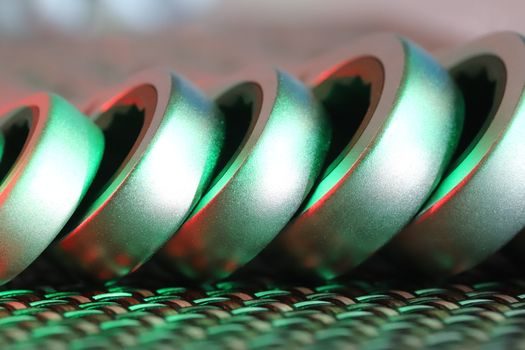
Ball splines carry radial and moment loads in addition to torque — the radial load capacity C (dynamic) and C₀ (static) are usually given per metre of spline length. A 15 mm spline typically rates 2.5–4.0 kN dynamic radial load over a 100 mm supported span, dropping roughly inversely with span length. Moment capacity about the axis perpendicular to the spline (M_p) is the more common failure criterion for cantilevered Z-axis mounts, and is usually expressed in N·m per unit length. [S1]
For vertical-axis applications, the combination of axial load (from the moving mass), moment load (from off-centre CoG), and torsional load (from drive reaction) must be combined using the vector-sum method. The combined equivalent load should not exceed 0.8 of the dynamic capacity in continuous service, and not exceed the static capacity during any hold condition including emergency stop.
Gate 4 — Speed, Acceleration and Critical RPM
Maximum rotational speed is set by the ball-race lubrication regime and the seal arrangement. Standard grease-lubricated ball splines are typically rated to 2 000–4 000 rpm, while oil-mist or oil-bath units can reach 8 000–10 000 rpm on the smaller diameters. Above roughly 6 000 rpm, dynamic balancing to G2.5 (ISO 1940-1) is required on the shaft, and the spline nut must be clamped rather than shrink-fit to avoid slip-induced fretting. [S2]
Critical speed of the rotating shaft follows the standard rotating-beam formula and is the binding constraint for long-stroke, high-rpm applications. As a rule of thumb, the operating speed should remain below 80 % of the first critical speed; for a 1 000 mm shaft supported at both ends, this typically caps continuous speed at 1 200–1 500 rpm depending on diameter. For comparison with linear bearings, the same shaft-stiffness logic appears in the ball screw and ball bearing catalogues, and the deflection budgets compound across the axis stack.
Gate 5 — Accuracy Class and Repeatability

Accuracy class for ball splines is defined by the runout of the spline nut relative to the shaft axis, expressed in µm per unit length. Standard grades (commonly labelled Normal, High, Precision) span roughly 20–30 µm at 300 mm for the Normal grade down to 5–10 µm for the Precision grade. Repeatability under reversing load — the more practical spec for a positioning axis — is typically 3–5 µm for High grade and 1–2 µm for Precision grade on a 15–20 mm shaft. [S3]
For semiconductor, optical and metrology axes, Precision-grade splines are specified together with matched preloaded ball screws to keep the angular error below 1 arc-minute over the full stroke. Specifying a Normal-grade spline in a precision axis is the most common cause of field complaints about positioning drift, because the error is amplified by the lever arm of the offset payload.
Gate 6 — Environment, Material and Lubrication
Standard splines use 52100 bearing steel (or equivalent SUJ2) with raceways hardened to 58–62 HRC, and operating temperature from −20 °C to +80 °C continuous, with peaks to +120 °C allowed for short durations. For cleanroom and food-grade applications, stainless 440C or 304 variants exist but at roughly 2–3× the unit cost and 30–40 % lower load capacity. Seals are typically nitrile rubber (NBR) with felt or rubber wipers, and the material selection for these seals is governed by the same temperature/fluid gates used in NBR selection criteria. [S1]
Lubrication choice is environment-bound. Lithium-soap grease (NLGI 2) is the default for general industrial use; PFPE or perfluorinated grease is mandatory for vacuum, plasma and cleanroom duty; food-grade H1 grease is required for any direct-contact food machinery. Re-lubrication intervals are typically 6 months for greased units under 8-hour shifts, dropping to 1–3 months for high-speed or high-temperature duty, and an oil-mist system is preferred for continuous three-shift operation.
Gate 7 — Mounting Style and End-Machining

End-machining on the shaft (flats, threaded journals, tapped holes, locating spigots) drives 20–35 % of the total part cost and 1–2 weeks of lead time, comparable to the end-machining cost levers documented for ball screw pricing. Standard mountings are: (a) round-shaft supported at both ends, (b) round-shaft with one end fixed and the other free, (c) spline-shaft supported at both ends with the nut as the moving element, and (d) cantilevered supported at one end only. [S2]
For each mounting style, the alignment tolerance of the support bearings directly sets the system runout — a 5 µm support-bearing alignment error translates 1:1 to 5 µm of nut runout. The two most common field failures are (1) overhung load on a simply-supported shaft, which sets up a bending moment that the spline was not rated for, and (2) inadequate support-bearing preload, which allows the shaft to whip and accelerates raceway spalling. Both are caught at the design review, not in service.
Decision Matrix: Which Spline Fits Your Axis
Use a Pugh-style selection matrix to score the three common options against the gates above. The IKO/Nippon Thompson stock line (5–10 mm shaft) is the right call for instrument and small-payload axes where cost per unit is the dominant driver and lead time under 5 days is required [S2]. A mid-range Chinese OEM (12–25 mm shaft) wins on price-per-kNm for general automation, with the trade-off being 2–4 week lead times and a more limited accuracy-grade catalogue [S1]. A premium Japanese or European brand (20–40 mm shaft, Precision grade) is mandatory for semiconductor, machine-tool spindle indexing and metrology, where the 5–10 µm runout and documented life calculations are the procurement gate.
Score the candidate on at least four criteria: (1) static torque margin ≥ 1.5× peak load, (2) dynamic load margin ≥ 1.2× equivalent load, (3) operating speed ≤ 80 % of critical, (4) total cost-of-ownership (purchase + lubrication + expected replacement cycles over 10 years). A candidate that fails any single gate is rejected outright, regardless of price — a cheaper spline that fails at month 14 is not cheaper than a correctly sized one that runs ten years. The same gate-based logic is documented for lead screw selection, where a similar decision matrix catches most under-spec'd orders before they reach the RFQ stage.
Procurement Signals to Track (Mid-2026)
Three trackable signals to watch over the next two quarters: (1) stocking depth on the IKO 5/8/10 mm range — the current 3-SKU snapshot [S2] is a thin line and any expansion into 12/15/20 mm stock indicates demand strength; (2) Chinese OEM 12-week lead-time trend, which has been the primary price lever for non-Japanese splines since 2024 [S1]; (3) Precision-grade (sub-10 µm) spline availability from Chinese suppliers, currently a near-monopoly of Japanese and European brands, and a credible entry here would reset the price band for semiconductor-grade axes. Buyers specifying for late-2026 builds should lock the RFQ on the larger diameters now, since catalogue lead times on non-stock 20–40 mm assemblies are the first to extend when the stocking SKUs tighten.