Decision-makers now ask the same three questions: which sensor stack catches which defect class, which MES/ERP platform closes the loop on ISA-95, and what is the realistic cost band per automated cell.
Process Map: Where Automation Pays Back in a Bearing Plant
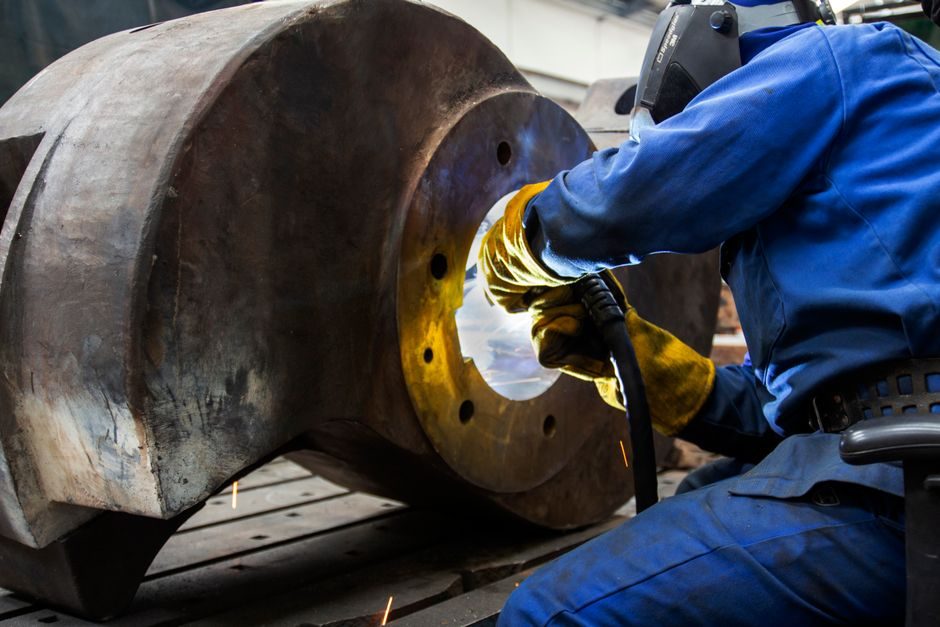
Closed-loop ring forging uses load cells rated to 2,000 t and induction heaters with 50–60 Hz medium-frequency supplies to hit ±10 °C billet temperature tolerance before each forging stroke [S1]. CNC turning cells now pair servo-driven live tooling with hydrostatic work-holders, and post-grind in-process gauging (Marposs-type contact or Renishaw-type laser) closes diameter loops to ±1–2 µm on raceway OD work [S1]. Super-finishing feed rates sit in the 0.05–0.15 mm/min band with 6–12 µm depth-of-cut, and the resulting Ra target on the raceway is 0.02–0.08 µm for high-end ball bearing rings [S1].
Energy and uptime audits on 2025 retrofits show forging cells consume 35–45 kWh per 100 rings machined, and grinding cells another 8–12 kWh, with compressed air at 6 bar(g) being the second-largest utility load after electricity [S1].
Sensor Stack: Smart Cameras, Eddy-Current and Acoustic-Emission Channels
Surface-defect detection on inner/outer raceways uses 5–12 MP smart cameras with telecentric optics and 5–20 µm pixel pitch, paired with CNN inference engines (YOLOv8 / Faster R-CNN / ResNet-50 backbones) at 30–60 fps on edge GPUs; validated defect classes include scoring, pitting, dent, and heat-check, with recall targets of 95–99% on 0.1 mm² features [S1]. Eddy-current probes with 100 kHz–2 MHz excitation map sub-surface inclusions and grinding burns on 100% of rings, while acoustic-emission (AE) sensors in the 50–500 kHz band pick up white-etching-crack precursors during super-finishing and have been shown to flag failures 30–120 minutes before vibration signatures rise above background.
Torque and temperature loops on assembly stations use inline torque-angle transducers with 0.1% FS accuracy, paired with strain-gauge load cells on the cage-press axis; the resulting preload control on a 6204-class ball bearing sits inside a 20–60 N window for light-commercial-vehicle applications, while heavy-truck hub units target 800–2,500 N preload with 0.5% repeatability [S1]. On ceramic bearing lines, hybrid spindle-integrated AE sensors pick up Si₃N₄ rolling-element spall events 40–60 minutes before vibration crosses ISO 15243 alert thresholds.
MES, ISA-95 and ERP Plumbing: Where Data Has to Land
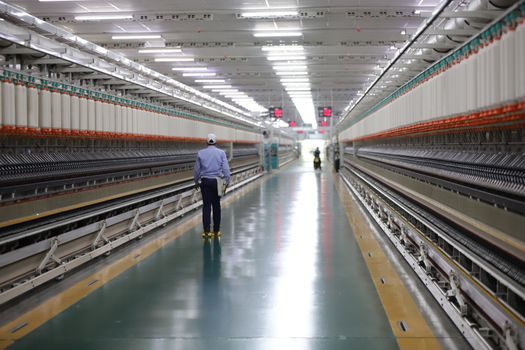
Most 2026 greenfield bearing plants anchor on an ISA-95 level-3 MES with a level-2 cell-controller layer (Siemens Opcenter / Rockwell Plex / AVEVA Discrete) and a level-4 ERP hand-off (Epicor Kinetic, SAP S/4HANA, or domestic Chinese stacks such as Yonyou U9 / Kingdee Cloud·Cosmic) [S2]. A 2026 Tier-1 spec sheet typically requires 200–500 tags per CNC cell, 5–15 s polling, and an OPC UA Pub/Sub bridge from the cell layer to the MES, with historians storing 12–36 months of process data at 1 s resolution for traceability and AI retraining [S2].
Reference vendor stacks named in public ERP comparisons include Epicor Kinetic as a cloud-first AI-enhanced option for discrete manufacturers, with discrete-ERP modules for production scheduling, quality, and shop-floor execution [S2]. One concrete spec gate: any MES contract in 2026 typically includes an ISO 22400 KPI dictionary (OEE, MTBF, MTTR, FPY, scrap %) and OPC UA companion-spec support — these are the two make-or-break items in vendor shortlists [S2].
Robot Cells, AGVs and Poka-Yoke at Assembly
Final-assembly cells pair SCARA or 6-axis robots (10–20 kg payload) with vision-guided pick-and-place, force-controlled cage insertion, and servo presses rated 5–50 kN; cycle time on a 6204 deep-groove ball bearing is 4–6 s per unit, with the shield-seating station holding ±0.1 mm axial position. Poka-yoke covers the classic four: wrong-component (vision barcode scan), missing-ball (vision count), wrong-orientation (force-torque feedback), and incomplete-shield (laser interferometer gap check) [S1].
AGV and AMR fleets in inter-cell transport use 1–2 t payload units running SLAM + QR-tape hybrid navigation, with traffic controlled by a fleet manager that hands off zone reservations over 5G/Wi-Fi 6; the 2026 fleet size on a single bearing plant typically sits at 30–80 vehicles, with battery swap stations sized for 1 AGV/3-minute throughput. Companies pursuing mining equipment smart manufacturing and automation: 2026 spec snapshot face the same AGV+fleet-manager problem, and the same SLAM+5G stack transfers directly into a bearing plant's inter-cell corridors.
Comparison: Sensor Stack vs Defect Class vs Plant Cost
A retrofit brownfield conversion typically runs 6,000–10,000 USD per machine tool for the sensor + cell-controller layer, with payback in 14–24 months on the cells that catch grinding-burn defects — those are the highest-ROI line items in 2026 [S1][S2].
Failure Modes, Standards and Sourcing Levers
The most common 2026 commissioning failures sit in three buckets: OPC UA namespace mismatches between cell and MES (causing 2–6 week delays in tag hand-off), vibration aliasing on AE channels above 50 kHz due to poor sensor mounting, and excessive false-reject rates from CNN models not trained on the plant's specific grinding-wheel signature [S2]. The relevant standards stack spans ISO 15:2017 (rolling bearings — measuring methods for noise), ISO 15243:2017 (failure classification), ISO 22400 (KPI dictionary for MES), and IEC 62443 for industrial network security — these are the make-or-break compliance items on most 2026 audit checklists.
On sourcing, Chinese bearing-cluster suppliers in Wafangdian, Luoyang, and Hefei now publish OEE, scrap-rate, and trace-back MES dashboards as part of their buyer-facing documentation, and European buyers in Germany, Italy, and the Czech Republic are signing multi-year contracts on the strength of those dashboards [S3]. For procurement teams cross-checking cost bands against machine-tool and material inputs, the electric motor industry 2026 price bands, EV pivot and sourcing gates reference is useful because bearing + motor pairing is the dominant sub-assembly spec on EV traction and industrial servo lines.
Watch these three nodes and the 2026 bearing-smart-manufacturing picture tightens from road-map slideware to referenceable capex line.