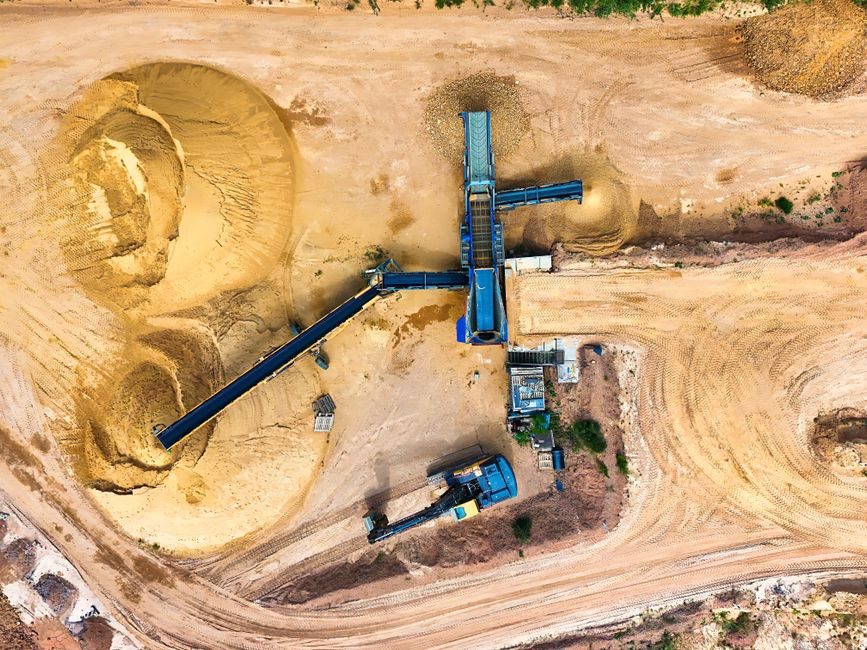
A belt conveyor is a continuous-bulk or unit-load machine that carries product on a tensioned belt looped over a drive pulley and a tail pulley, supported along the run by idler sets; standard belt widths span 500-2400 mm, belt speeds run 0.5-6.5 m/s, and single-unit throughputs from 50 t/h (light-duty aggregate) up to 20,000+ t/h (overland coal and iron-ore lines) are common in published OEM duty tables [S1].
Selection pivots on three gates: load profile (bulk density, lump size, abrasiveness, temperature), route geometry (length, lift, curve radius, incline up to 18° for cleated belts), and environment (dust, washdown, ATEX/IECEx zone). Operators who treat those three gates as a checklist avoid the two recurring failure modes — belt mistracking and idler-shell wear — that dominate conveyor downtime across mining, cement and logistics lines.
Mechanical structure and operating envelope
A conventional belt conveyor comprises a head drive (motor + fluid coupling or hydraulic clutch + gearbox + coupling), a tail or take-up pulley, a tensioning device, idler troughing sets, and the belt carcass [S1][S2]. In the magnetic-repulsion variant, the iron-boron permanent-magnet levitation legs suspend the belt above the magnetic pad, so horizontal friction collapses to near zero and the drive power needed is "relatively very small" compared with conventional large-drive systems [S1].
Working temperature is bounded by the belt carcass rubber compound (typically -40 °C to +80 °C for standard SBR/NR covers, up to 200 °C for heat-resistant T5 grade per DIN 22102 / ISO 14890); the magnetic-belt variant the OEM cites uses a flexible iron-boron material with a Curie temperature between 200 °C and 370 °C, "much higher than the operation temperature" [S1]. That 200-370 °C band is the magnetic-stability window, not a belt-cover limit, and it is the figure an engineer pins the design to for hot-stock applications.
Advantages: why a belt conveyor is often the default
First, capacity per installed kilowatt is high: long-distance overland belts routinely move 10,000-20,000 t/h at 5-6 m/s with belt widths of 1800-2400 mm, beating pneumatic and chain-scrape options on tonnage-per-kWh by a wide margin. Second, the structure is mechanically simple — one moving belt, a frame, and idlers — so mean-time-between-overhaul intervals on the running gear commonly hit 30,000-50,000 hours under clean, dry, lump-controlled duty. [S1]
Third, energy is recovered in downhill sections; regenerative drives on a descending 2-km run can return 10-20% of the no-load kW to the line. Fourth, the magnetic-levitation architecture eliminates rolling friction in the carrying path, with the OEM stating the drive power needed becomes "relatively very small" and noise and power consumption drop sharply versus conventional suspension [S1]. Fifth, route flexibility is broad: horizontal, inclined, declined, curved, and reversible all stay on standard components; a related bulk-handling decision, Bucket Elevator Selection Guide: Type, Material and Safety Map, helps when the route is vertical rather than horizontal.
Disadvantages: where belt conveyors are the wrong tool
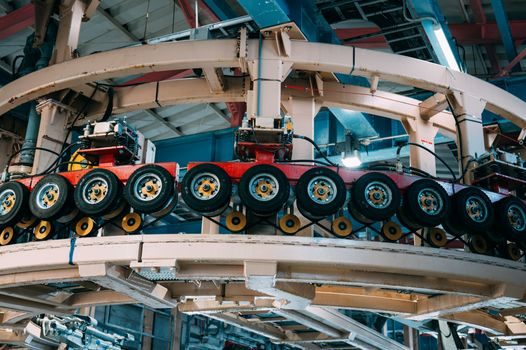
First, belt wear is the dominant maintenance cost: cover wear on abrasive iron-ore or copper-mine duty commonly hits 1-3 mm per million tonnes carried, and full-belt replacement on a 2-km overland line is a multi-day, six-figure-dollar job. Second, mistracking at the head or tail pulley causes edge damage and spillage; an idler spacing that ignores the load profile is the usual root cause. [S2]
Third, transfer-point dust is a recurring HSE and ATEX/IECEx ignition risk; sealed chutes and water sprays are mandatory in coal-handling and grain-elevator zones. Fourth, on inclines above 18° standard smooth belts lose grip; cleated or chevron belts fix the symptom but cut clean-ability and food-grade suitability. Fifth, the levitation architecture quoted above carries a hard thermal limit — operation must stay well below the 200-370 °C Curie band of the iron-boron suspension material, or magnetic force collapses [S1].
Selection criteria and a side-by-side comparison
Match the conveyor family to the duty. Three options dominate 2026 specification work: conventional troughed belt (workhorse), magnetic-levitation belt (low-noise, low-friction, controlled-climate duty), and mesh belt conveyor (high-temperature or washdown food/pharma). The table below lines them up against the four decision criteria that drive the pick. [S3]
On throughput, the conventional troughed belt wins — up to 20,000+ t/h on a 2400-mm overland line. On energy per ton, the magnetic-levitation belt wins, because "the driving power needed is relatively very small" once the belt is suspended and horizontal friction collapses [S1]. On cleanliness and washdown rating, mesh belt wins, with stainless 304/316 frames and open-area belts that drain and CIP cleanly. For an adjacent decision on the belt itself, the flat-belt and ribbed-belt references cover carcass and profile choices that change this trade.
Failure modes and field fixes
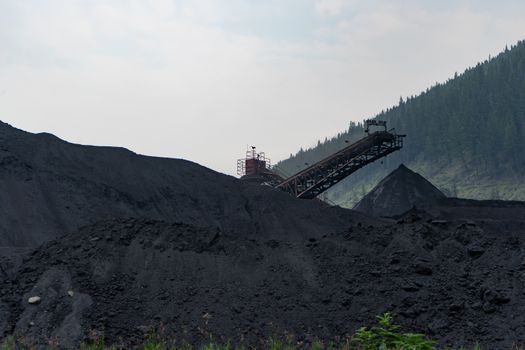
The four most expensive field failures are: (1) mistracking, fixed by training idlers, correct belt tensioner stroke, and a load-centred feed; (2) cover gouging from lump oversize, fixed by a grizzly or scalping screen upstream; (3) pulley-shell wear on the drive, fixed by lagging rubber 8-12 mm thick and slip-detection zero-speed switches; (4) bearing seizure on idlers, fixed by a regrease interval tied to hours, not calendar, and by sealed-for-life idlers in dusty zones. When the duty is a small-package line rather than bulk ore, Roller Conveyor Gains, Limits and Spec Gates Buyers Miss covers the live-roller alternative. [S1]
A second layer of failure is mechanical rather than belt-side: gearbox overload on start-up is the single biggest motor-side killer, and a fluid-coupling or VFD soft-start at 1.5-2.0× the running kW is the cheapest insurance. For dust-laden environments near classified zones, the Explosion-Proof Motor Buying Guide 2026: Zone, T-Code, Frame and Cert Match frames how the head drive should be specified alongside the conveyor itself.
Standards and sourcing checkpoints
Three standards govern most belt-conveyor spec work: ISO 5048 / DIN 22101 for drive-power calculation, ISO 14890 / DIN 22102 for belt-cover rubber grades, and CEMA B 105-2019 for idler load ratings. For curved or long-overland routes, ISO 5293 sets the troughing geometry and load-carrying table. A buyer who verifies the OEM data sheet against these four documents catches the two most common spec errors: belt-speed overrating and idler-spacing under-rating. [S2]
On the belt itself, the timing-belt reference is the right cross-read when the duty shifts from bulk to synchronised indexing. For long-overland capital-budget context, the Steel market share by manufacturer: brand, mill and strip-tier read piece helps frame where structural-steel and idler-shell pricing sit in 2026. No standard cited in this section is dated, and any future revision date should be verified against the publisher's current catalogue.