
A belt tensioner contributes 1–3% of a typical belt conveyor drive-side bill of materials, but the cost of mis-specifying one shows up across the full life cycle as accelerated flat-belt wear, premature bearing failure, and unscheduled line stoppages; engineering teams that only price the part, not the life-cycle exposure, are typically surprised by the ratio [S3][S4].
Total Cost of Ownership is defined as the total cost incurred over the life cycle of an item, encompassing all direct and indirect cost elements [S4]. Applied to a belt tensioner, that means combining unit price, install labour, scheduled re-tension events, belt-pair replacement triggered by mis-tension, energy loss from slip, and the financial exposure of any downtime the line absorbs when the tensioner fails [S3][S5].
What actually drives belt-tensioner cost
The unit price of a tensioner assembly is set by four primary levers: spring/actuator type (mechanical spring vs. hydraulic damper vs. automatic take-up), shaft and bearing grade, arm material (SG iron, forged steel, or stamped steel), and whether the unit is OE-matched to a specific drive layout [S3][S5]. A stamped-steel mechanical spring tensioner for a light flat-belt accessory drive sits at the low end of the range, while an automatic hydraulic take-up for a heavy conveyor head pulley sits at the high end, with the cost difference often running 8–15× [S5].
Beyond the part, the operation-and-maintenance share typically dominates. In a dynamic TCO model for production machinery, energy and maintenance cost blocks cannot be determined by static calculations and must be modelled against actual duty cycle, ambient conditions, and service interval [S5]. For belt-tensioner duty, that translates into three recurring line items: periodic re-tension or spring verification, bearing re-grease or replacement, and the cost of any belt replacement triggered by under- or over-tension damage on the ribbed-belt or timing-belt it services [S3].
Comparing the three tensioner architectures
Three architectures are in common service, and they trade off on upfront cost, predictable maintenance, and sensitivity to drive misalignment. A mechanical-spring (fixed-force) tensioner has the lowest unit price and the simplest install, but it cannot compensate for belt stretch or pulley wear, so re-tension events accumulate over the belt's life [S5]. A hydraulic-damper tensioner adds damping at moderate cost, which is valuable on drives with cyclic load or torsional vibration, but it requires seal inspection and a fluid-change interval that the maintenance schedule must carry [S5].
An automatic take-up (gravity or pneumatic) carries the highest unit price but the lowest steady-state maintenance cost, because the system self-compensates for stretch and maintains constant wrap angle on the drive pulley across the belt's full wear range [S3][S5]. The selection map below lines the three against the four decision criteria that matter most in a TCO comparison: purchase cost, scheduled maintenance burden, ability to absorb belt stretch, and suitability for high-cyclic or contaminated environments.
The "more, smaller systems vs. fewer, larger systems" framing from general TCO literature applies directly here: a low-cost fixed-force tensioner deployed across many drives minimises per-line capital exposure but inflates aggregate maintenance, while a single high-end automatic take-up on a critical line concentrates spend but cuts cumulative service hours [S2]. The right choice is set by the cost of downtime on each drive, not by the part ticket.
Where the indirect cost actually lives
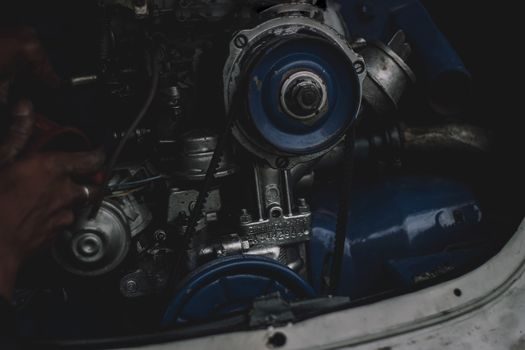
Direct cost is the upfront expense of the tensioner assembly and its install labour; indirect cost is the ongoing expense of maintenance, unexpected replacement, and the financial impact of breakdowns that take the line down [S3]. On any drive where unscheduled stoppage runs into hundreds or thousands of dollars per minute — typical for a conveyor head pulley or a packaging line main drive — the indirect block dwarfs the tensioner line item within the first year [S3][S5].
Two indirect line items are routinely underestimated. First, belt-replacement cost triggered by mis-tension: an under-tensioned ribbed-belt slips, generates heat, and hardens the rubber compound, cutting service life; an over-tensioned timing-belt loads the bearing and the tensioner arm, accelerating wear on both [S3][S5]. Second, the labour cost of accessing the tensioner for inspection or re-tension: a tensioner mounted on a guarded head pulley that requires a 30-minute shutdown and a two-person crew per check can consume the price of an automatic take-up in maintenance labour over a 5-year window alone [S3].
Reliability, maintenance, and longevity — the engineering levers
Reliability starts with the manufacturing process; brands that manufacture their own component parts rather than simply assembling third-party components have better control over product quality, and it is common to see well-engineered drive components still in service 20 years after installation [S3]. For a belt tensioner, the equivalent lever is bearing and seal sourcing: a tensioner built on a name-brand sealed-for-life bearing will outlast one on a generic shielded bearing by a wide margin, especially in dusty or wash-down environments.
Maintenance pays off when the schedule is realistic. Proper care and maintenance help ensure performance and prevent costly repairs or early replacement, and the cheapest maintenance is the one a technician can execute with the tensioner still in place [S3]. Designs that allow in-situ spring check, in-situ re-tension without belt removal, and greasing through a single accessible zerk keep the indirect cost block contained; designs that require belt removal for any service action push the same work into a planned outage [S3].
Longevity is a function of duty. In a dynamic TCO model, energy and maintenance cost blocks cannot be determined by static calculations and must be modelled against actual duty cycle, ambient conditions, and service interval [S5]. A tensioner on a 24/7 aggregate conveyor in a dusty environment will not see the same service life as the same part on an intermittent-duty fan drive, and assuming equal service intervals across both duties is the most common TCO error on belt conveyor fleet planning.
Who a premium tensioner is — and is not — for
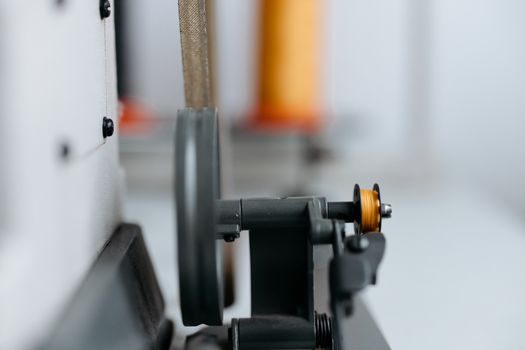
An automatic hydraulic or pneumatic take-up is the right call on any drive where (a) the belt is sized above the duty threshold where re-tension labour is material, (b) the downtime cost of an unscheduled stop exceeds the price delta between a fixed-force and an automatic unit, or (c) the drive is inaccessible for routine service [S3][S5]. A fixed-force spring tensioner remains the right call on low-duty accessory drives where the belt is a consumable expected to be replaced before the tensioner itself shows wear [S3].
The selection also tracks the matched-belt architecture: a timing-belt drive with metal-strip tensioners behaves differently from a ribbed-belt drive with a spring-loaded arm, and a flat-belt conveyor with a gravity take-up is a different animal again — the tensioner spec must follow the belt spec, not lead it. For a broader look at how belt-and-pulley choice sets the upstream maintenance burden, see the Timing Pulley Types and Classifications spec map.
Standards, sourcing, and a 5-year cost model
No single international standard governs belt-tensioner TCO, but three spec anchors do: the OEM-matched part number on the driven machine (which sets form/fit and the spring-rate window), the bearing dynamic load rating and L10 life figure for the tensioner shaft (which sets the replacement interval), and the belt manufacturer's tension-vs.-deflection table (which sets the initial setpoint and the re-tension trigger) [S3][S4]. Sourcing a tensioner against OEM part data — rather than a generic catalogue cross — is the most common avoidable TCO error, because a non-OEM spring rate that is even 10% off moves the belt into the under- or over-tension zone across its full wear range [S3].
A defensible 5-year TCO model on a single drive sums five blocks: tensioner purchase and install; scheduled re-tension or inspection labour; one expected belt replacement at mid-life; expected bearing replacement on the tensioner arm; and the expected downtime exposure based on MTBF and the line's cost-per-minute of stoppage [S3][S4][S5]. On a critical conveyor head pulley, the downtime block alone routinely returns the entire price premium of moving from a fixed-force spring tensioner to an automatic take-up within 12–18 months, which is the working case for specifying automatic take-ups by default on any new belt conveyor build where the line stoppage cost is non-trivial.
For adjacent reading on how life-cycle cost is built into other rotating-equipment selections — pump duty sizing in particular — the Centrifugal Pump Sizing and Selection walk-through carries the same TCO logic into a different asset class.