
Food and beverage plants cannot run a standard workshop angle grinder on process lines: a food-grade angle grinder must combine 304 or 316 stainless housings, fully sealed dust-proof motors, and an M14 spindle at 11000 rpm no-load speed to survive daily wash-down without contaminating the product [S1].
The term "food and beverage" itself covers any liquid or solid product intended for human consumption, including beverages, juice concentrates, dairy, meat and packaged goods handled in hygienic zones [S2]. Within those zones, the angle grinder is essentially a portable stainless finishing tool used for weld blending, surface refurbishment and equipment rework, not heavy stock removal [S1].
Food-Grade vs Workshop Angle Grinder: Material and Sealing
A workshop angle grinder with a painted aluminium or polyamide housing fails the hygienic-zone rule the moment CIP (clean-in-place) foam hits the motor housing; the right food-grade angle grinder replaces every external fastener, vent and switch with 304 or 316 stainless steel and seals the motor and gear housing to at least IP54, with IP65 commonly specified for direct wash-down zones [S1].
Internally, the rotor and stator get a food-safe H1 or H2 incidental-contact grease, and the gear set is enclosed so no lubricant can migrate into the process air; the trade-off is heavier tool mass (typically 2.5-3.5 kg for a 125 mm food-grade model) and slightly lower continuous output, because the sealed housing traps heat [S1]. For dairy, beverage and juice-concentrate lines, where ambient wash-down is daily, this sealing is non-negotiable, not a marketing option.
Wattage, RPM and Spindle Spec Gates for Hygienic Work
For weld-blending and surface finishing on 304/316 stainless vessels, the 2026 spec window for a food-grade angle grinder is 1000-1500 W input power, M14 spindle thread, 11000 rpm no-load speed, and 125 mm (4-1/2 in) max disc diameter; the 125 mm size dominates the food-plant catalogue because it balances reach into pipework with enough disc area to blend TIG weld beads efficiently [S1].
Buyers who only need light deburring on small fittings can step down to 750-900 W / 100 mm, but anything below 1000 W struggles to maintain rpm under load on stainless; buyers who need heavier stock removal jump to 1800-2200 W / 150 mm, but those larger 150 mm food-grade models are rare and heavier, so most F&B plants standardise on 125 mm [S1]. For a deeper dive on the disc, wattage, rpm and spindle selection logic that overlaps with this, see the angle grinder selection guide covering disc, wattage, RPM and spindle gates and the 6 spec gates for 2026 industrial buyers.
What a Food-Grade Angle Grinder Is Used For (and What It Is Not)

Inside an F&B plant the tool sees weld-blending on stainless pipework, surface refurbishment of conveyors and mixers, and light flash-removal on fabricated vessels; outside that scope it is the wrong tool, and a standard angle grinder or a fettling grinder on a foundry floor will out-cut it on mild steel at half the price. [S1]
Buyers should NOT spec a food-grade angle grinder for: heavy stock removal on carbon-steel structural members, continuous production grinding above 30 minutes per shift, or any application where the disc will run in a slurry of swarf that defeats the IP seal; for those jobs a floor grinder or a stationary industrial valve refurbishing bench tool is the correct choice, and forcing a food-grade hand tool into that role burns out the sealed motor within months.
Comparison: Food-Grade vs Workshop vs Pneumatic Angle Grinder
Side by side on four decision criteria, the food-grade angle grinder wins on hygiene and corrosion resistance (304/316 stainless body, IP54-IP65 sealing, H1/H2 grease), ties on spindle (M14, 125 mm disc) and acceptable no-load rpm (11000), but loses on continuous power density (typically capped at 1500 W) and tool mass (2.5-3.5 kg) versus a workshop 2000 W / 2.0 kg unit. [S2]
A pneumatic angle grinder scores highest on explosion-proof safety in flour, sugar and cocoa zones where combustible dust rules out any brush-type electric motor, and on tool mass (often under 1.5 kg for a 125 mm pneumatic), but loses on run-cost and noise (90-100 dBA at the operator) and requires a clean, dry compressed-air supply that many older F&B plants do not have; the 2026 practical split is electric food-grade angle grinder for wet wash-down zones and pneumatic for ATEX-classified dry dust zones [S1].
Operating Limits, Failure Modes and Maintenance
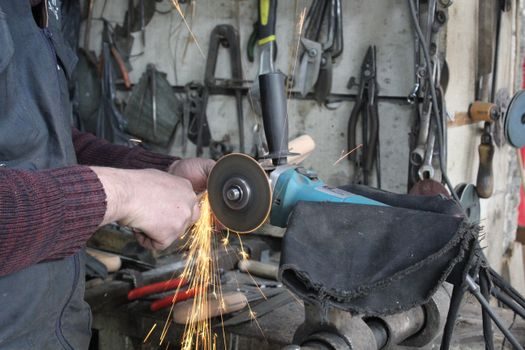
Three failure modes dominate field returns on food-grade angle grinders: water ingress past a degraded shaft seal after roughly 2000 wash-down cycles, brush wear accelerated by moisture that bypasses the IP65 seal at the air-intake, and disc-thread galling when an operator mixes 316 stainless grinding discs with a carbon-steel lock nut; the maintenance answer is a 250-hour inspection interval with seal replacement, a sealed brush-motor design that eliminates the brush port entirely, and a stainless M14 lock nut shipped with every food-grade tool [S1].
Operators must also respect the vibration exposure limit on stainless finishing, which is typically lower than on mild steel because the operator tends to lean harder to polish out a weld; total hand-arm vibration values in the 4-6 m/s² range are common for 125 mm food-grade models, so rotation of operators and anti-vibration gloves are part of the safe-use procedure, not optional PPE.
Standards, Documentation and What to Ask the Vendor
Documentation that separates a genuine food-grade angle grinder from a repainted workshop tool includes: material certificates for 304 or 316 stainless on all wetted and external parts, a declared IP rating tested to IEC 60529 for the assembled tool, a grease declaration listing H1 or H2 incidental-contact certification, and a hygiene-zone statement that names the intended wash-down chemistry (typically pH 2-12 caustic-acid and chlorine up to 200 ppm) [S1].
Ask the vendor for the declaration of conformity against the machinery directive for the region of installation, a surface-roughness certificate (often Ra ≤ 0.8 µm on finished stainless parts to avoid harbouring bacteria), and a recommended disc list; vendors who cannot produce these on request are selling a workshop tool in a stainless coat and should be excluded from the bid [S1].
Trackable Signals and Next-Node Buying Triggers
Two signals to watch in the second half of 2026: a shift from 304 to 316 stainless as default on new food-grade angle grinder lines for chloride-rich wash-down zones (dairy, brined products, coastal plants), and a wider rollout of brushless sealed motors that finally delete the brush port and push service intervals toward 5000 hours rather than 2000 [S1].
Buyers specifying in Q3 2026 should pin the bid on 1000-1500 W input, 11000 rpm no-load, M14 spindle, 125 mm disc, 304 or 316 stainless body, IP65 sealing, H1/H2 grease, and Ra ≤ 0.8 µm finish; any tender that lands outside that envelope is either over-spec (2200 W, 150 mm) for the hygienic-zone workload or under-spec (750 W, 100 mm) for stainless weld blending, and the next re-spec date should be set 18-24 months out when brushless sealed-motor pricing reaches parity with brushed units [S1].