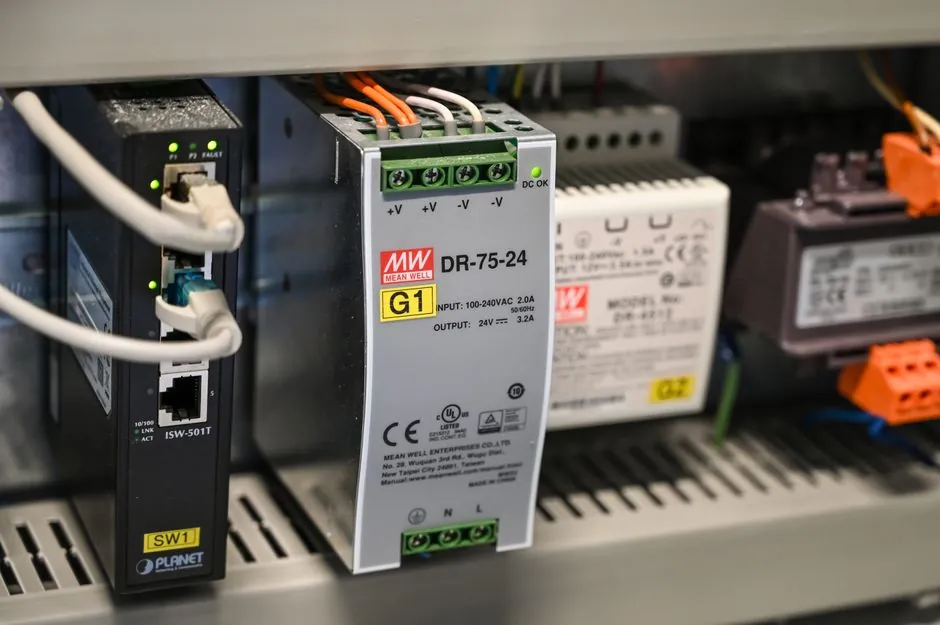
An industrial UPS provides battery-backed ride-through for AC or DC loads during a grid failure, while a switching power supply converts utility AC into a regulated DC bus for continuous operation of control hardware. The two are routinely confused in panel design, but their roles diverge on a single question: does the load have to survive a power loss, or does it just need clean DC under normal mains conditions?
Industrial UPS autonomy is bounded by battery capacity and typically runs minutes to hours, while a switching supply has no stored energy and only conditions what flows through it [S4]. Specifying the wrong device either strands critical loads on a dead bus, or spends battery money on circuits that never actually lose power.
Where Each Device Actually Sits in the Power Chain
A switching power supply takes AC input, rectifies it, high-frequency switches it through a small transformer, then rectifies again to produce a regulated DC output, with the regulator closing a feedback loop on the output. That topology is why modern industrial supplies reached 50 years of refinement from bulky 50 Hz linear units into the compact, high-efficiency modules used today [S1]. The supply is a converter: power in, regulated DC out, nothing in between stored as energy.
A UPS, by contrast, always sits between the source and the load with an energy reservoir bolted to the DC bus. Under normal conditions the rectifier/charger feeds the inverter and tops up the battery; on loss of mains the inverter draws from the battery and the transfer is described in practice as nearly zero interruption [S3][S4]. The defining component is the battery bank, and the defining behavior is the speed of source handoff, usually specified in milliseconds for online double-conversion units [S4].
Five Decision Criteria: UPS vs Switching Power Supply
Core function. The UPS exists to bridge a power loss with stored energy, the switching supply exists to convert and regulate. An ATS belongs to a different category again: it switches between two AC sources, typically in milliseconds to seconds, and has no battery of its own [S3]. The UPS answer for ride-through is therefore battery energy; the ATS answer is a secondary feeder; the switching supply answer is neither.
Energy storage. The switching supply holds no energy beyond output capacitance. The UPS is defined by its battery, historically VRLA, increasingly lithium-ion with two to three times the cycle life of VRLA under comparable conditions and integrated battery management for cell-level health [S2]. Replacement interval is a hard cost line: lead-acid cells in a UPS typically need replacement every 3 to 5 years depending on temperature, duty cycle, and chemistry [S3].
Hold-up time. A switching supply output decays within milliseconds of input loss, fast enough that an undervoltage lockout on a downstream PLC will drop the rail. A UPS is rated in minutes of full-load autonomy at a specified power factor, and that number is the dominant spec on the UPS data sheet. For a 24 VDC control cabinet the practical bridge is a DC-UPS module, which adds battery control to a DC supply and seamlessly transfers to battery when AC is lost [S5].
Output topology and load type. The switching supply is a DC power supply feeding a DC bus, sized to the load plus derating. The industrial UPS feeds AC loads (online double-conversion) or DC loads (DC-UPS / battery-backed DC supply). An AC UPS can sit upstream of multiple switching supplies, a common architecture in control rooms, but the UPS autonomy then has to cover the sum of all downstream supplies plus their connected loads.
Cost structure. Switching supply cost is essentially capex; UPS cost is capex plus battery replacement and periodic capacity testing every 3 to 5 years [S3]. Modular UPS architectures partially blunt this by letting the user right-size on day one and add hot-swappable power modules as load grows, with no scheduled downtime for module replacement [S2]. For sites where floor space and thermal load matter, lithium-ion modular UPS also reduces footprint and widens the operating temperature window versus VRLA [S2].
Selection by Application
For a PLC panel, sensor bus, or HMI on a 24 VDC rail, a regulated switching power supply sized at roughly 125% of the measured load is the baseline; add a DC-UPS module only if the process must ride through a brief AC loss or perform an orderly shutdown [S5]. For a server room, SCADA master, or any AC load where a power cycle corrupts state, specify an online double-conversion UPS and budget battery replacement at year 3 to 5 [S3][S4].
For a facility with a standby generator, an ATS handles the long-duration source handoff and a small UPS handles the seconds-to-minutes gap until the generator stabilizes; specifying a UPS sized for hours of autonomy in that case wastes battery capacity that the generator already covers [S3]. For distributed outdoor cabinets, a DC-UPS with lithium battery management and remote outlet-level PDU monitoring gives both ride-through and per-circuit load visibility, which is now table stakes for industrial power distribution [S2].
Switching power supply sizing is its own exercise, but the rule of thumb is unchanged: measure real load, add 25% headroom, and verify the inrush of the largest single load against the supply's peak rating.
Limits and Failure Modes Engineers Hit in the Field
UPS autonomy collapses fast when the connected load exceeds the nameplate, or when the battery has been temperature-stressed. Lead-acid life halves for every sustained 8 to 10 °C rise above 25 °C, which is why cabinet ventilation and battery placement are not optional in a UPS room. [S2]
Switching supply failures are usually input-side: sustained overvoltage, brownouts below the supply's input range, or capacitor aging on the input stage after 7 to 10 years of service. The supply will not save the load during any of these events; that is the UPS's job if the load is critical. Pairing a switching supply with a DC-UPS module addresses both failure modes for 24 VDC loads [S5].
Modular UPS architectures reduce mean time to repair but introduce a new failure surface: module firmware skew and inter-module current sharing. Specifying a single controller family and insisting on documented hot-swap procedures is the practical mitigation; the modularity is not free.
Standards and Sourcing Discipline
UPS safety and performance are governed by IEC 62040 family documents; switching power supplies for industrial DC use fall under IEC 61204 and the relevant EMC standard for the environment. Battery installations must follow IEC 62485 for stationary cells, and any UPS deployed in a hazardous area must carry the appropriate ATEX or IECEx rating for the zone. These designations are what auditors and insurers will look for first on a nameplate, and substituting a generic office UPS into a chemical plant panel is a common spec error. [S2]
Two trackable signals for the next design cycle: lithium-iron-phosphate (LFP) battery packs continue to displace VRLA in new modular UPS frames [S2], and outlet-level intelligent PDUs are now being bundled with UPS monitoring so that per-circuit load data feeds the same dashboard as battery state of health [S2]. Both are mature enough to specify on 2026 builds rather than pilot.