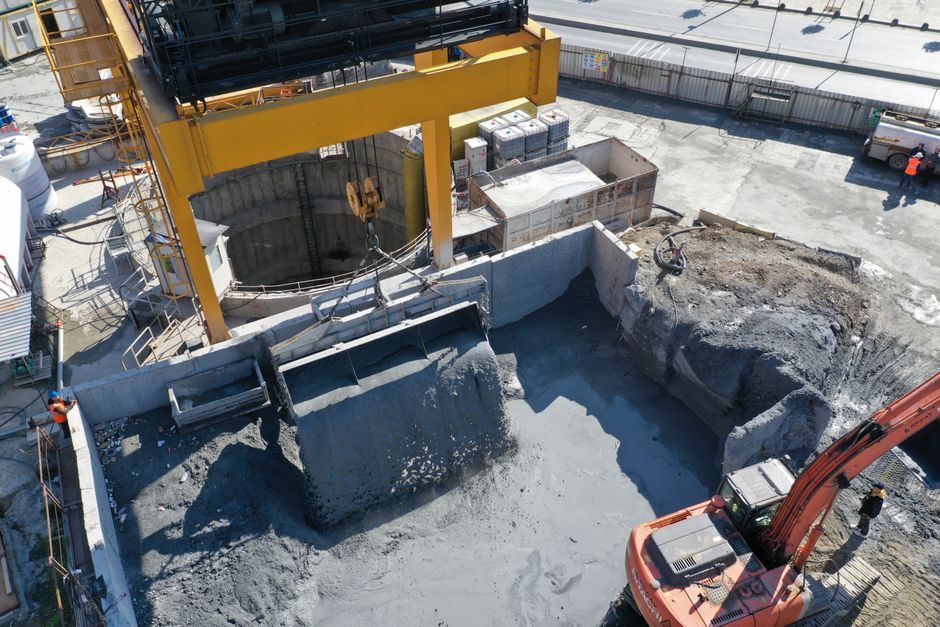
Automotive iron and aluminium foundries running cylinder blocks, heads, brake drums and differential housings specify sand mixers in the 30–60 t/h class with 18.5–75 kW drive power, dual-hydraulic mulling, and bottom-discharge doors, according to current Chinese OEM build sheets [S4].
The machine category covers four operating regimes — green sand for high-volume iron, resin-bonded (furan/phenolic) for steel and large iron, no-bake self-hardening for short-run steel prototypes, and clay-bonded bench units for laboratory work — and each regime has a distinct spec envelope, not a single "best" model [S1][S4].
Sizing Throughput and Drive Power Against Casting Weight
Continuous sand mixers in the 30–60 t/h band pair with molding lines producing 120–240 moulds/h, the typical envelope for engine block and housing output at 30–60 s cycle time [S4]. Smaller dual-shaft units from approximately 5 t/h up to 30 t/h serve job-shop iron pours and core bench refill; laboratory and R&D units sit at 50–500 kg/batch with 0.75–4 kW drives, a separate spec class that does not scale linearly to production [S1][S4].
Drive sizing follows a 1.8–2.5 kW per t/h rule of thumb for green sand and 1.2–1.6 kW per t/h for resin sand, where lower resin viscosity reduces mulling load; a 30 t/h green-sand machine therefore lands near 55–75 kW, while a 30 t/h resin unit is closer to 36–48 kW [S4]. For the small end, a 5 t/h unit typically carries 7.5–11 kW, and bench-top resin mixers used for cores run from 0.75 kW up to about 4 kW for 5–10 kg batches [S1].
Mechanical Layout: Shaft Type, Lining and Discharge
Wheel (muller) mixers remain the workhorse for green sand because the rolling-and-sliding action de-aerates and tempers bentonite-bonded mixes; rotor-style horizontal-shaft mixers dominate resin and no-bake lines, where paddle-tip speed matters more than mulling pressure [S1][S4]. Lining choice correlates with abrasiveness: ductile-iron or manganese-steel liners handle silica-sand green systems, while polyurethane or Ni-Hard liners extend life in resin lines with acid-cured furan [S4].
Discharge geometry — bottom-door, end-door, or side-pneumatic — must match conveyor height and mould-loop geometry; bottom-discharge doors with hydraulic actuation are the 2026 default for new automotive green-sand lines because they evacuate the pan in 3–5 s and avoid sand carry-back on inclined conveyors [S4]. For resin lines, end-discharge with pneumatic or hydraulic gates is typical, and the discharge should be sealed against furan fumes that would otherwise attack the conveyor belting [S1].
Resin vs Green vs No-Bake: A Criteria-Based Comparison
Resin-bonded mixers win on cycle time and dimensional accuracy for steel castings such as automotive crankshafts and knuckles; green-sand mixers win on cost per tonne for high-volume iron castings such as blocks and heads; no-bake mixers sit between them for short runs and large steel prototypes where mould strength matters more than throughput [S1][S4]. The decision is driven by binder chemistry and pouring temperature, not by machine brand.
On four decision criteria: (1) throughput — green-sand 30–60 t/h, resin 10–30 t/h per unit, no-bake 5–15 t/h per unit; (2) binder cost per tonne — green sand is lowest, furan resin intermediate, phenolic urethane highest; (3) sand reuse rate — green sand above 90% with rebond, resin sand typically single-use unless mechanically reclaimed; (4) tolerance on casting — green ±0.5–1.0 mm on small iron, resin ±0.2–0.4 mm on steel, no-bake ±0.3–0.5 mm [S1][S4]. For engine blocks poured at 1,350–1,450 °C, green sand is the default; for steel knuckles at 1,550–1,620 °C, resin or no-bake is required.
Process Control and PLC Integration on 2026 Equipment
Current OEM build sheets specify PLC-controlled binder and catalyst dosing with closed-loop flow meters, plus temperature and moisture probes on the muller pan, so the operator sees moisture in the 2.5–4.0% band and bentonite activation in real time [S4]. For resin lines, acid-to-resin ratio is held within ±5% of setpoint via coriolis or gear-meter dosing, and the catalyst (often an organic sulfonic acid) is added in a separate stage to avoid premature cure in the pan [S1].
Sand temperature control is a recurring 2026 buyer concern: incoming silica at above 35 °C shortens bench life in resin systems, so plants either store sand under cover or install a sand cooler upstream of the mixer. For green sand, the same cooler can be used to keep return sand below 45 °C, which is the working range where bentonite activation stays predictable [S4].
Cell Layout With Mixers, Molding Lines and Reclamation

A typical automotive green-sand cell pairs a 30–60 t/h sand mixer with a high-pressure molding line, an overhead return-sand conveyor, a vibrating screen, magnetic separator, and either a power mixer feed for additives or a fluidized-bed cooler [S1][S4]. Resin cells replace the green-sand cooler with binder tanks, amine catalyst skid, and a reclamation loop, while a resin sand line integrates mixing, molding and hardening on a single track. Where a plant runs both green and resin, the two lines usually share a common concrete mixer truck-style overhead bin fleet for silica storage, which simplifies sand logistics but forces strict lot segregation.
Sand-blasting machines downstream of the casting shakeout share return-sand routing with the mixer cell on some layouts; a sand blasting machine fed from the same silo fleet must be guarded against tramp metal with a magnetic head pulley and a scalping screen rated below 2 mm, or it will feed oversize back into the molding line and cause scrape defects [S1][S4].
Standards, Safety and Vendor Watch
CE-marked mixers for export carry the EN 12100 machinery-safety conformity, and Chinese-built units commonly ship with documentation against GB/T 25019 (foundry machinery — sand mixers) and JB/T equipment codes; explosion-relief panels are standard on resin lines because furan-acid reactions release heat and fume [S4]. For automotive tier-1 sourcing, the audit checklist typically covers CE/UL control panels, PLC source code escrow, and a documented MTBF above 8,000 h on the gearbox [S1].
The sourcing map in 2026 remains concentrated in Chinese OEM hubs, with Qingdao-based builders quoting 30–60 t/h resin and green units in the USD 35,000–120,000 band FOB, plus optional PLC and cooler skids at 15–25% of base price [S4]. Lead times from PO to FAT are typically 30–45 working days for a 30 t/h unit and 60–75 days for a 60 t/h line with full conveyor and cooler integration [S4]. Plants that already run a wire-rod feed for the foundry shop floor — discussed in the best wire-rod for food and beverage sourcing guide for an adjacent cell — should treat the wire-rod supplier relationship as a parallel data point for raw-material traceability, not a substitute for mixer qualification [S1][S4].
Specifying engineer should anchor the purchase on three documents from the vendor: a benchlife-versus-temperature curve for the resin system, a power-versus-throughput curve at the plant's incoming moisture, and a lining-life table tied to abrasive index; these three data sheets are the most reliable way to compare two 30 t/h quotes that look identical on the brochure [S1][S4]. Two signals to watch in the second half of 2026 are the rollout of 75 kW IE4-class dual-motor resin units and the wider adoption of inline moisture probes feeding closed-loop water dosing on green-sand muller pans, both already visible in current OEM build sheets [S4].