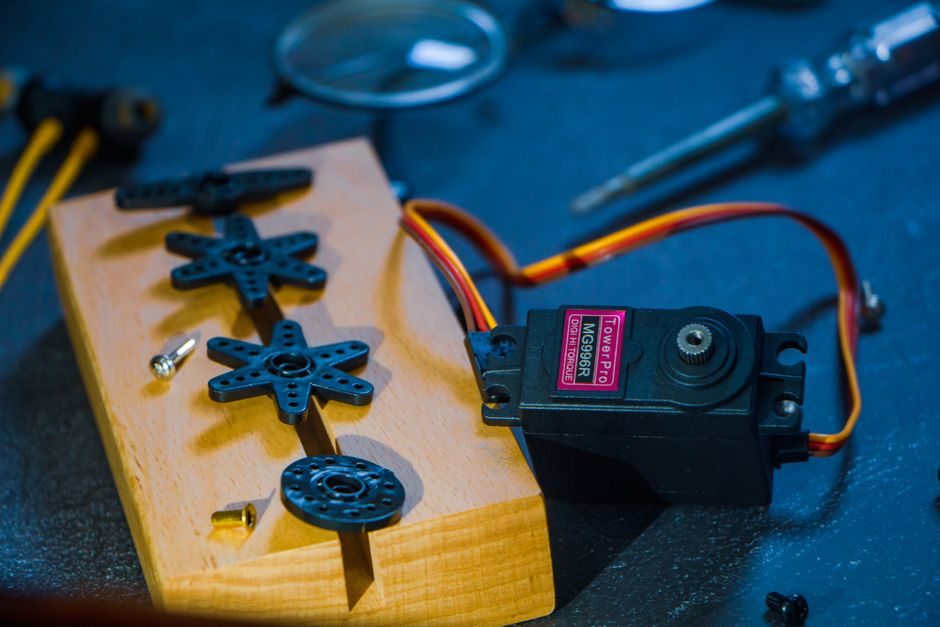
A fractional-horsepower BLDC outrunner priced for industrial buyers sits at US$24.99-50.81 per piece at 100-piece MOQ from Chinese OEM listings [S7], with a 24 V/157 W 70BL3A60 unit spec'd at 0.5 N·m rated torque and 3000 rpm.
On the heavier end, 200-640 W brushless DC servomotors with integrated speed controllers — examples include Mabuchi IS-74BZA, IS-94BZC and IS-B5BZA at 0.6-2.3 N·m and 2400-3200 rpm — are listed as catalog items rather than commodity SKUs and typically transact in the low-to-mid three-digit US dollar range [S1].
Where the price actually comes from
BLDC list prices are dominated by four line items: permanent-magnet material, stator copper mass, bearing/sensor stack, and the power-processing electronics [S3]. A three-phase inverter replaces the mechanical commutator and brush set of a brushed DC motor, so the bill of materials shifts from consumable wear parts to solid-state gate drive, current sensing, and rotor-position feedback (Hall sensors or sensorless back-EMF) [S3][S5].
At 100-piece MOQ, a 24 V 157 W outrunner (70BL3A60 series) is listed at US$43.55-50.81/piece, while higher-voltage 310 V 313 W and 470 W siblings drop to US$24.99-39.99/piece in the same supplier's tier — the spread tracks winding count and magnet volume rather than the wattage alone [S7]. A small-frame brushless HVAC actuator on made-in-china lists at US$45.00/100-piece MOQ with 100,000 pcs/year capacity from a Guangdong supplier [S4].
Spec tiers and what they cost
Low-power micro BLDCs (under 10 W) — typified by the 9.2 W 16ZWC32L-1 at 0.65 A and 0.007 N·m — are commodity items, often sub-US$10 at hobby-tier volumes but climbing into US$15-30 when paired with an integrated controller [S1]. Mid-power industrial BLDCs (50-100 W) cluster around US$30-60/piece at 100-piece MOQ; high-power industrial units (200-640 W) with integrated electronics sit in the US$120-400/piece band based on the catalog data shown [S1][S4][S7].
Three pricing rules of thumb hold across the 2026 supplier set: (1) doubling torque roughly doubles unit cost because it requires more magnet mass and copper, not just better control; (2) integrating the ESC inside the motor housing adds 20-40% to the price versus a motor-only SKU; (3) sensorless versus sensored configurations cut cost roughly 10-15% but require the controller to handle back-EMF commutation in the low-speed region [S5][S7]. For guidance on how rotor KV, voltage class, and driver matching interact with these cost tiers, see the BLDC selection spec map.
Application-driven price bands
Drone and UAV BLDCs (X-TEAM XTO-1106 through XTO-3115 series) target multirotor and fixed-wing platforms; pricing on these is driven by KV rating and stator volume rather than wattage, and volumes are typically quoted in hobby-grade MOQs at well under US$50/unit [S2]. Underwater ROV and electric-hydrofoil motors are direct-drive configurations with IP-rated housings, and the same X-TEAM line publishes pump-jet integrated power systems that bundle motor + ESC + impeller for surface-watercraft duty [S2].
Industrial servomotor-grade BLDCs (BXT flat external-rotor, BX4 SC with integrated speed controller) cross over into the servo motor selection space — they trade raw low-end cost for torque density, low cogging, and closed-loop capability. The BXT family covers 6-100 W at 0.0097-0.134 N·m and up to 10,000 rpm; the BX4 SC adds onboard speed control in a diameter-compliant package [S1].
Total cost of ownership, not just unit price
Brushless designs eliminate brush replacement and, per Power Integrations, offer higher efficiency and reliability than brushed motors, which can reduce thermal load and energy cost over the operating life [S6]. Power Integrations notes that efficiency regulations for white goods and HVAC are pushing the consumer side of the market hard toward BLDC, which means the BLDC price-per-watt is on a sustained downward curve [S6].
Maintenance is the second TCO lever: a sensored BLDC with electronic commutation removes the brush-and-commutator wear-out path that limits brushed DC service life, so for high-duty-cycle applications (medical pumps, AGV wheels, industrial fans) the lifetime cost math usually favours BLDC even at a 30-50% unit-price premium [S5][S6]. For plants already standardising on DC power supply rails and DC-DC converter bus architectures, dropping in a BLDC also removes the AC-drive infrastructure that an induction motor would otherwise need.
Who BLDC pricing is for — and who it isn't
The US$25-50/piece tier is for volume buyers willing to accept Chinese OEM lead times, 100-piece MOQs, and standard 24-310 V windings [S4][S7]. It is not for buyers needing ATEX/IECEx certification, IP67+ housings, or sub-arcminute positioning — those requirements push buyers into the US$200-2,000+ servomotor bracket.
Buyers who need closed-loop positioning, very low cogging, or compatibility with industrial fieldbuses (EtherCAT, PROFINET, CANopen) should evaluate [servo motor](/encyclopedia/servo-motor-selection-spec-based-decision-map-for-2026.html) platforms instead of commodity BLDCs, since the encoder, drive, and bus-stack costs dwarf the motor cost itself. Buyers who simply need reliable rotary motion on a fixed voltage rail, with no positioning requirement, get the strongest TCO story from sensored industrial BLDCs in the 50-200 W band.
Selection and sourcing criteria
Supplier landscape in the 2026 catalog: DirectIndustry indexes 124 manufacturers and 890 products for "brushless motor" [S1]; X-TEAM, founded 2007 in Dongguan, runs ISO 9001:2015 and ISO 14001:2015 certified lines with CE/FCC on its consumer drone line [S2]; Changzhou Sunrise and similar Changzhou/Guangdong OEMs compete on the fractional-horsepower outrunner tier at the price points quoted above [S4][S7]. For buyers cross-referencing BLDC against linear guide and crossed-roller guide stages, the motor cost is usually under 25% of the stage BOM once the drive, feedback, and mechanics are added.
Limits, failure modes, and trackable signals
Common BLDC failure modes that affect cost-in-use: bearing wear in high-rpm outrunners (typical service interval 5,000-10,000 hours); demagnetisation of NdFeB rotors at sustained temperatures above 120-150°C; ESC MOSFET failure from inadequate heat-sinking; and Hall-sensor misalignment on sensored units, which causes startup torque loss. None of these are exotic, but they all interact with how a unit is specified, so the cheapest catalog SKU is rarely the cheapest installed cost. [S1]
Trackable signals to watch into late 2026: Power Integrations and other driver-IC vendors are pushing higher-integration BLDC controller ICs, which should continue compressing the integrated-ESC price premium [S6]; the same efficiency regulatory pressure is forcing HVAC and white-goods OEMs to migrate brushed→brushless at scale, and that volume should keep dragging the US$25-50 hobby/light-industrial band downward. The next decision node for any BLDC buyer is the encoder/feedback stack choice — once that is fixed, the servo motor selection map applies directly.