Bucket elevators in food and beverage plants require 304 or 316 stainless steel contact surfaces, FDA-grade polymer or stainless buckets, and IP66 or IP69K wash-down-rated drives, with centrifugal discharge at 50-100 m/min belt speed for free-flowing dry goods such as grain, sugar, salt, and milk powder [S1][S6].
Selection pivots on nine inputs: material type, density, capacity in ft³/h, discharge height, material temperature, moisture, max lump size, ambient temperature, and duty hours, all of which fix the elevator class, bucket code, and casing choice [S2].
Sanitary Construction: Stainless, Polymers, and Surface Finish
Food-grade elevator buckets ship in 304 stainless for dry ambient lines and 316 stainless for salty, acidic, or chlorinated-cleaned products, with surface finishes specified to Ra ≤ 0.8 µm on welds in high-care zones [S4][S6]. Polymer buckets in HDPE, nylon, or polyurethane satisfy FDA food-contact requirements where metal-to-product contact is undesirable, and most food-grade lines run 9 x 5 in (229 x 127 mm) or 9 x 6 in (229 x 153 mm) buckets with 6-9 in (152-229 mm) spacing [S1].
Casing, head, and boot sections should be 304/316 stainless with continuous seam welds ground smooth, and external fasteners limited to captive stainless hardware to eliminate crevices that trap product or cleaning fluid [S4]. For high-care or WIP lines, the bucket elevator reference architecture aligns with sanitary pressure transmitter and flow meter installations where CIP residual must be drained and surfaces verified cleanable to 3-A / EHEDG practice [S4].
Discharge Type and Centrifugal Sizing for Free-Flowing Foods
Centrifugal discharge elevators run 1.5-2.5 m/s (300-500 fpm) belt speed and are the default for free-flowing food ingredients: flour, sugar, salt, rice, malt, milk powder, and dry starch, all of which discharge cleanly from the head pulley without carry-back [S1][S2]. Brock's BE180912 family at 95 rpm and 448 fpm (2.28 m/s) on an 18 in (458 mm) pulley handles 1,350-2,650 BPH (37-72 MTPH) at 48 lb/ft³ (768 kg/m³) water-level-plus-10% fill, which is the standard reference for dry grain [S1].
Continuous-bucket elevators running at 0.5-1.0 m/s suit fragile or friable foods (extruded cereals, flakes, agglomerated powders) where centrifugal impact would fracture the product, and the same code logic maps into the bucket-spacing column of the Brock table [S1][S2]. For dairy, brewing, and distillery grain handling, IS 7167 specifies boot-shaft take-up for materials that compact or settle after shutdown, with head-shaft take-up reserved for free-flowing dry products [S3].
Drive, Motor, and Wash-Down Ratings
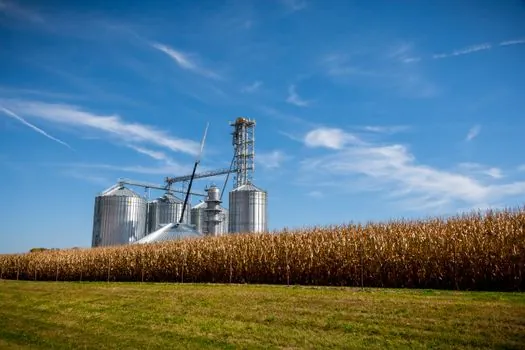
Food-grade elevator drive packages typically pair a helical-bevel or shaft-mount gearbox with a TEFC or wash-down motor in IP66 (NEMA 4X) enclosure, with VFD control for start-up sequencing and product changeover; in zones with flour dust or sugar fines, ATEX/IECEx-rated motors are specified even where the line is not formally classified [S2][S6]. Head pulley diameters run 18-48 in (458-1220 mm) across the Brock line, with belt speeds from 2.28 m/s at the small end to 3.30 m/s on the BE4814 series at 25,000-35,000 BPH (681-953 MTPH) [S1].
Motor horsepower scales with lift height and capacity: a 20 m lift at 10 MTPH typically lands in the 5-7.5 kW band, while a 35 m lift at 50 MTPH needs 22-30 kW, and reverse-run backstops plus zero-speed switches on the boot are standard for food-line safety [S2]. In CIP areas the same engineering envelope applies to industrial valve selection for wash-fluid routing: pneumatic actuators, stainless bodies, and IP-rated solenoids that survive daily foam and rinse cycles [S4].
Materials and Capacity Reference Table
Capacity planning for food-grade elevators is dominated by bulk density: grain at 48 lb/ft³ (768 kg/m³) is the Brock reference, sugar at 50-55 lb/ft³, salt at 70-80 lb/ft³, and milk powder at 35-45 lb/ft³, all of which fit the centrifugal envelope at 9 x 6 in buckets [S1][S2]. For reference, the bucket elevator selection logic starts with the material code in the Martin catalog (A200, A100, B6, C1/2, D3, D7) which maps to fine powders, granules, and lump sizes up to 7 in, and the same code system drives the bucket style, spacing, and belt speed in the OEM table [S7].
Chief's CBE48 at 500 BPH (13 MTPH) up to 20,000 BPH (544 MTPH) covers the small-to-mid food plant range, while Brock's BE481447 at 35,000 BPH (953 MTPH) addresses large brewery, malting, and grain-elevator operations; the choice between them is set by lift height, ambient temperature, and whether the line is wash-down or dry-clean only [S1][S8].
Standards, Hygiene Codes, and Rejection Criteria
Food-grade bucket elevator selection is anchored in 3-A Sanitary Standards for dry-product contact, FDA 21 CFR for food-contact polymers, USDA-FSIS accepted materials for meat and poultry, and EHEDG Doc. 2 for cleanability, with ATEX 2014/34/EU and IEC 60079 applying inside dust-classified zones around flour, sugar, and cocoa lines [S4][S6]. Belt selection must be polyester/polyamide with FDA-grade thermoplastic cover, antistatic to ISO 284, and oil-resistant in bottling or brewing lines where incidental lubricant contact is possible [S6].
Common rejection points during FAT and SAT include: crevice welds not ground to Ra ≤ 0.8 µm, ferrous hardware above the product zone, bucket fasteners that retain product, and motors rated below IP66 in wet zones; a related cold-chain spec map for refrigerated grain and sugar handling is covered in Bucket Elevator Selection for Cold Chain Logistics [S4].
Trackable signals for the next sourcing cycle: a 3-A / EHEDG certificate dated within 12 months on every food-grade elevator, FDA compliance letter for all polymer buckets, ATEX/IECEx rating matched to the dust zone, and IP66 or higher on every drive component. Engineers specifying a PLC-controlled bucket elevator with VFD and CIP interlock should reference the same wash-down rating cascade used for pressure sensor selection on the same skid, so documentation stays consistent across the line [S2][S4].