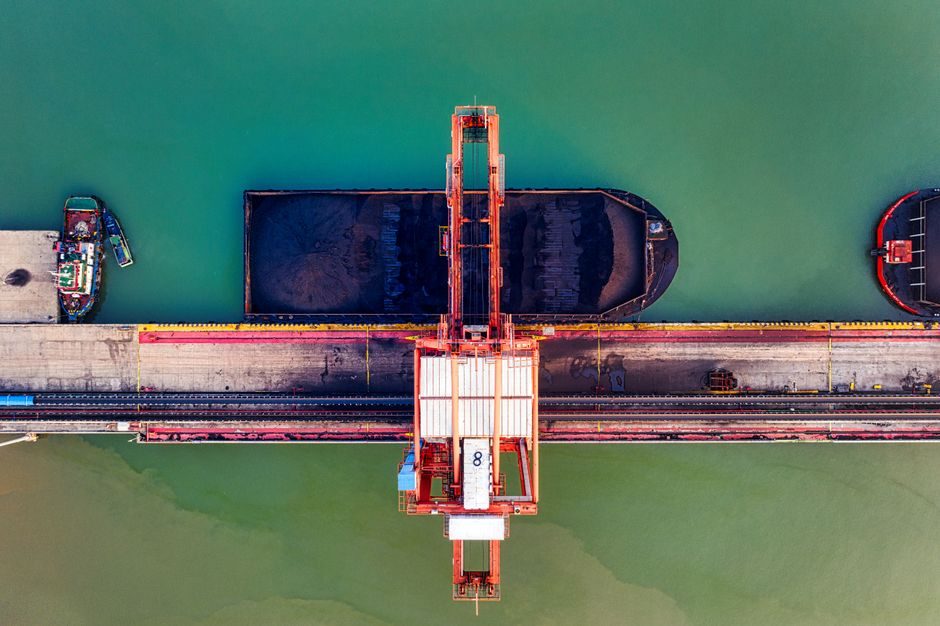
Port-logistics overhead conveyors in 2026 are specified around three hard numbers: maximum unit load (typically up to 2,000 kg for palletised container handling), chain pull calculated as 0.035 × total live load for monoplane systems, and chain pitch equal to minimum load spacing [S1].
Scope covers berth-side bulk transfer, quayside pallet movement, and intermodal yards; the equipment is selected against salt-air corrosion, vertical lift between quay and stacking areas, and continuous-duty operation in 24/7 terminal shifts [S3][S4].
Why an Overhead Conveyor, Not a Belt or a Forklift
Overhead conveyors reclaim the ground plane in terminals where quay width is fixed and the apron already carries RTG cranes, straddle carriers and road traffic; they move suspended loads on elevated rails, freeing the deck for vehicle and vessel operations [S2].
Compared with a belt conveyor running on the quay, an overhead chain system can traverse multiple elevation changes and process obstacles without a horizontal footprint, which is decisive in narrow apron layouts [S3].
The 2025-11 guidance for vertical-logistics equipment frames overhead conveyors as core equipment precisely because they convert otherwise-wasted high-altitude volume into active throughput, with continuous circulation replacing batch forklift moves [S3].
Three Architectural Types and Where They Fit
Monorail overhead conveyors (non-accumulating) couple every load carrier directly to a single rope, chain or cable, so all hooks move together — the simplest and lowest-cost architecture, suited to continuous paint-line or bulk-feed duty without station buffering [S2].
Power-and-free (Birail) systems run two tracks — a powered chain track and a free load track — so carriers can decouple, accumulate between workstations, and re-engage on command; this is the typical port-yard pick-and-stage architecture because it absorbs vessel-arrival surges [S2].
Electrified monorail systems (EMS) fit a powered drive into each individual carrier, letting each load move autonomously along the rail; that independence supports the multi-process, re-sequenced flows found in modern automated container terminals [S2].
For high-throughput automotive feeders running under the same selection logic, see the JIS logistics spec map — the architectural trade-offs (monoplane vs power-and-free vs EMS) translate directly to port pallet feeders.
Selection Criteria: Load, Pull, Span, Environment
Unit load and chain pitch dominate: minimum load spacing equals nominal chain pitch, and loads are spaced on integer multiples of that pitch; tighter turns need extra clearance, larger-radius turns need less [S1].
Drive pull is sized by the empirical 0.035 × total live load rule for monoplane systems, plus a lift-pull term for inclined rises — multiply total elevation gain of inclines (declines excluded) by product weight per foot of conveyor [S1].
If this method returns more than 50% of the rated system capacity, the drive train must be re-checked; getting the drive arrangement right up front is cheaper than retrofit correction, and lift pull commonly dictates the final drive size in port vertical-lift layouts [S1].
Structural frame in port use is typically high-strength steel for primary spans with aluminium-alloy sections where weight must be minimised; the frame is engineered to the preset span and height for full-load vibration control [S3].
Port-Specific Design Constraints
Port-logistics systems must be evaluated against four environmental factors: salt-laden atmosphere, ambient humidity, wind loading on suspended carriers, and the structural capacity of the quay building or yard gantry to take conveyor reactions [S4].
Designers use 3D modelling and simulation to evaluate ceiling height, structural support, and integration points with adjacent cranes and yard equipment before the track layout is frozen — a step that is non-negotiable on berth retrofits where headroom is constrained [S4].
Drive units in port duty are geared-motor with sprocket or belt drive delivering continuous, controllable torque; the tensioning system applies a constant preload through screw or counterweight to absorb chain elongation across long, multi-span runs [S3].
Related article: the cold-chain spec map covers condensation control; for port chemical shipping where corrosion is the dominant constraint, see the chemical-shipping spec map.
Cost and Capacity Trade-Offs
Capacity is increased by adding load-bars to a given chain size, but the manufacturer's own guidance is blunt: "it is often less expensive to go to the larger conveyor" unless load-bars are spaced far apart, because the fixed-cost block (drive, take-up, lubricator, curves) dominates the budget per foot [S1].
Reference budgetary pricing in the Martin Gregory example is anchored on a 700 ft sample paint-line layout, with a cost-per-foot adder for straight runs with attachments on 2 ft centres; longer or shorter layouts are estimated by linear adjustment of that per-foot figure [S1].
Free (hand-pushed) overhead systems deliver the lowest capex but require manual labour on every move, and are essentially excluded from port throughput economics; power systems with chain and drive are the floor for serious terminal duty, and power-and-free or EMS layers add cost only where accumulation or individual-carrier routing earn it back [S7].
Control, Safety and IoT Integration
Control systems in 2026-spec port installations integrate variable speed, start/stop interlocking, and position detection with the terminal's upper-level management system, with sensors providing real-time operating feedback to the TOS [S3].
Safety devices and screen guarding are treated as baseline by the Cardinal Conveyor reference, which organises overhead-conveyor scope into layout, chain pull, drives, trolleys, safety and electrical controls as parallel design packages rather than afterthoughts [S7].
IoT and machine-vision upgrades feed condition monitoring and predictive maintenance, lowering failure rates on the long, inaccessible spans above quay cranes; data-driven path and load-distribution optimisation is now specified as part of new builds rather than retrofitted later [S3].
Decision Matrix: Monorail vs Power-and-Free vs EMS for Ports
On four decision criteria — accumulation capability, per-carrier routing, capex, and suitability for 24/7 marine duty — the three architectures rank differently: monorail scores low on accumulation and per-carrier routing but lowest on capex; power-and-free adds accumulation and switched routing at moderate capex and is the default for most port pallet feeders; EMS delivers full per-carrier autonomy at the highest capex, justified where sequences change frequently or buffer lanes are long [S2].
For a yard comparing monoplane to power-and-free for a quayside pallet line: monoplane needs every load to move together (no surge absorption), drive pull is set by 0.035 × total live load plus lift pull, and minimum load spacing is the chain pitch itself [S1][S2].
For a container terminal mixing inbound and outbound flows, the practical rule is: specify power-and-free where surges are bounded and routes are stable, step up to EMS where the TOS is re-sequencing moves minute-by-minute, and keep monorail for steady-state feeders such as crane-to-stack transfers on a fixed path [S2][S4].
Failure Modes and Pitfalls
The most common port-duty failure modes are chain elongation beyond the take-up travel, drive undersizing on inclined lift sections, and corrosion at trolley wheel bearings — each of which is addressable at spec stage, not after commissioning. [S3]
If the simple 0.035 × live-load method returns more than half the rated system capacity, the drive must be re-engineered, not accepted; lift pull on port vertical rises routinely trips this threshold and is the single most common source of port-conveyor drive failure [S1].
Pitfalls to avoid, per the Cardinal Conveyor reference, include under-specifying safety devices, omitting screen guarding at floor crossings, and treating electrical controls as a separate work-package rather than integrating them with the mechanical design from day one [S7].
Trackable signals for 2026 procurement: insist on the chain-pull calculation method stated explicitly, the corrosion-class designation for trolley and track components, and the IoT sensor list with named interfaces to the terminal operating system before signing the PO [S1][S3][S4].
Detailed specification references: overhead conveyor, and overhead bridge crane.