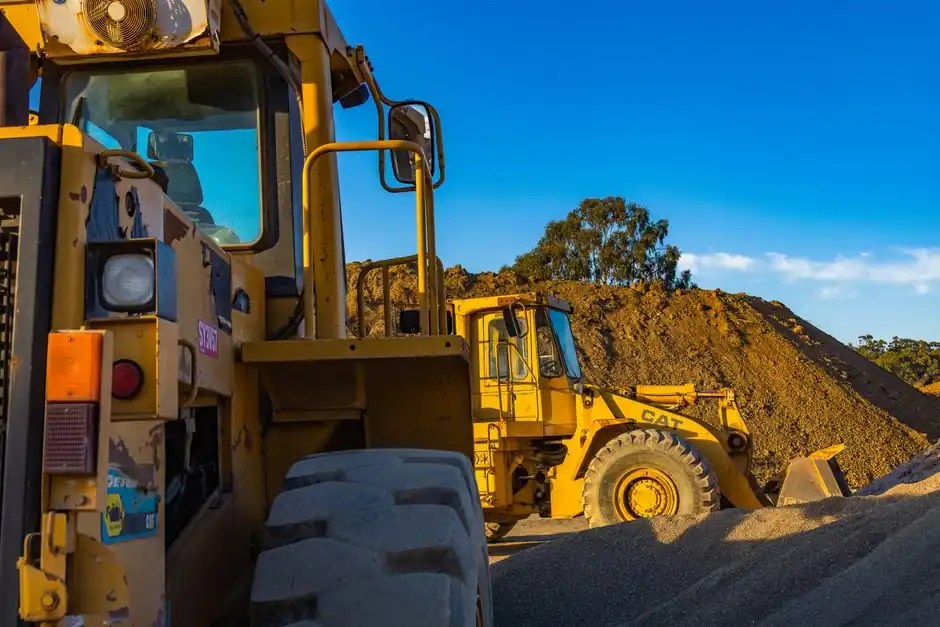
A bulldozer is the right pick when the jobsite is still raw: the tracked machine pushes soil, rock, demolition debris, and vegetation with a front-mounted steel blade and breaks compacted ground with a rear ripper [S1][S2]. A motor grader is the right pick when the roadbed already exists but the surface needs millimeter-class correction: the long moldboard mounted between the front and rear axles trues grade, slope, and crown in a way no dozer blade can match [S1][S5].
The two machines overlap, but only at the margins: a dozer can do rough, imprecise grading, and a grader can move small amounts of material in a pinch [S5]. Engine power on crawler dozers spans from about 80 HP on compact units to over 900 HP on machines such as the Komatsu D475A, one of the largest dozers in production [S2]. For more on the tracked earthmoving platform itself, see the bulldozer reference, and for the finishing machine used on the same roadbed, see the motor grader entry.
Core Function Split: Push vs Finish
The defining job of a dozer is to push, cut, move, and shape soil in bulk during the early stage of a road project, using blade power and track traction rather than fine control [S4]. Its front blade types split the work further: a Straight (S) blade handles fine grading on hard surfaces, a Universal (U) blade with curved edges pushes large volumes, a Semi-U (SU) sits between the two, an Angle blade sidecasts material, and a Power-Angle-Tilt (PAT) blade adds full hydraulic adjustment for versatile grading [S2].
A motor grader's defining job is fine grading, surface leveling, and slope control on a roadbed that already exists, using a long adjustable moldboard typically mounted between the front and rear axles, with some models adding a second blade ahead of the front axle [S4][S5]. Because the moldboard sits in the middle of the machine and can be rotated, tilted, and shifted laterally, the grader controls cross-slope, ditch profile, and crown to a tolerance that a dozer's front blade cannot hold [S1][S4]. For a deeper look at how the grader drivetrain supports that fine hydraulic control, see the hydraulic motor reference.
Dozer Blade Types and Where Each One Wins
Five blade geometries cover most dozer work. The Straight (S) blade is short and flat, best for fine grading on hard ground and for drifting material short to medium distances [S1][S2]. The Universal (U) blade has tall, curved side wings that hold large loads over long push distances, which is why it dominates stockpile and land-clearing work [S1][S2]. The Semi-U (SU) is a compromise shape that retains modest side wings for moderate loads while keeping the narrower S-blade footprint.
The Angle blade pivots left or right to push material off to the side (sidecasting), and the Power-Angle-Tilt (PAT) adds independent hydraulic control of angle, tilt, and lift for finish-grade work where a dozer is being used in place of a grader on tight sites [S2]. Tracks are the default undercarriage because wide track shoes lower ground pressure, letting the machine float over sand and mud where a wheeled machine would bog down [S1][S5]. Wheeled dozers do exist, but only for projects where mobility on firm ground matters more than tractive effort [S2][S3].
Grader Geometry: Why the Long Mid-Frame Moldboard Matters
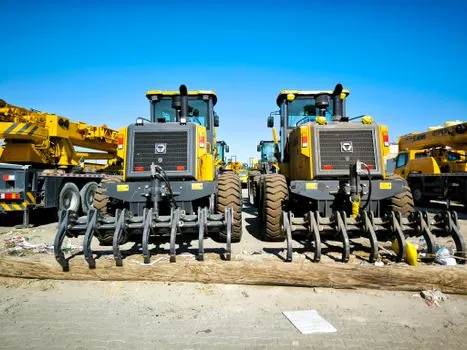
A motor grader's productivity comes from the moldboard's location and its range of motion. Mounted between the front and rear axles, the moldboard can be lifted, lowered, shifted sideways, tilted forward, and rotated through a full circle, which is what allows the operator to cut, carry, and spread material in one pass [S5]. This geometry is the reason a grader can place aggregate on a windrow, cut a V-ditch, or shave a high spot without losing control of the surrounding surface.
Typical grader applications include fine grading of road surfaces, controlling road slope and cross-slope, shaping drainage profiles, finishing the road base, correcting surface irregularities, and preparing the surface for compaction or paving [S4]. A grader can also move small amounts of dirt, but its physical size and the mid-frame blade position make it unsuited to moving large or heavy loads, which is the work a dozer is built for [S3][S5]. For the broader drivetrain category that powers the grader's hydraulic systems, see the AC motor and drive motor references.
Decision Matrix: Dozer vs Grader on Four Project Criteria
Choosing between the two comes down to stage, tolerance, material volume, and terrain. On a raw, uneven site that needs large-scale earthmoving, a bulldozer is the correct machine, and any grader sent in at that stage will waste time and under-perform [S4]. On a formed roadbed whose surface is inaccurate or not smooth enough, a motor grader is the correct machine, and a dozer will only make the surface worse by re-distributing material it cannot place precisely [S1][S4].
On material volume, dozers win by a wide margin: a U-blade pushes heavy loads over long distances, while a grader is designed for thin cuts and small carries [S1][S3]. On tolerance, the grader wins: its mid-frame moldboard is the only one of the two that can hold a designed cross-slope or crown within a tight band, while a dozer's best finish-grade work (PAT blade) is still coarser than a single grader pass [S2][S4]. On terrain, tracked dozers handle soft, muddy, sandy, or uneven ground because wide tracks lower ground pressure, while graders need a firmer, pre-formed surface to be productive [S1][S5].
Where the Two Machines Are Used Together
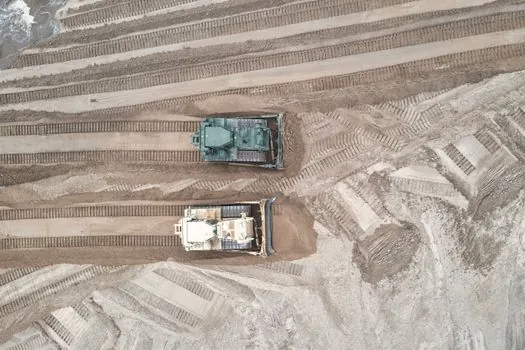
On real road and earthworks projects the two machines are sequenced, not swapped. The dozer runs first: clearing debris and obstacles, pushing and moving large volumes of soil, filling low-lying areas, rough-grading and shaping the initial roadbed, and preparing embankments and the basic road profile [S4]. That work turns raw or uneven ground into a workable construction base.
The grader runs second: fine grading the surface, controlling road slope and cross-slope, shaping drainage profiles, finishing the road base, correcting surface irregularities, and preparing the surface for compaction or paving [S4]. On mining and haul roads, the same sequence applies, with dozers building access and the grader maintaining the running surface during operations [S5]. The same pairing is used in mining dump truck haul route selection, where the dozer shapes the bench and the grader keeps the haul road to tolerance.
Limits, Failure Modes, and Common Mis-Selections
Three mis-selections account for most of the wasted machine-hours on road jobs. First, sending a grader onto raw, uneven ground: the machine's mid-frame blade cannot move large volumes, so the operator either abandons the cut or pushes the machine into a productivity floor [S3][S5]. Second, sending a dozer to do finish grading: even with a PAT blade, a dozer's front-mounted blade cannot hold cross-slope to the same tolerance a mid-frame moldboard can, and the result is a wavy surface that still needs a grader pass [S2][S4].
Third, ignoring ground conditions. Tracked dozers handle soft, muddy, and sandy terrain because wide tracks distribute weight and lower ground pressure, which is why they are specified for land clearing, mining, road building, and forestry [S1][S5]. Graders need a firm, pre-formed surface; a grader bogged in soft ground is one of the most common avoidable losses on a road job [S5]. When compaction, not grading, is the bottleneck after the grader has finished, the next step is a dynamic compactor selection review rather than more dozer or grader time.
Standards and Operating Reference Points
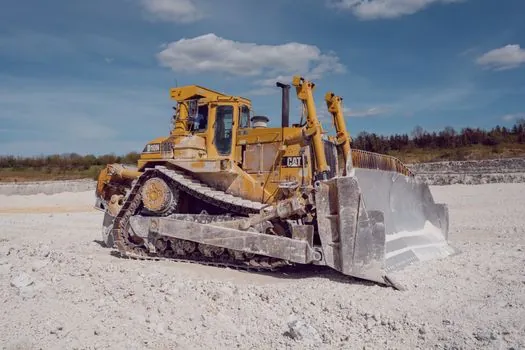
For machine selection, the governing documents are typically the project specification and the manufacturer's operating envelope: engine power class, machine operating weight, blade width and capacity, moldboard dimensions, and track shoe width. The 80 HP to over 900 HP spread across compact to ultra-class crawler dozers such as the Komatsu D475A is the practical power band contractors use to size a dozer to a project [S2]. On the grader side, moldboard length, frame articulation, and the number of powered axles are the headline numbers that distinguish a maintenance grader from a production road grader [S5].
Safety references on both machines center on the ROPS/FOPS cab structure, which is standard on modern enclosed operator cabs and is the reason dozer and grader cabs are designed to take impact and rollover loads [S1][S2]. For projects that need both machines in the fleet, the practical next step is a spec map that pairs the dozer class (and blade type) to the project stage, then matches the grader class to the tolerance required on the final road surface, with no overlap between the two roles.