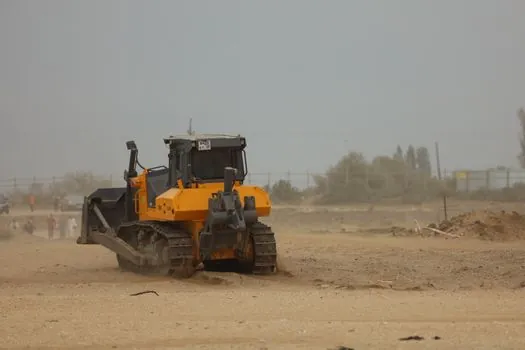
A bulldozer is a steel-bladed crawler built to push, spread, and rip material across open ground, with operating weights typically running from about 8 t on small construction dozers to over 100 t on large mining units.
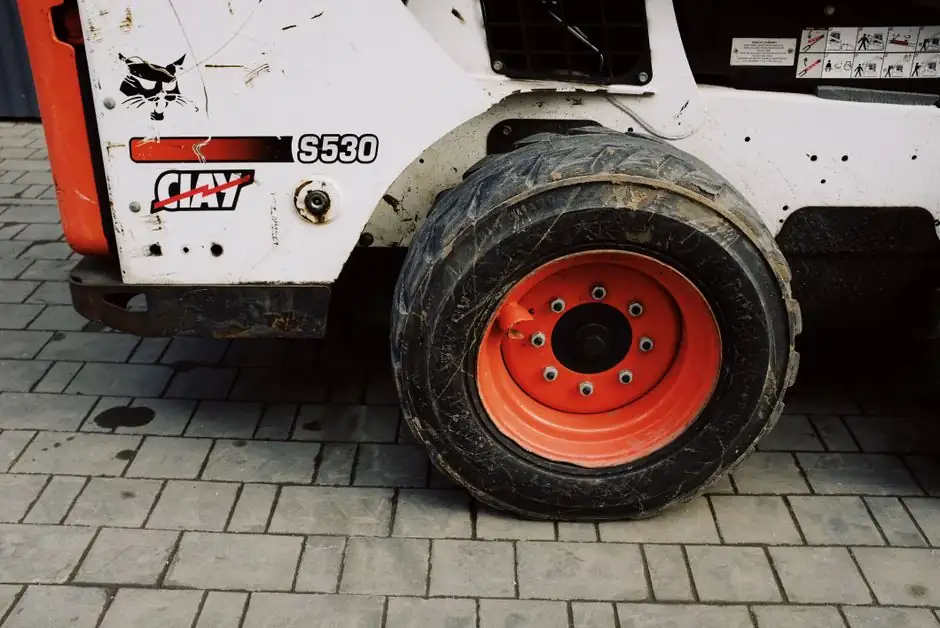
A skid steer is a compact, wheeled (or tracked) machine in the 2.5 to 4.5 t class that steers by driving the left and right wheels at different speeds, allowing zero-radius turns inside a footprint roughly 1.5 m wide and 3 m long, and it swaps hydraulic attachments in seconds.
Ground pressure and undercarriage: tracks vs wheels
Compact track loaders spread machine weight across a larger contact area than wheeled skid steers, which produces meaningfully lower ground pressure, on the order of 4 to 5 PSI for a CTL versus roughly 25 to 35 PSI for a same-class wheeled skid steer on hard ground [S1][S3].
A dozer rides on steel tracks with ground pressure commonly between 5 and 12 PSI depending on shoe width, putting it in the same low-pressure band as a CTL but at a much higher mass class, so a dozer rut soft soils far deeper than any skid steer, even though both protect finished surfaces relative to tires [S1][S3].
For sensitive surfaces (turf, asphalt, compacted subgrade) the spec ladder runs skid steer tire (highest PSI) > CTL rubber track (4 to 5 PSI) > dozer steel track (5 to 12 PSI but at far higher mass), and that mass-to-PSF ratio is the single biggest predictor of ground damage.
Productivity envelope: push force, lift capacity, travel speed
A skid steer typically cycles a 0.4 to 0.6 m³ bucket, lifts 600 to 1,400 kg at the coupler, and travels 10 to 14 km/h, so its productivity comes from short, fast, repeatable cycles rather than brute push force [S2][S4].
A dozer moves 2 to 11 m³ per pass with a semi-U or full-U blade, generates drawbar pull in the 100 to 600 kN range depending on class, and travels 8 to 12 km/h, so its productivity is measured in cubic meters pushed per hour, not in lift-and-go cycles [S2].
The 10 to 50x gap in per-pass material volume is the clearest decision gate: a skid steer is sized for truck-loading and finish grading in confined pads, while a dozer is sized for bulk cut/fill, site prep, and clearing where no compact machine can match the hourly throughput.
Site geometry: open ground vs confined work
Skid steers win on tight-space maneuverability, push-and-lift tasks, and attachment versatility where the machine does not need to travel across wide-open ground, a working envelope typically limited to about a 4 m radius [S4].
Dozers need at least a 6 to 8 m corridor for efficient V-pattern passes and do not work productively inside a standard 3 m wide utility trench, so they are wrong for any confined urban pad where a skid steer or mini excavator completes the same work in less space [S2].
For work in basements, inside buildings, or between existing structures, a skid steer (or compact track loader in the 3 to 5 t class) is the only machine in this comparison that physically fits and still leaves room for a truck or dumpster to receive material.
Attachment economics and crew model
A skid steer's standard auxiliary hydraulic flow runs about 60 to 90 L/min at 200 to 230 bar, which drives dozens of quick-attach tools: buckets, augers, trenchers, grapples, brooms, and breakers, all changed by the operator from the cab in under a minute [S4][S5].
A dozer's toolset is mostly fixed (blade, rear ripper, sometimes a winch) and changes are job-to-job, not cycle-to-cycle, so the attachment ROI on a dozer is measured in project weeks, while on a skid steer it is measured in single shifts [S5].
One operator with a skid steer and three attachments can replace a small labor crew on tasks like post-hole augering, brush cutting, and pallet loading, where a dozer with the same operator headcount would be idle most of the day waiting on support equipment.
Operating cost, transport, and maintenance reality
A new 75 hp skid steer lists in the $50,000 to $70,000 USD range with comparable daily rental around $250 to $400, while a 20 t class construction dozer lists from roughly $350,000 to $600,000 USD and rents for $1,200 to $2,000 per day, a 4 to 6x capital gap that defines the contractor scale each machine fits [S1][S2].
Track undercarriage replacement on a CTL or dozer runs $5,000 to $25,000 USD depending on machine class, while a skid steer's tire replacement is closer to $800 to $2,000 USD per set, a maintenance line item that is materially smaller for wheeled machines [S1].
Transport is a second hidden cost: a skid steer fits on a 5 t trailer behind a 1 t pickup, while a dozer above 15 t typically needs a lowboy and a dedicated tractor, which adds $300 to $800 USD per move and pushes dozer economics toward long, single-site deployments rather than multi-stop urban work.
Decision matrix by job type
For bulk site prep, cut/fill over 5,000 m³, and clearing brush or stumps on raw ground, a bulldozer is the only correct choice; a skid steer wastes hours on these tasks and never reaches required production rates [S2].
For truck loading, backfill around foundations, interior demolition, landscaping on finished pads, and any task with more than four attachment changes per shift, a skid steer (or CTL on soft ground) is the correct choice; a dozer is over-sized, over-priced, and physically too large [S1][S4].
For utility trenching where both digging and backfill are required, a mini excavator typically beats both machines on the dig pass, leaving the skid steer to handle backfill cycles; the dozer only enters the picture once the trench line is closed and grading the full pad begins, a sequencing logic that mirrors the broader comparison logic in Excavator vs Bulldozer: Spec Cut and Job-Site Match.
Limitations and failure modes each buyer should price in
Skid steers have a tipping risk when loads exceed the rated ROC (rated operating capacity) or when the operator carries a load high on uneven ground, so a tilt sensor and a load-moment indicator are the two spec gates that prevent the most common on-site injury [S4].
Dozers under 10 t often lack the drawbar pull to rip shale or hardpan, and renting up to a 20 t class unit is the only practical fix when ground resistance exceeds about 1 MPa; under-rating the dozer is the single most common productivity miss on first-time site prep work.
Wheeled skid steers lose traction and rut soft turf in conditions a CTL handles without issue, so buyers operating in spring thaw or wet-season conditions should default to a tracked platform from the first quote rather than upgrading after the first stuck machine [S1][S3].
Trackable signals for the next 6 months
Watch OEM price lists for the 2027 model-year skid steers, where high-flow hydraulic options (around 120 to 150 L/min) are now standard on mid-frame units, a spec change that widens the attachment catalog into full-size cold planers and hydraulic hammers [S4].
Track dozer telematics adoption is now common on 20 t and larger units, so contractors can pull fuel-per-cubic-meter benchmarks against their own moving-average targets, a metric that has become the standard internal KPI for site-prep bidding on earthworks over 10,000 m³.
Spec-level background on the components involved: backhoe loader.