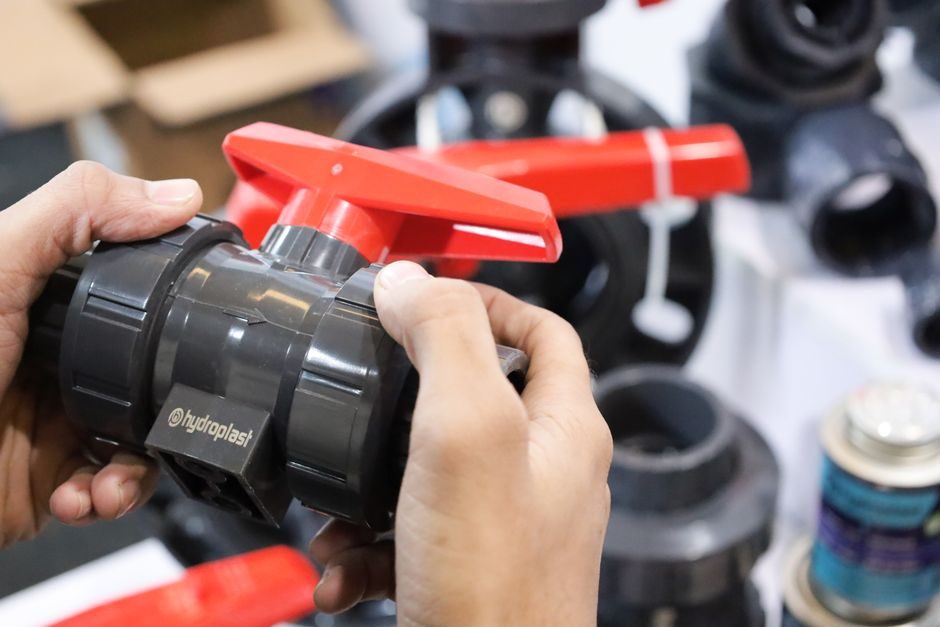
Specifying a butterfly valve in 2026 means choosing among concentric, double-offset, and triple-offset geometries; wafer, lug, or double-flanged bodies; and soft versus metal seats — each combination maps to a defined pressure-temperature and media envelope.
The decision starts with the duty: isolation only, modulating control, or high-cycle tank car service, because the seat technology, stem offset, and body class change with each role. Established product lines such as SFERACO 1115, Neles WSRR, and DeZURIK BTG bracket the three main use clusters seen in current OEM catalogs [S1][S2][S3].
Seat Architecture: Concentric, Double-Offset, and Triple-Offset
Concentric (resilient-seated) butterfly valves use a disc centered on the shaft with an elastomer or PTFE liner; the Neles WSRR series applies this layout with a flexible one-piece PTFE seat, rated to 260 °C (500 °F) at DN 6 in for tank car and food service [S3]. The flexible lip seat automatically compensates for wear and temperature changes, and a low-profile tank-car variant needs roughly one-third the skid height of a conventional bottom-outlet valve, enabling 100 % unloading without intruding into the tank shell [S3].
Double-offset (high-performance) designs move the shaft behind the disc sealing plane and offset the disc centerline from the pipe centerline, taking the seat out of the sealing contact during the first 10° of opening. The SFERACO 1115 series is built this way: wafer, double-offset, fire-safe per ISO 10497:2010, with an ISO 5211 mounting pad, 100 % tight bidirectional shutoff, and a preferred flow direction marked on the body [S1]. Rated DN 50–350 mm, PN 20 bar, and -29 °C to +210 °C, the 1115 sits in petrochemical, shipbuilding, and steam service up to 10 bar saturated steam [S1].
Triple-offset (metal-to-metal) butterfly valves add a third conical offset that lifts the seat completely off the disc at all points except closure, eliminating seat wear during throttling. These are the standard choice for polymerization-prone tail gas, hydrocarbon, and refinery services where soft seats would degrade, as the DeZURIK BTG tail gas high-performance butterfly valve illustrates [S2]. The BTG is built to API, ANSI, BS, DIN, and JIS standards with metal-seated or resilience-seated options for service where media solidification would otherwise lock a soft seat [S2].
Body Style: Wafer, Lug, and Double-Flanged
Wafer bodies sandwich between pipe flanges with bolts passing around — not through — the valve, which is the lowest-cost and lowest-weight layout. The SFERACO 1115 fits between PN 16 and PN 25 flanges and is supplied in carbon steel (1113 wafer with handle) or with a stainless steel CF8M disc and epoxy primer/epoxy finish (10–30 µm thickness, RAL 2012 / RAL 7045) [S1]. Manual handwheel operation is via a 10-position ductile iron handle with locking device up to DN 150; DN 200 and above use a gear box [S1].
Lug bodies have threaded inserts that allow the valve to serve as a pipeline end, suitable for dead-end service at full differential pressure on one side. Double-flanged (double-eccentric) bodies bolt to separate pipe flanges on each face and are the typical configuration for DN 100–DN 2000, PN 10/16/25 trunk mains built to EN 593 and EN 1074-1/2 with face-to-face per EN 558-1 series [S6].
Pressure-temperature envelope widens from concentric to triple-offset. Concentric PTFE units cap around 200 °C for most elastomers; the Neles WSRR reaches 260 °C with PTFE only because of the lip-seat design [S3]. Double-offset soft-seated valves such as the 1115 reach 210 °C with the right seat compound; metal-seated triple-offset units push beyond 400 °C and into full ASME Class 150–300 trim territory when built to API 609 dimensions [S1][S2].
Materials, Standards, and Face-to-Face
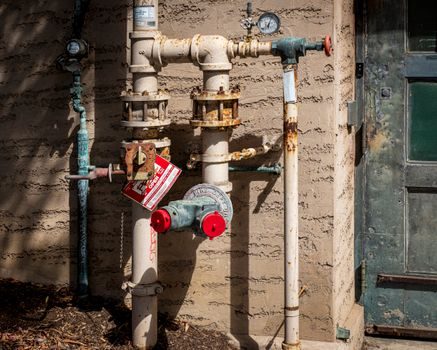
Body materials in current catalogs cover cast iron, ductile iron, carbon steel, stainless steel, aluminum, and PTFE/PFA-lined variants for chemical duty. The SFERACO 1115 lists steel, aluminum, stainless steel, and carbon steel; the disc is stainless steel CF8M, with ductile iron EN-GJS-400-15 handle and RAL-coated finishes [S1]. For commodity wafer lines in water service, the typical body is cast iron with EPDM or NBR liner, face-to-face per ISO 5752, and PN 10/16 drilling [S10].
Design standards form a layered hierarchy: API 609 covers lug and wafer butterfly valves for the process industries, EN 593 covers double-flanged and wafer types in European water and process service, AWWA C504 covers large-diameter water butterfly valves, and ISO 5752 defines short-pattern face-to-face dimensions used by many Chinese-built wafer units [S6][S8][S10]. For refinery and chemical service, manufacturers also publish compliance with API, ANSI, BS, DIN, and JIS simultaneously to cover global project specs [S2][S9].
Fire-safe certification is a separate overlay: ISO 10497:2010 (the version cited in the SFERACO 1115 datasheet) verifies seat integrity after exposure to fire, with external leak rates defined in the standard's classes [S1]. API 607 / API 6FA are the parallel fire-test references for soft-seated valves used in hydrocarbon service; ATEX 2014/34/EU governs equipment for zone 1 / zone 2 locations, while IEC 60079-x covers the equivalent IECEx scheme. Where media includes polymerizing hydrocarbons, soft seats are typically deselected in favor of metal-seated triple-offset designs [S2].
Application Matrix: Which Geometry Fits Which Duty
For tank car, food, and low-pressure chemical service below 200 °C with clean media, a concentric PTFE seated Wafer-Sphere-type unit (Neles WSRR) gives bubble-tight shutoff and lightweight installation [S3]. The lip seat design derived from the Jamesbury ball valve delivers bidirectional sealing with automatic wear compensation, and the polished, passivated stainless WSRR 36HB TT6KT variant is built for food-grade media such as corn syrup [S3].
For general process, HVAC, shipbuilding, and steam service up to 10 bar and 210 °C, a double-offset wafer design (SFERACO 1115) provides fire-safe certification per ISO 10497:2010 and an ISO 5211 actuator pad ready for gear, electric, or pneumatic actuator retrofits [S1]. Its DN 50–350 mm wafer envelope covers most building-services and light-industrial line sizes [S1].
For refinery, petrochemical, tail gas, and high-temperature hydrocarbon service where soft seats would polymerize, coke, or leak past 300 °C, a triple-offset metal-seated butterfly (DeZURIK BTG class) built to API 609 dimensions with API, ANSI, BS, DIN, and JIS compliance is the correct choice [S2]. Larger DN 100–2000 trunk lines, including raw-water and cooling-water headers, fall to the AWWA C504 / EN 593 double-flanged family (such as the PN 10/16/25 double-eccentric double-flanged units) [S6][S8].
Modulating control is a separate question: for continuous throttling, a control valve with characterized trim generally outperforms a butterfly valve, but double-offset and triple-offset designs with anti-cavitation discs and higher shaft stiffness can be used for moderate modulating duty. For on-off isolation where cost and weight dominate, a wafer concentric butterfly is almost always selected over a ball valve of the same line size because of lower mass and price at DN 100 and above [S7].
Selection Checklist and Common Failure Modes
Five items to lock down before issuing a butterfly valve datasheet: (1) maximum operating pressure and temperature, including any excursion during start-up or steam-out; (2) media composition, with a flag for hydrocarbons, polymerizing fluids, slurries, or sterile/food-grade service; (3) body style — wafer, lug, or double-flanged — driven by piping class and dead-end requirements; (4) seat material — EPDM, NBR, PTFE, or metal — driven by temperature and chemical compatibility; (5) actuation — lever, gear, pneumatic, or electric — with actuator sizing verified against the disc torque at the worst-case differential pressure [S1][S2][S3].
Common failure modes trace back to seat selection. Soft-seated concentric valves fail when the elastomer exceeds its temperature rating or swells in incompatible media, leading to leak-by or stem packing rupture. Double-offset soft-seated valves can suffer seat deformation in throttling service if the disc is allowed to dwell in the partial-open position at high differential pressure. Triple-offset metal-seated valves avoid those modes but add the cost of precision machining and require strict adherence to the preferred flow direction marked on the body [S1][S2].
For chemical and hydrocarbon service, specifying NACE MR0175-compliant trim on wetted parts is often required when H₂S partial pressure exceeds the standard's thresholds; this is independent of the seat type and applies to any valve carrying sour service. Cyclic service on tank cars benefits from the WSRR's flexible lip seat, which is engineered for tens of thousands of open/close cycles and bubble-tight sealing under pressure test [S3][S9].
Bidirectional shutoff capability is now standard on high-performance double-offset designs (the 1115 advertises 100 % tightness in both directions with a preferred flow direction), so designers no longer need to oversize for directional uncertainty, but a check valve is still required for anti-surge protection on pump-discharge headers where reverse flow would damage equipment [S1].
Where to Pull Datasheet Numbers, and What to Watch Next
Authoritative 2026 catalogs confirm three concrete data points useful as baselines: SFERACO 1115 rated -29 °C to +210 °C at PN 20 bar, DN 50–350 mm, fire-safe per ISO 10497:2010; Neles WSRR rated to 260 °C (500 °F) at DN 6 in with PTFE lip seat; DeZURIK BTG tail gas units built to API/ANSI/BS/DIN/JIS with metal-seated or resilience-seated trim for polymerization-prone media [S1][S2][S3].
For larger sizes, EN 593 double-flanged double-eccentric units at PN 10/16/25 cover DN 100–DN 2000 with face-to-face per EN 558-1, while ISO 5752 short-pattern wafer units cover DN 40–DN 1200 in PN 10/16/25 for water and HVAC [S6][S10]. A second encyclopedic anchor worth keeping at hand for cross-comparison is the diaphragm valve page, which covers the principal alternative for low-pressure corrosive and hygienic service.
Trackable signals to monitor: the rate at which triple-offset units displace double-offset in refinery and tail-gas retrofits, especially where API 609 monogrammed bodies are now specified; updates to ISO 10497 fire-test acceptance criteria; and the gradual migration of wafer butterfly suppliers from cast iron to fully lined ductile iron bodies for potable water per the EN 1074-1/2 family [S1][S6]. Engineers specifying control valves versus butterfly valves for throttling duty should also watch for new characterized-disc trims that close the modulation gap on high-performance double-offset geometries.
For related coverage, see FRL Unit vs Pneumatic Cylinder: EMC Immunity Decision Map.