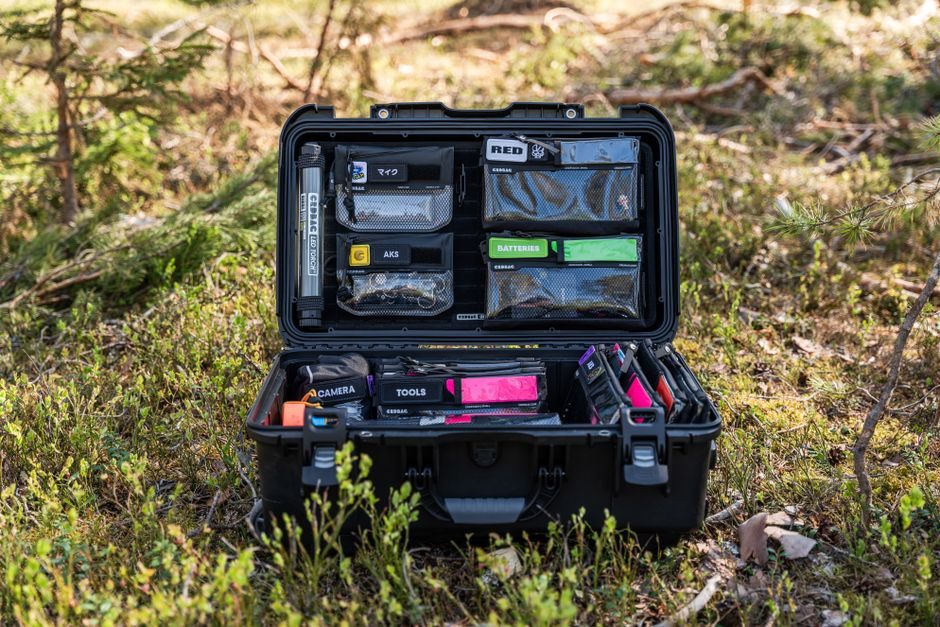
A carrying case is not packaging; it is a structural enclosure rated for impact, ingress, and chemical exposure, so the right choice is driven by quantifiable mechanical thresholds, not by catalog aesthetics [S2][S4]. Industrial buyers in 2026 typically evaluate four decision variables — payload mass, drop height rating, IP/IK seal, and forming process — before shortlisting material candidates, with MOQ ranging from a single retail SKU on wholesale platforms to ≥500 units for ISO 13485 custom medical cases [S1][S2].
For consumer electronics and earbud-style accessories, a wholesale supplier such as DHgate lists 22–29 results in a single carrying-case subcategory, indicating the consumer tier's breadth, while B2B custom shops (Shell-Case, Chellis) run separate engineering workflows for EVA, vacuum-formed, blow-molded, plastic-injected, and soft-sewn constructions [S1][S2][S4].
Payload Mass and Drop Height: The Two Mechanical Gates
Payload mass and drop-height rating are the first filters, because each forming process carries a different mechanical ceiling: soft-sewn and EVA shells typically cover 0.2–5 kg payloads with modest drop ratings, while blow-molded and plastic-injected cases target heavier instrument loads in the 5–25 kg range, per Shell-Case's process taxonomy [S2]. Concrete-moisture meter vendor Wagner Meters ships an L600 Series ruggedized case as a purpose-built enclosure for a portable test instrument, demonstrating how a mid-weight measurement tool is matched to a dedicated ruggedized shell rather than a generic pouch [S3].
Chellis — operating in custom cases since 1902 and advertising USA manufacture — explicitly markets engineered cases as "The Toughest On The Market," a positioning consistent with their targeting of test-and-measurement, electronics, and optics customers who need verified drop performance rather than cosmetic protection [S4]. The two mechanical gates (mass and drop height) therefore eliminate roughly half the candidate materials before ingress or compliance are even considered.
Material Forming Processes: EVA vs Vacuum-Formed vs Blow-Molded vs Plastic-Injected vs Soft-Sewn
Shell-Case lists five primary custom technologies, each with a distinct cost/durability profile: Custom EVA Case (low tooling cost, mid durability), Vacuum Forming Case (low–mid tooling, smooth cosmetic shell), Blow Molded Case (higher tooling, high impact resistance), Plastic Injected Case (highest tooling cost, tightest tolerances, highest durability), and Soft Sewn Case (textile-based, lowest tooling) [S2]. The decision is essentially a cost-versus-durability axis, with EVA favored for short-run industrial and medical cases, blow-molded for medium-volume rugged applications, and plastic-injected reserved for high-volume programs where amortized tooling beats per-unit cost [S2].
For industrial procurement, EVA dominates medical-device custom cases in the 500+ unit tier because it supports ISO 13485-documented production with biocompatibility material selection, while vacuum-formed and blow-molded shells are the more common choice for sales-and-demo kits and hardware-and-measuring instruments [S2]. A linear guide or flow meter being shipped to a field service team will more often live in a blow-molded or plastic-injected enclosure, where drop-rating and seal integrity outweigh the cost premium.
Compliance Pathway: ISO 13485, REACH, RoHS, and Biocompatibility
For any case touching a medical device, EU-bound electronics, or California retail, the material-selection conversation must satisfy ISO 13485 quality-system documentation, REACH chemical-substance registration, RoHS restriction of hazardous substances, Proposition 65 (CAL65), and where skin contact is plausible, biocompatibility per ISO 10993 — Shell-Case explicitly names all four frameworks in its materials-selection workflow [S2]. A custom medical-device case is, in Shell-Case's own framing, "a second skin" for the device, and the supporting documentation is what makes a case regulatory-defensible rather than just physically protective [S2].
For non-medical industrial buyers, REACH and RoHS are still the gating chemical-compliance items; if the case is used to ship a pressure transmitter or industrial valve into the EU, the enclosure itself must not introduce restricted-substance exceedances, even though the device inside carries its own ATEX/IECEx certification. Chellis's 1902 heritage implies long-term material-traceability documentation, which is the practical differentiator when a buyer needs audit-ready paperwork, not just a rugged box [S4].
MOQ, Lead Time, and Sourcing Tier
MOQ divides the market cleanly: wholesale marketplaces (DHgate) sell earbud cases in single-piece increments at the lowest unit cost, with 22–29 SKUs visible in a single subcategory and a "Last updated: July 11, 2026" timestamp confirming active listing churn [S1]. Custom B2B shops such as Shell-Case set a 500-unit minimum for custom medical-device cases, with separate Hybrid 300 and Hybrid 500 product lines suggesting pre-engineered mid-volume tiers between fully custom and off-the-shelf [S2].
For most industrial buyers, the practical sequence is: (1) confirm payload + drop rating → (2) pick forming process → (3) confirm chemical-compliance scope → (4) decide whether to buy stock or commission custom. Stock makes sense when a crossed-roller guide or sensor fits a generic case size; custom is justified only when the device's geometry, branding, or compliance scope rules out an off-the-shelf fit [S1][S2]. Buyers comparing total cost should weigh tooling amortization, sample lead time (typically 2–4 weeks for EVA, 4–8 weeks for blow-molded and injected), and per-unit cost at their expected annual volume.
Decision Matrix: Process vs Use Case
A criteria-based comparison makes the trade-off explicit: EVA is the lowest-cost option for medical-device and electronics demo cases in 500–5,000 unit annual volumes, but offers modest impact performance; vacuum-formed shells give smoother cosmetics for sales-and-demo kits at slightly higher cost; blow-molded cases deliver high impact resistance for 5–15 kg instruments and field service tools; plastic-injected cases provide the tightest tolerances and highest durability but require tooling amortized over typically 10,000+ units; soft-sewn cases remain the lightest and lowest-cost option for sub-1 kg accessories where textile aesthetics matter more than drop rating [S2].
The matrix is the same one Shell-Case uses to route its medical, electronics, optics, hardware-and-measuring, and sales-and-demo customers to different production lines, and it is the cleanest way to translate a spec sheet into a vendor shortlist [S2]. Chellis competes in the same custom space with a USA-made positioning that appeals to defense and government-procurement buyers for whom country-of-origin documentation is part of the spec [S4].
Who a Custom Case Is For — and Who Should Buy Stock
Custom cases are economically justified for medical devices with ISO 13485 documentation requirements, branded sales-and-demo kits, ruggedized field-service enclosures for 5–25 kg instruments, and any product where the case carries brand identity alongside physical protection [S2][S4]. Stock cases are the right call for earbud and small-electronics SKUs moving through wholesale channels, generic foam-cut inserts for a standard instrument, and any low-value accessory where tooling cost would exceed the per-unit savings over a 2-year lifecycle [S1].
The "wrong" reasons to commission a custom case are common: brand prestige alone, without measurable drop or compliance uplift; a one-off promotional giveaway; or a product still in pre-production geometry freeze. Each of those wastes the 4–8 week sample lead time and locks in tooling that may not survive a design revision [S2].
Limits and Failure Modes
Every forming process has a documented failure mode: EVA shells delaminate at the bonded seam if the substrate-to-foam adhesive is under-cured; vacuum-formed shells stress-crack at sharp interior radii; blow-molded cases thin unevenly at deep draw points; plastic-injected cases warp if cooling is non-uniform; soft-sewn cases fail at stitch rows under cyclic loading [S2]. Specifying the case without specifying the failure mode — for example, "must survive 1.2 m drop onto concrete, 26 orientations, per ASTM D4169" — leaves the supplier free to optimize for cost rather than survivability.
Buyers should also audit IP/IK ratings when ingress is a requirement; not every custom case shop publishes these by default, and the absence of an IP code is a signal the case was engineered for handling protection, not for wet or dusty environments [S2]. For cases that will ship alongside a case packing machine line or live on a factory floor, the IP rating is a hard requirement rather than a nice-to-have.
Two signals worth tracking over the next sourcing cycle: (1) whether custom case vendors begin publishing standardized drop-test data (ASTM D4169 / ISTA 3A) per SKU rather than per inquiry, and (2) whether REACH/RoHS documentation moves from per-shipment certificates to always-on digital compliance portals, given that Shell-Case and Chellis both already position material documentation as a sales argument [S2][S4].
For related coverage, see Gland Packing vs O-Ring: Selection Criteria for Pumps and Valves.