Industrial hardware foundries pouring iron, bronze, aluminum, and steel castings typically run ladle capacities from roughly 50 kg bench units up to 45-ton transfer ladles, with BMF Industrial's published forging and casting window of 0.1 kg to 45 tons defining the upper envelope that hardware part buyers should expect on the open market [S1].
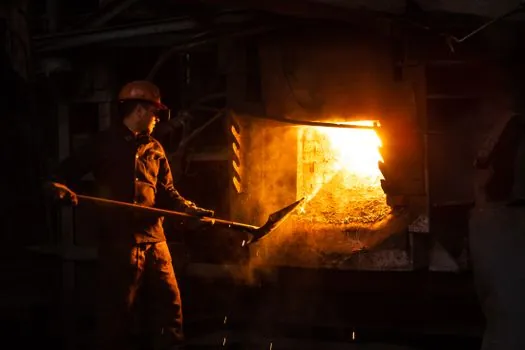
The ladle is the last process vessel between molten metal and the mold, so its capacity lining, pour rate, and preheat regime decide scrap rate, inclusion count, and pouring crew safety; the decision belongs with the foundry's process engineer, not purchasing alone.
Match Ladle Capacity to Pour Weight and Process Family
Ladle capacity must be sized at roughly 1.2 to 1.5 times the heaviest single-pour weight to give headroom for slag skimming and pour-bowl control; for investment casting of cabinet handles, knobs, and small hinges, single-pour weights are commonly in the 0.1–5 kg range, which pushes foundries toward hand-pour or bottom-pour ladles in the 5–50 kg class [S1][S4].
For larger iron hardware such as conduit bodies, valve parts, and rail fittings served by BMF's industrial hardware lines, pour weights climb to 10–200 kg per mold and ladles shift into the 250–1000 kg teapot or lip-pour class [S1]. At the upper end, transfer ladles in the 5–45 ton range handle steel and large ductile-iron pours, with BMF's 45-ton forging-side ceiling mirroring what large iron foundries specify for utility and rail hardware [S1]. The wrong capacity choice shows up as cold shuts on small hardware or excessive residence time and magnesium fade on ductile iron.
Refractory Lining and Preheat Discipline by Melt Chemistry
Iron and steel hardware foundries run high-alumina or magnesia-based ladle linings rated for 1,600–1,700 °C peak metal temperature, while aluminum hardware pours use insulating castable or isostatically-pressed silicon carbide linings limited to roughly 700–800 °C; mismatched linings crack on the first heat and contaminate the pour with oxide inclusions [S1].
Preheat before every tap is non-negotiable: gas-fired burners typically hold ladles at 200–400 °C minimum and 600–1,000 °C for steel, with ramp rates held below 150 °C/hr to drive moisture out of the refractory; Bearon Manufacturing's high-volume casting sourcing explicitly covers castings finished in multiple methods, which is only achievable if ladle temperature is consistent shot to shot [S5]. Buyers should ask suppliers for a documented preheat log and a lining-life record in number of heats, not just a generic ISO 9001 claim.
Pour-Rate and Geometry Gates per Casting Process
Investment casting of small hardware (handles, hinges, furniture fittings) needs gentle, low-turbulence pouring; bottom-pour or stopper-rod ladles in the 5–50 kg class are the typical fit, with pour rates commonly held below 5 kg/sec to avoid mold wash and gas entrapment [S1].
Permanent mold and pressure die casting for electrical and architectural hardware demand faster, more directional fills, which pushes foundries toward ladles with calibrated spouts or auto-pour nozzles delivering 5–20 kg/sec for aluminum permanent mold work; teapot ladles dominate this niche because the pour stream is shielded from atmosphere by the spout cover [S1]. Green sand and resin sand lines for utility hardware typically use larger lip-pour or teapot ladles where the pour stream is chopped by hand or by automatic pour-cup indexing; for large ductile iron pours, the in-stream inoculant and Mg-treatment stations are usually mounted directly on the ladle, so any ladle change has to retain that hardware envelope. A practical comparison of the four dominant ladle families appears below.
Comparing the Four Ladle Families Hardware Foundries Actually Use
On capacity, hand ladles cover 5–50 kg, bottom-pour ladles 20–500 kg, teapot ladles 100–5,000 kg, and transfer ladles 2,000–45,000 kg; on lining cost per heat, hand and bottom-pour sit at the low end while transfer ladles run high-alumina or magnesia linings that can exceed several thousand dollars per rebuild at large sizes [S1].
On pour-rate control, hand ladles are the least repeatable, bottom-pour units offer the best low-turbulence control, teapot ladles give moderate control with good atmosphere shielding, and transfer ladles act as reservoirs metered by secondary pour units; on typical process fit, hand and bottom-pour suit investment casting, teapot suits permanent mold and resin sand lines, and transfer ladles feed steel and large iron pours for hardware used in gas, electric, rail, and safety applications [S1][S5]. The cost-versus-control trade-off means that hardware buyers specifying high-mix small parts should expect most of the work to be done from bottom-pour or small teapot ladles, where pour stream control outweighs throughput.
Supplier Selection: Domestic vs Offshore Sourcing Models
BMF Industrial's published model combines domestic and offshore facilities specifically to balance local quality assurance with competitive pricing, and lists ductile iron, grey iron, malleable iron, bronze, aluminum, and steel as the in-house material envelope; this is the same material envelope a hardware OEM should expect its casting suppliers to support end-to-end without subcontracting exotic alloys [S1].
Bearon Manufacturing, by contrast, focuses on the U.S. market and runs an integrated supply chain with high-volume casting sourcing, screw-machine parts, prototyping, and pattern making under one roof, with the Rapid Modular Casting service explicitly delivering cast parts in roughly two weeks without tooling expense for prototyping and end-of-life spares [S5]. For hardware buyers weighing these models, the choice is essentially lead time and engineering intimacy against unit cost: a domestic integrated supplier cuts sample loops from months to weeks, while a dual domestic-offshore model wins on per-piece cost once volumes stabilize. The same buying logic applies when you select ancillary casting aux such as ladle preheaters and inoculation hardware, where domestic service depth often matters more than headline price.
What Hardware Buyers Should Verify Before Releasing a PO
First, ask for the supplier's ladle capacity list with pour-weight envelopes and the number of identical ladles in service, so production planning is not held hostage to a single vessel; BMF's 0.1 kg–45 ton envelope and Bearon's 40-plus years of casting sourcing are useful public benchmarks for what mature suppliers can document on request [S1][S5].
Second, require a written lining specification (refractory grade, max service temperature, expected heat count) and a preheat procedure with recorded temperatures; third, confirm the pour-rate control method (hand pour, stopper rod, auto-pour nozzle) and tie it to the specific hardware part being sourced, because a cabinet handle and a conduit body do not belong on the same ladle; finally, align the casting mold material and the architectural hardware finish spec so that the ladle's stream chemistry and the mold's venting match the target ASTM or DIN grade. Two trackable signals to watch in 2026 are broader adoption of stopper-rod and auto-pour nozzles on iron hardware lines, and tighter ladle-level telemetry tied to scrap dashboards, both of which are already appearing on supplier capability pages such as BMF's casting section [S1].
Related analysis: Rebar Bender Specs for Plumbing Installation: 2026 Selection Map.