
For flight-rated aerospace components, ladle selection is governed less by furnace size than by alloy chemistry, pour temperature, and the foundry's Nadcap and AS9100 qualification stack, per OEM capability statements [S1][S2]. Titanium, nickel superalloy, and stainless pours in the 1500–1700 °C band demand refractory-lined transfer ladles or pressurised bottom-pour vessels, while aluminum pours below 1000 °C still run safely in open-top, hand-poured ladles with silicon carbide or clay-graphite linings [S1].
Investment casting (lost wax) and sand casting are the two dominant process routes feeding aerospace ladle pours at shops like Kovatch and Castingpar, which hold ISO 9001, AS9100, and Nadcap weld/NDT certifications covering critical aerospace, defense, and medical work [S2]. Selection starts with the alloy on the melt card, not with the ladle catalog page.
Alloy family and pour temperature band
Titanium (Ti-6Al-4V, Ti-6Al-4V ELI) reacts aggressively with oxygen above ~430 °C and dissolves most ceramic refractories, so titanium foundries rely on vacuum arc remelt (VAR) or cold-hearth ladle transfer into copper-cooled molds rather than conventional refractory-lined ladles. Nickel superalloys (Inconel 718, Waspaloy, MAR-M247) pour at 1400–1550 °C and need high-alumina or magnesia-spinel linings rated for thermal cycling at that band. Aluminum aerospace alloys (A356, A357, 2014, 7050) pour at 680–780 °C, and standard clay-graphite or silicon carbide hand ladles handle the duty comfortably; for high-integrity structural castings, bottom-pour units reduce oxide entrainment. [S2]
Stainless and carbon steel pours (17-4PH, 15-5PH, 304, 316) sit in the 1500–1650 °C window and use alumina-based linings comparable to nickel-superalloy practice, per casting-process OEM descriptions [S1]. The pour temperature drives the lining choice more than the alloy identity itself, with a practical rule: the higher the superheat above the alloy liquidus, the higher the alumina content required in the working lining.
Ladle type, capacity, and pour method
Three ladle architectures dominate aerospace work. Open-top hand ladles (5–50 kg aluminum, 10–100 kg steel) suit short pours, small lot sizes, and alloys that tolerate minor oxide folding. Transfer ladles (50–500 kg steel, 25–200 kg nickel alloy) are refractory-lined, preheated to 600–1000 °C, and used to move melt from a primary melting furnace to a pouring station without recontamination. Pressurised bottom-pour ladles (200–2000 kg+) feed directly into the mold sprue, control fill rate through a stopper rod or slide gate, and are the standard for investment-cast nickel superalloy turbine blades and vanes. [S1]
Open-top hand ladles suit prototype runs, small aluminum structural brackets, and low-volume 17-4PH housings where lead time matters more than fill control. Transfer ladles fit the mid-volume case, including 50–500 kg batches of 15-5PH or A356 landing-gear brackets and hydraulic manifolds. Pressurised bottom-pour is the right architecture for high-value, defect-intolerant pours such as single-crystal or directionally solidified turbine blades, where fill rate and oxide avoidance drive yield. A related decision, the casting mold and tooling family, must be matched to the chosen ladle because the sprue geometry, pour basin design, and shell temperature all assume a particular fill rate from the vessel.
Refractory lining selection and preheat discipline
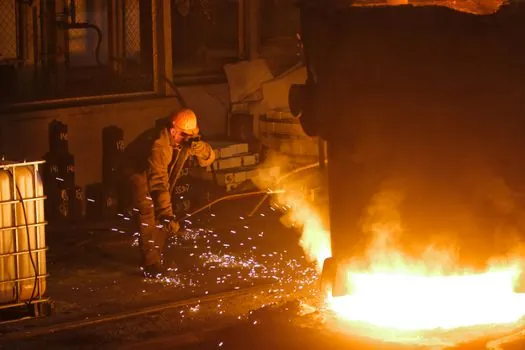
Refractory choice follows the alloy and temperature band. High-alumina (70–90 % Al₂O₃) linings cover most steel and nickel-superalloy transfers. Magnesia-spinel linings tolerate the basic slag chemistry of some nickel alloys. For titanium, refractory ladles are bypassed in favor of cold-hearth or VAR skull-melt transfer directly into the mold cavity. Clay-graphite and silicon carbide handle aluminum and magnesium; for magnesium specifically, sulfur-based cover flux and steel-wool filtration are added to the ladle, not the lining. [S1]
Preheat discipline is the second lining-life driver. Ladle preheat to 600–1000 °C for ferrous and nickel pours (300–500 °C for aluminum) prevents thermal shock that cracks the working face. Shops holding Nadcap AC7110/12 heat treating and AC7110/5 casting certifications are audited on preheat records, not just final chemistry, per standard foundry quality-system language visible in supplier portals [S2].
Qualification, certification, and inspection chain
For aerospace buyers, the foundry's qualification stack is the first filter. AS9100 covers the quality management system, Nadcap AC7110 covers the casting process, and Nadcap AC7110/5 (for investment castings) plus Nadcap weld/NDT cover the inspection chain [S2]. Castingpar publishes Nadcap certificates directly on its portal and lists titanium, stainless, and carbon steel capability for aerospace and defense [S1]. Kovatch publishes AS9100 and ISO 9001 certificates and confirms Nadcap weld/NDT coverage on its market page [S2].
The chain reads: alloy on the melt card → ladle type and lining → pour temperature and fill method → in-process inspection (X-ray, fluorescent penetrant) → final dimensional and NDT release. A ladle selection that breaks the chain (wrong lining, undersized for the pour rate, no preheat) cascades into scrap, repair, or quarantine. Buyers who specify only "investment cast per AMS 2175" or similar castings standards without naming the foundry process window leave the ladle decision to the supplier, which is acceptable only when the supplier holds current Nadcap and AS9100. The role of casting auxiliaries such as filters, chills, and exothermic risers interacts with the ladle pour rate, and selecting them after the ladle is locked in is a common source of mis-specification.
Where aerospace ladle selection breaks down
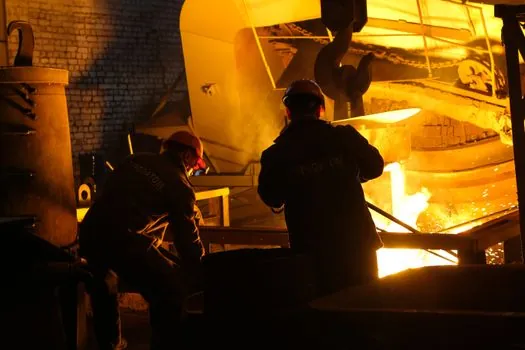
Three failure modes recur. First, using a steel-mill transfer ladle for a nickel-superalloy pour without relining picks up iron and sulfur contamination that shows up as slag inclusions in radiography. Second, pouring titanium through a refractory-lined ladle introduces oxygen and nitrogen pickup, which is why titanium foundries do not use conventional refractory transfer vessels at all; the die casting die and ladle selection guidance for titanium diverges from steel and aluminum practice. [S1]
Third, open-top hand pouring of A357 or 2014 above 50 kg invites oxide films and gas porosity that downstream HIP (hot isostatic pressing) cannot fully heal, and which ultrasonic inspection will catch. Limit hand pouring to small, non-structural parts or where the geometry tolerates weld repair. The castings specification, the alloy, and the post-casting NDT plan must agree, or the ladle choice is wrong by definition.
Decision map: pick by alloy and qualification gate
For aluminum aerospace structural castings below 1000 °C: open-top hand ladle or small transfer ladle, clay-graphite or SiC lining, AS9100 foundry, A356/A357/2014 alloys. For stainless and 17-4PH: transfer ladle, high-alumina lining, 1500–1650 °C pour band, Nadcap AC7110 process coverage. For nickel superalloys: pressurised bottom-pour vessel, magnesia-spinel or high-alumina lining, single-crystal or DS capable foundry, AS9100 + Nadcap. For titanium: cold-hearth or VAR transfer, no refractory ladle in the pour path, dedicated vacuum or inert-atmosphere foundry, AS9100 + Nadcap. Foundries and OEM supply chains aggregated through industry groups such as the Aerospace Components Manufacturers cluster continue to anchor these qualification stacks across the U.S. aerospace supplier base [S3].
For buyers building a sourcing spec, the next step is to request the foundry's Nadcap audit scope letter, last AS9100 surveillance audit date, and a ladle-preheat log covering the last 12 production heats of the target alloy; a supplier that cannot produce those three documents in a week is not qualified for aerospace work regardless of catalog claims. Also worth confirming before release is the supplier's position on die casting versus investment casting for the part geometry, since some aluminum aerospace brackets cross over to high-pressure die casting once volume justifies tooling. Watch for late-2026 OEM announcements on single-crystal superalloy capacity expansions and on titanium cold-hearth retrofit programs at tier-one casting suppliers, both of which are likely to shift ladle architecture choices for new programs over the following 12–18 months.
Related analysis: Pallet rack selection for electronics handling: 2026 spec map.