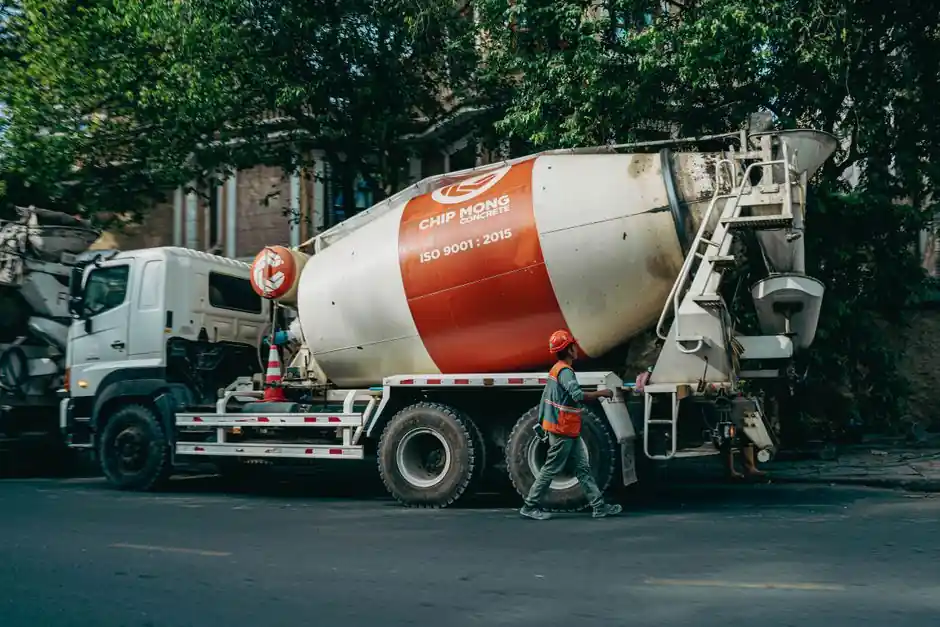
A centrifugal pump is a rotating dynamic machine that adds energy to a fluid via an impeller, and is normally rated for clean or finely particulate service with specific speeds that map to low-to-moderate head duty; a concrete pump truck, by contrast, is a positive-displacement, hydraulically driven double-piston pump built to push aggregate-laden concrete at hundreds of atmospheres of line pressure [S2][S5].
The two machine families share almost nothing mechanically, but they are routinely confused on jobsites because both are called "pumps," both ride on truck chassis in some variants, and both end up in the same concrete-yard procurement discussion. The honest answer to "centrifugal pump vs concrete pump truck" is that they are not competing options, they are different tools solving different fluid problems.
Operating Principle and Pressure Class
A centrifugal pump builds head through the rotational conversion of velocity into pressure inside the impeller and volute, with single-stage end-suction models typically limited to roughly 50-150 m head and multistage units reaching into the 300+ m range, while its flow-versus-head curve is a steeply drooping characteristic. A centrifugal pump cannot generate the discrete, high static pressure required to move stiff concrete, because any attempt to dead-head it simply recirculates fluid inside the casing rather than building line pressure [S2].
A concrete pump truck is a double-piston positive-displacement machine, hydraulically driven by an electric or diesel engine, using an S-valve or rock-valve to alternate the two concrete cylinders, and it can produce hundreds of atmospheres of line pressure to push a heterogeneous mix of cement paste and rock aggregate through steel pipe and flexible hose [S2][S5]. The boom variants add a multi-section articulating arm on a turret with the first boom swinging 2 to 90 degrees, the second and third booms at 180 degrees, and the fourth at roughly 240 degrees, with full 365-degree turret rotation around the truck [S5].
Fluid Compatibility and Wear Profile
Centrifugal pumps handle clean water, mildly viscous oils, and dilute chemical slurries, with closed-impeller clearances set tight enough that 3/4-inch aggregate would destroy them in seconds; concrete pump cylinders, by contrast, are designed around the reality that concrete is heavy, viscous, abrasive, and contains pieces of hard rock, and that it solidifies if it stops moving [S2].
Line pumps specifically use 3/8-inch pea-gravel grout hoses or 3/4-inch aggregate hoses with standard 3.0, 3.8, 7.6, and 15.2 m hose sections (10, 12.5, 25, and 50 ft), and the line-pump family is the smallest practical machine for placing structural concrete on residential slabs, sidewalks, and swimming pools [S2]. Piston seals, wear plates, and S-valve wear rings are the consumable parts, not the impeller or the mechanical seal that dominates centrifugal-pump maintenance. Choosing the wrong family for the fluid is the single fastest way to either choke a centrifugal pump or to destroy a concrete pump's hydraulic system.
Reach, Throughput, and Site Footprint

A line-pump concrete system on a trailer or truck chassis can reach roughly 150 m vertically and over 1000 m horizontally when extended with extra pipe, which makes it the default for low-rise residential pours and backyards that a concrete mixer truck cannot physically enter [S2][S5]. A boom concrete pump truck trades that horizontal reach for vertical placement at height and high volumetric throughput, with machines such as the CIFA K42L and K56L rated at approximately 180 m3/h through a five- or six-section robotic arm on a single stabilized chassis [S1].
The site-footprint difference matters as much as the throughput number: a line pump can be towed into a tight side yard, while a boom pump needs outrigger pads and a stable setting area and generally stays in one place for the entire pour, with concrete mixer trucks cycling in and out to feed the hopper [S4]. When the concrete pump truck is stationary, traffic flow on a busy slab pour is more efficient than a wheelbarrow chain, but the truck occupies a footprint that simply does not exist for a centrifugal-pump skid.
Selection Criteria: Centrifugal Pump vs Concrete Pump Truck
Use a centrifugal pump when the fluid is water, glycol, diesel, light chemical, or a fine slurry below roughly 5 percent solids by volume, and the required head sits inside the single-stage or multistage published curve. Use a truck-mounted concrete pump when the fluid is structural concrete with up to 3/4-inch aggregate, the placement is above ground level, and the pour rate justifies the truck mobilization. [S2]
Four criteria separate the two cleanly. First, fluid class: clean or fine-particulate liquids go to centrifugal; aggregate-laden concrete goes to piston. Second, pressure mechanism: dynamic (rotational) versus positive-displacement (piston). Third, reach profile: a centrifugal pump pushes along a fixed pipe to a fixed destination, while a line pump snakes a hose to the pour point and a boom pump lifts concrete on a robotic arm. Fourth, maintenance model: a centrifugal pump's lifetime is governed by mechanical seal, bearing, and impeller wear, while a concrete pump's lifetime is governed by the concrete cylinder, wear plate, and S-valve. If the job involves structural concrete, a dump truck or a reach truck cannot substitute, only a piston-based concrete pump will work.
Common Misconceptions and Field Limits

The first misconception is that a centrifugal pump can be re-tasked as a concrete pump by swapping the impeller. It cannot, because the pressure it generates is fundamentally limited by tip speed and volute geometry, and concrete's 3/4-inch rock will stall it instantly. The second misconception is that any piston pump can pump concrete: peristaltic pumps handle low-pressure, fine-grout duty, and standard hydraulic piston pumps without a rock valve will choke on aggregate, which is why concrete pumps specifically use seat-valve or S-valve geometry [S2].
Field limits on the concrete side are real: cold weather thickens the mix and increases blockage risk in delivery pipes, which is why regular flushing of the delivery system is a standing maintenance requirement, and high altitude pours cap the practical vertical reach of a line pump at about 150 m regardless of how much extra hose is laid [S1][S5]. On the centrifugal side, running a centrifugal pump against a closed discharge at full speed for more than a short ramp will overheat the fluid and starve the mechanical seal of lubrication, a failure mode that simply does not exist on a positive-displacement concrete pump.
Procurement, Sourcing, and Standards
Specifying a centrifugal pump typically references ISO 5199 (process centrifugal pumps), ISO 9906 (hydrostatic testing), API 610 (heavy-duty refinery), or ANSI/HI standards for performance and dimensions, while a concrete pump truck is selected by boom reach in meters, vertical-pipe capacity, and rated throughput in m3/h, with manufacturer published values such as 180 m3/h for the CIFA K-series boom pumps serving as the headline metric [S1]. Buyers comparing machine classes should anchor on the fluid specification first and the published curve second, because picking by brand alone is how the wrong family gets ordered.
For a deeper look at how a boom pump truck is actually commissioned on site, including outrigger load and first-pour checks, the field walk-through in Concrete Pump Truck Installation: Site Prep, Outrigger Load, and First Pour Checks lines up with the boom-pump selection criteria above. For the structural-class and payload view of the dump trucks that supply the hopper, Mining Dump Truck Types: Structural Classes, Payload Bands, and Selection Map is a useful cross-reference. Track next the EN 12001 concrete-pump-product-standard updates and any new ISO 9906 revisions for centrifugal-pump acceptance testing.