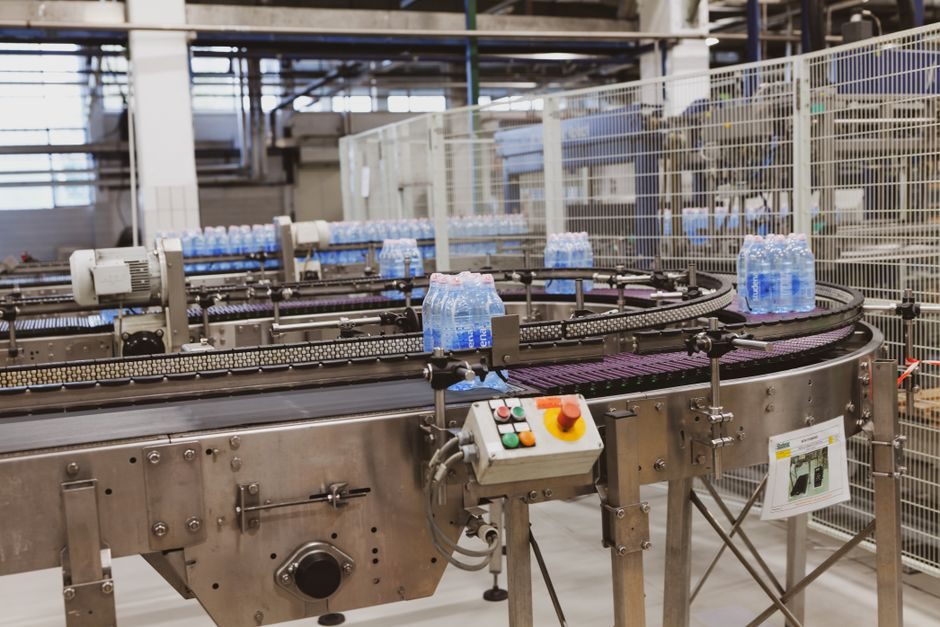
A screw conveyor is a single- or double-helix rotating auger inside a U-trough, tubular housing, or open casing, used to move powders, granules, flakes and sludges horizontally, on an incline, or vertically [S1]. Selection is governed by material bulk density, particle size, moisture/fat content, abrasiveness, corrosiveness, required tonnage per hour, conveyor length, and the inclination angle — skipping any of these variables produces chronic carryback, overload tripping, or accelerated flight wear.
This guide walks the spec gate-by-gate so a process engineer can shortlist a conveyor geometry and a drive package before requesting quotes. As a baseline: shafted U-trough units typically run 50–200 rpm, are limited to ~25–30° inclines for most non-free-flowing bulk solids, and are most efficient at lengths under 30 m, while shaftless designs extend to ~40 m horizontal, steeper inclines, and sticky or fibrous materials [S1].
Gate 1: Material Classification Drives Geometry Choice
Material behaviour — not bulk density alone — is the first filter, because a sticky sludge and a dry grain at the same 0.8 t/m³ density call for opposite flight geometries [S1]. Thomas lists the standard four buckets (free-flowing, non-free-flowing, sluggish/interlocking, and fluid/abrasive) and matches each to a flight style: standard pitch for free-flowing grains, shorter pitch for sticky or interlocking bulk, ribbon flights for pasty or fibrous matter, and paddles for fluid sludges [S1].
Bulk density is the second discriminator: light powders (cement, fly ash) sit near 0.5–1.0 t/m³, while mineral aggregates push 1.6–2.0 t/m³, and the same screw diameter will deliver roughly 2–3× the mass flow on the heavier material at the same rpm — which feeds directly into the HP and torque calculation at Gate 4. Abrasiveness (Mohs hardness, silica content) and corrosiveness (chloride, acid, salt) then push the engineer toward hard-faced flights, stainless 304/316 construction, or UHMW liners [S1].
Gate 2: Capacity, Length, Incline and the Throughput Math
Capacity is governed by screw diameter, pitch, rotational speed, trough cross-section, and the percentage of cross-section that the material actually fills — the so-called "fill factor" or "loading factor" [S1]. Standard design fill factors for horizontal conveying sit in the 0.30–0.45 range for free-flowing materials and drop to 0.15–0.25 for non-free-flowing or sluggish bulk; exceeding those values causes excessive wear and torque spikes [S1].
The throughput equation most engineers quote in the field is: Q = (π/4) × D² × p × n × φ × 3600 × ρ / 1000, where D is screw diameter, p is pitch (typically equal to D for standard), n is rpm, φ is fill factor, and ρ is bulk density in t/m³. Typical small-diameter screw conveyors at 100–200 mm handle 1–10 m³/h; mid-size 250–400 mm units reach 20–80 m³/h; and industrial 500–600 mm screws can exceed 200 m³/h of free-flowing grain at moderate rpm [S1]. Length is harder-capped than diameter: a horizontal 30 m run is straightforward, beyond that the cumulative deflection of the shaft, the heat soak into bearings, and the required HP all rise non-linearly.
Beyond 30° you are no longer in a conventional screw conveyor — a vertical screw or a steep-angle flighted unit is the more honest spec, with CEMA-style inclined-screw capacity correction factors applied throughout the calculation. For comparison, a belt conveyor at the same angle preserves a much higher share of horizontal capacity, which is why the choice between the two is rarely just about footprint.
Gate 3: Shafted vs Shaftless vs Vertical — Geometry Options Compared
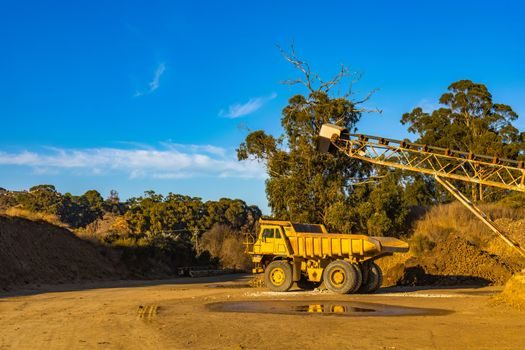
Three geometries dominate, and a side-by-side pass over the four decision criteria most engineers ask about — material fit, max incline, length ceiling, and cleanability — looks like this: [S1]
- Shafted U-trough: standard pitch flights on a centre pipe with end bearings. Material fit = free-flowing to mildly sluggish; max incline ≈ 25–30° for non-free-flowing; length ceiling ≈ 30 m horizontal; cleanability = good with removable cover/hinged trough [S1].
- Tubular shafted: fully enclosed pipe, dust-tight, often used for cement, fly ash, lime, and food-grade powders. Material fit = fine, dry, free-flowing; max incline ≈ 45° in some designs; length ceiling ≈ 25–30 m per section; cleanability = limited — usually a pull-out or CIP add-on [S3].
- Shaftless (cable-and-spiral, or "cable conveyor"): continuous helix wound on a wire rope, no centre pipe. Material fit = wet, sticky, fibrous, dewatered sludge; max incline ≈ 45–60°; length ceiling ≈ 40 m horizontal; cleanability = excellent for sludge, poor for sanitary washdown [S3].
- Vertical screw lift: enclosed tube with screw and driven top-end bearing; used for elevating powder into silos. Material fit = free-flowing dry powder; max incline = 90°; length ceiling ≈ 10–15 m lift; cleanability = good with bottom clean-out [S4].
Selis markets its SVH line as either collecting (multiple inlets along the trough for bin/tank bottom collection) or distributing (one inlet, multiple outlets for splitter feeding) [S4]. The collecting variant is the workhorse under grain silos; the distributing variant sees service in flour mills, animal-feed batching, and chemical plants splitting one feed into several silos.
Gate 4: Drive HP, Torque, and the Motor Sizing Math
Required HP is the sum of material-lift HP, friction HP on the bearings and trough, and a contingency multiplier for starting under load (typically 1.25–1.5× on loaded start). For horizontal conveying, a 250 mm screw at 60 rpm moving 25 m³/h of grain (ρ ≈ 0.75 t/m³) over 15 m typically lands in the 1.5–3 kW band; the same screw inclined 20° jumps to 3–5 kW because lift HP scales with mass × vertical rise [S1].
Start-up torque is the underrated number: starting a fully loaded, sticky, inclined screw from rest can demand 1.5–2.0× the running torque for the first 5–15 seconds, and undersizing the motor or gear reducer is the single most common cause of conveyor trips in the first month of service [S1]. Engineers normally spec a service factor of 1.5 on the gearbox, a soft-starter or VFD on the motor, and a shear-pin or torque-limiting coupling between gearbox and shaft to absorb the slug loads. In abrasive service the flight is the wear part, not the trough — hard-facing (e.g., chromium-carbide overlay) on flight faces extends life 2–4× versus mild steel at the same bulk throughput [S1].
Gate 5: Service Environment, Liners, and Material of Construction
Food, chemical, and abrasive service each push a different materials spec. Sanitary duty (flour, sugar, food-grade additives) needs 304 or 316 stainless flights and troughs, polished or bead-blasted welds, and food-grade seals at the end bearings; standard industrial grain duty is usually mild steel with a powder coat; mining and aggregate duty is typically heavy-gauge steel with replaceable UHMW or rubber trough liners in the high-wear zone, plus hard-faced flights [S3].
For chloride- or acid-bearing bulk solids (dewatered mining tailings, salt, fertilizer), 316 stainless or fiberglass-reinforced plastic troughs are common, with the screw itself in higher-alloy or coated construction. CableConveyors' product line (active 2026-06-21) advertises 20 years in custom powder and bulk-solids handling, emphasising application-specific fabrication over a fixed catalogue [S3]. Temperature is the silent limiter: standard EPDM or nitrile end-shaft seals are rated to roughly 80–100 °C continuous; above that, high-temp grease and metal labyrinth seals are needed, and above 250–300 °C the screw itself may need to be alloy [S1].
A chain conveyor or belt conveyor is the more honest spec for ambient-temperature, dusty, abrasive mineral service over 30 m horizontal — a screw over that length spends more HP turning the shaft in its bearings than moving the material, and the maintenance burden climbs. The fit-test rule of thumb: pick a screw when the material is hard to push with a belt (sticky, hot, fibrous, oily) and the run is short; pick a belt or chain when the run is long, the material is dry/granular, and the angle is gentle. For the related bearing specification on the drive and tail shafts, the roller bearing selection 2026 framework covers the same gate logic applied to the end bearings.
Selection Failure Modes and Constraints
Five failure modes account for the bulk of premature screw-conveyor problems: overfilling (fill factor above the design value, usually because the upstream feeder was upsized without re-checking the screw); wrong flight geometry for the material (standard pitch on a sticky sludge instead of ribbon); under-rated motor (no soft-start, no service factor); abrasive wear in a non-lined trough with no flight hard-facing; and bearing failure on the tail or hanger bearings from contamination and under-greasing [S1].
Constraint ceilings worth writing into the spec: max horizontal length ~30 m shafted, ~40 m shaftless; max practical incline 25–30° shafted with standard pitch, 45° shaftless; max continuous temperature ~100 °C with standard seals, higher with metal labyrinth and special grease; max particle size typically 1/3 of screw diameter for shafted designs (large lumps can jam the hanger bearings) [S1][S3]. Anything beyond those ceilings is no longer a standard screw conveyor; it is a custom engineered unit, and the lead time and price step up accordingly.
Sourcing and Standards
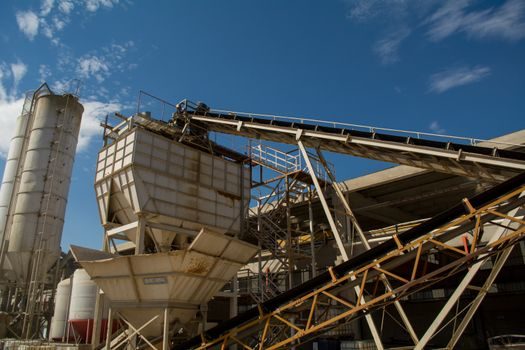
The governing design reference in the US is the CEMA Screw Conveyor Standards (CEMA 300/350 series), which standardises dimensionalspecification, capacity, load factors, and the trough/flight nomenclature used throughout this article; in Europe, DIN 15261 covers helical screw conveyors and is the closest equivalent for material-handling plants. For sanitary service, EHEDG and 3-A sanitary design guidelines govern the welds, surface finish, and cleanability requirements; for ATEX/zoned service (grain elevators, fertilizer, flour mills), the explosion-vent area and dust-tightness specs are typically derived from the relevant national codes, with the screw-conveyor supplier confirming the rating per build [S3][S4].
Spec sheets worth pulling before requesting quotes: bulk density (kg/m³ loose, packed), particle size distribution (max lump, d10/d50/d90), moisture content, temperature, abrasiveness (Mohs or silica %), corrosiveness (pH, chloride), and any tendency to pack, fluidise, or cake. With those numbers and the five gates above, two or three vendors can be shortlisted and quoted on equal terms [S1][S3].
For a parallel selection walkthrough on belt conveyors — useful when a screw has been ruled out on length or incline — see the belt conveyor buying guide 2026 and the belt conveyor selection criteria. Trackable signals for the next design review: a confirmed material datasheet covering bulk density, moisture, and particle size, plus a vendor shortlist of two or three with CEMA/DIN-compliant designs at the calculated diameter, length, and HP.