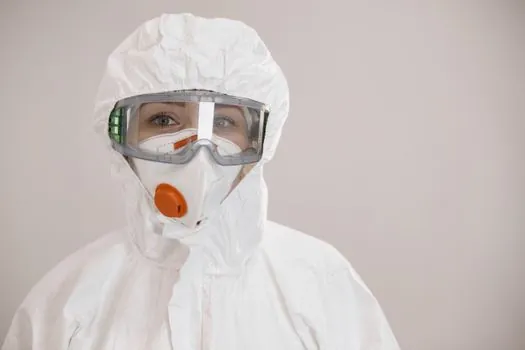
OSHA 29 CFR 1910.134 requires the employer to identify the respiratory hazard, select a respirator whose assigned protection factor (APF) exceeds the calculated hazard ratio, and run that respirator inside a written respiratory protection program (RPP) with medical evaluation, fit testing, and training [S1].
For a typical warehouse, the relevant airborne hazards are dusts (MERV-related particulates from cardboard, pallet wood, and concrete), organic vapors from adhesives or solvents during battery-charging areas, welding fumes in maintenance bays, and IDLH-from-propane forklift exhaust in confined rooms; the chosen respirator class, cartridge, and APF are driven by which of these is present and at what concentration [S3][S6].
Hazard Assessment: What a Warehouse Is Actually Exposing Workers To
OSHA 1910.134(d)(1) mandates a written hazard assessment that lists each contaminant, its form (gas, vapor, aerosol), and measured or estimated exposure concentration, because respirator class and filter media both key off that data [S1]. Particulate hazards in a distribution center are dominated by cellulose and silica dust (cardboard fluff, pallet abrasion, concrete sweepings) at typical total-dust levels of 2-10 mg/m³ without local exhaust, which puts them in the N95/P95 filtering-facepiece band rather than a simple dust mask [S3][S5].
Gas and vapor hazards appear at defined micro-environments rather than ambient warehouse air: battery charging rooms produce sulfuric acid mist (relevant acid-gas cartridge), while solvent dispensing or pesticide-treated container zones generate organic vapors that demand a cartridge with an end-of-service-life indicator (ESLI) where specified [S1][S6]. The CDC frames respiratory protection as the last line of defense behind elimination, substitution, engineering controls, and administrative controls, so the assessment should first ask whether dust collection, LEV, or aisle-width ventilation can bring exposure below the OSHA permissible exposure limit (PEL) before a respirator is issued at all [S3].
Respirator Classes, APF Table, and Where Each One Fits a Warehouse
Per OSHA Table 1 under 1910.134, the APF for a filtering facepiece (N95/P100 disposable) is 10, for a half-face elastomeric air-purifying respirator it is 10, for a full-face elastomeric it is 50, for a powered air-purifying respirator (PAPR) with a loose-fitting hood it is 25, and for a tight-fitting full-face PAPR or any pressure-demand SAR/SCBA it rises to 1,000 or 10,000 depending on configuration [S1]. Choosing a class is therefore a math step: divide the measured or estimated exposure concentration by the relevant OSHA PEL or ACGIH TLV to get the hazard ratio, then select the respirator whose APF is greater than or equal to that ratio [S1][S6].
For warehouse dusts, an APF-10 disposable (N95 or P95) typically covers the hazard ratio, and the N-series vs R-series vs P-series letter codes the oil resistance of the filter media: N is not oil-resistant, R is somewhat oil-resistant, P is oil-proof, which matters the moment an operation sprays petroleum-based lubricants or solvents [S4][S6]. For welding fume generated by in-house battery repair or rack fabrication, a P100 elastomeric or a PAPR with a loose-fitting hood is the standard answer because the fume contains hexavalent chromium and manganese, both of which have PELs in the sub-1 mg/m³ region and push the hazard ratio above 10 [S3][S7].
Filter and Cartridge Selection Beyond the Letter Code
NIOSH approval prefixes the filter letter with a number, where 95, 99, and 100 denote the minimum filtration efficiency of 95%, 99%, and 99.97% respectively against a 0.3 µm MMAD aerosol challenge [S3][S4]. A P100 filter is the right call whenever the warehouse process generates sub-micron welding fume, pesticide aerosol, or pharmaceutical dust where any leakage past a 95% filter becomes meaningful at the PEL [S3].
For organic vapors or acid gases, OSHA requires a cartridge certified to NIOSH CBRN or chemical-specific standards, and the user must track service life either by an ESLI, a manufacturer-supplied change-out schedule, or a calculated break-through time based on temperature, humidity, and contaminant concentration [S1]. Honeywell's general-purpose guidance flags N95, R95, or P95 as the minimum baseline for dusty industrial work and adds that for solvent or paint operations an organic-vapor cartridge (often black, with a magenta P100 prefilter stacked behind it) is the typical configuration [S4]. Reference Respirator Types and Classifications: APR vs ASR, APF, and Fit-Class Specs lays out the same APF ladder with the matching facepiece categories so the math above stays auditable.
Fit Testing, Medical Evaluation, and the Programmatic Layer
OSHA 1910.134(f) requires qualitative or quantitative fit testing before any tight-fitting respirator is first used, annually thereafter, and whenever a different facepiece, model, or style is issued, with records retained until the next test cycle [S1]. A user seal check is required each donning per 1910.134(g)(1)(ii), and facial hair in the sealing surface area voids the protection regardless of filter class, which is why many warehouses with mixed-gender workforces default to PAPRs with loose-fitting hoods where fit cannot be compromised [S1][S3].
1910.134(e) requires a written medical evaluation by a PLHCP before fit testing, and the program must include procedures for routine and emergency use, training on donning, doffing, maintenance, and storage, plus a cartridge change-out schedule grounded in objective data rather than guesswork [S1].
Use Cases Mapped to Respirator Class
Order picking in a dry-goods DC with cardboard and ambient dust fits an N95 or P95 disposable, APF 10, replaced at the end of shift or when breathing resistance climbs, with no medical evaluation beyond the Appendix C questionnaire if usage is voluntary under 1910.134(c)(2) [S1][S3]. Battery charging rooms with spill potential and forklift propane exhaust in cold-weather loading bays both demand continuous monitoring with a calibrated gas detector and a respirator plan keyed off the alarm setpoints; if the CO concentration can exceed 100 ppm, an air-supplied SAR or a PAPR with an organic-vapor/acid-gas combination cartridge becomes the conservative pick, and the matching detector siting is covered in Toxic Gas Detector Selection for Chemical Plants.
Welding fume from in-house rack repair, pesticide-treated container handling, and any process generating a bioaerosol (rodent droppings in food-grade DCs) call for at minimum a half-face elastomeric with P100, APF 10, and for longer shifts a powered air-purifying respirator with a loose-fitting hood at APF 25 to reduce breathing resistance and heat stress [S3][S5]. Where warehouses feed industrial automation equipment, the dust load on conveyors and drives correlates with airborne load, so the Dust Detector Selection Criteria for Warehouse and Distribution Center Operations article pairs respirator selection with the optical and gravimetric sensor logic used in the same facility. A confined-space entry into a sump or grain silo flips the requirement to supplied-air or SCBA with APF 1,000-10,000, plus an attendant, a retrieval line, and a written confined-space program per 29 CFR 1910.146 [S1].
Common Selection Mistakes and the Limits of the Workflow
Three failure modes recur in warehouse audits: choosing a dust-mask style (no NIOSH approval stamp) for routine cardboard dust, which fails 1910.134(k) on certification, and gives a fit factor of 3-5 rather than the APF 10 of an N95 [S1][S3][S7]; using a half-face APR in an oxygen-deficient or unknown atmosphere, where only atmosphere-supplying devices are acceptable per 1910.134(g)(3); and mixing a particulate-only filter with an organic-vapor cartridge without checking the combination is NIOSH-certified for that contaminant pair [S1].
Other limits are quantitative: APFs assume a fit-tested facepiece, a clean cartridge in service life, and a wearer without facial hair crossing the seal, so the engineering judgment in Table 1 erodes quickly if any of those break [S1]. The other constraint is economic, because a PAPR at APF 25-1,000 can run 5-20x the unit cost of an N95, and the cost is justified only when the hazard ratio demands it or when fit-testing failure rates are high, so warehouses often standardize on a single elastomeric size with multiple cartridge options rather than a mix-and-match shelf [S4][S6].
Standards, Sourcing, and What to Verify Before Issue

The governing regulation is 29 CFR 1910.134, with selection logic backed by the NIOSH Respirator Selection Logic (2004 sequence, still the operational reference) and the NIOSH Pocket Guide to Chemical Hazards for PEL/TLV lookup [S1][S3]. Canadian warehouses under CCOHS follow the CSA Z94.4 selection and use guidelines, which mirror OSHA's APF structure but add a respirator-use category (RUC) that maps to a defined work rate, temperature, and contaminant profile, a useful cross-check for any U.S. site running a sister operation in Ontario [S5].
Every cartridge or filter must carry a NIOSH approval number (TC-84A for filtering facepieces, TC-23C for chemical cartridges, TC-13F for PAPRs) printed on the element or packaging, and OSHA's counterfeit-misrepresented respirator list is the public register to screen new lots against before purchase [S3]. The CCOHS biological-hazard selection logic adds working environment, bioaerosol risk group, generation rate, and control level as the four inputs, and the OSHA-cited paper for metalworking dusts applies the same APF-plus-hazard-ratio method to particulates from grinding and cutting, which read identically to warehouse particulate hazards [S5][S8][S9]. Reference Protective Clothing Types and Classifications pairs this respirator workflow with the suit and glove selection needed for full body coverage in spill response.
Trackable next node: confirm the written RPP under 1910.134(c) is current and that Appendix C medical evaluations are within the last 12 months; signal 1 is the NIOSH Trusted-Source page for counterfeit screening, signal 2 is the most recent fit-test record retention log under 1910.134(m).
Detailed specification references: respirator, pressure transmitter, and flow meter.