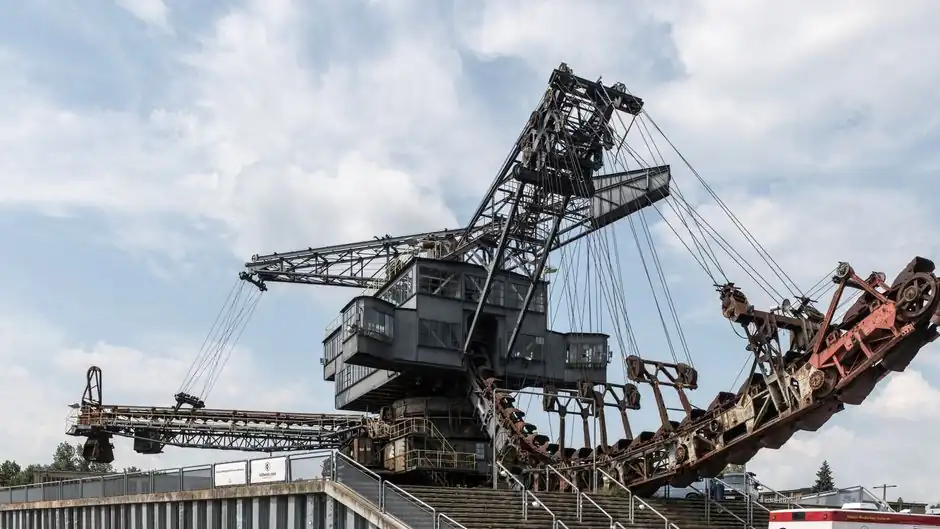
A slip ring transfers power, signals, and data across a continuously rotating interface without cable wrap-up, making it the practical choice for a 360° slewing drive [S1][S2].
Decision Rule: Uninterrupted Transfer Versus Managed Cable
A slip ring is the correct default when the rotating structure must remain electrically connected through unlimited 360° rotation. It transfers electrical power, control signals, and data between stationary and rotating equipment, while a multiport rotary union can carry hydraulic fluid through the same rotating axis [S1]. The load-carrying element remains the slewing ring bearing, which supports axial, radial, and moment loads rather than serving as the electrical interface [S1].
A cable reel is preferable when the machine has a finite rotation range and the cable should retract, feed, or remain physically manageable. For rotating electrical joints with continuous metallic connections, size, cable length, cable stiffness, and mechanical fatigue are the main design parameters, while the angular rotation range is limited.
Cable Wrap, Cable Reel, or Slip Ring
The three options differ in the way they address rotation. A slip ring replaces the twisting conductor with rotating electrical contact, supporting continuous rotation, power transfer, sensor signals, encoder feedback, CAN, and Ethernet [S1][S2].
Use the following selection logic:
Selection Criteria That Control the Choice
Rotation angle alone is not enough to classify a system. For a slip ring, specify the number and type of conductors, voltage and current ratings, signal integrity requirements, allowable rotational speed, and mechanical mounting arrangement. A variable-speed drive connected through a slip ring also requires a deliberate electrical review, not a generic “power ring” assumption.
The key engineering distinction is that a slip ring solves electrical continuity, while a reel solves cable management; neither automatically solves hydraulic pressure, bearing capacity, or signal compatibility.
Electrical Stress and Signal Compatibility
A slip ring may carry encoder feedback, sensor signals, and Ethernet data, but the specified circuit must support the protocol and bandwidth rather than merely provide continuity [S1][S7].
That case is an equipment-specific engineering discussion, not a universal rating rule, but it demonstrates why the drive manufacturer and slip-ring manufacturer must review the complete circuit.
Mechanical, Environmental, and Maintenance Constraints

The slewing assembly must be dimensioned around the mechanical stack, not around the cable route alone. The slewing ring bearing carries the axial, radial, and moment loads and provides the alignment for the rotary union and slip ring; optional internal or external gearing permits direct drive through a pinion or slewing motor [S1].
Field conditions change the maintenance profile. Fixed cable runs face corrosion, moisture, vibration, twisting, kinking, and fatigue [S2]. Slip rings require inspection of brush wear, ring cleanliness, contact noise, thermal rise, and fastener integrity [S5]. Cable reels require inspection of spring performance, cable damage, guide alignment, and retraction behavior. For wet, dusty, corrosive, or high-temperature service, specify the enclosure, seal arrangement, ingress protection, temperature range, and compatible materials on the selected assembly; the research establishes these as required design inputs but does not provide universal values for every machine.
The slewing drive should be selected for the required torque, speed, braking, control, and duty cycle, then integrated with the rotary electrical path. A slip ring does not provide torque or structural support, and a cable reel does not provide either function. Keeping those responsibilities separate makes failure analysis and maintenance planning more reliable.
Use Cases and Explicit Recommendations
For cranes, excavators, grapples, wind turbines, robotic arms, rotary indexers, machine tools, packaging equipment, and medical or imaging systems with continuous rotation, specify a slip ring when uninterrupted power, sensor, encoder, control, or data connections are required [S1]. A multiport rotary union is appropriate when hydraulic oil, coolant, or lubrication must also cross the rotating interface [S1]. The slewing bearing remains the structural member and must be sized independently from the electrical transfer device.
For mobile construction equipment where a power or data cable must deploy and retract, specify a spring-driven reel instead of forcing a continuous cable wrap into the rotating structure [S2]. For finite, low-speed indexing motion with modest electrical demand, a fixed cable wrap may be the lowest-complexity option, provided fatigue life and bend radius are demonstrated for the actual rotation count [S2][S3].
The practical recommendation is therefore conditional: choose a slip ring for continuous electrical continuity, choose a cable reel for controlled cable deployment, and use a fixed wrap only for a bounded rotation problem with verified cable life. For drive-fed systems, obtain written compatibility review from both the drive supplier and rotary-joint supplier, with particular attention to pulse voltage, current, brush loading, thermal rise, and data-circuit integrity [S4].
Procurement and Verification Checklist

A purchase specification should identify the mechanical interface, rotation requirement, electrical circuits, fluid circuits, environment, and maintenance access. For a slip ring, request the conductor count, voltage and current ratings, signal types, speed limit, and tested operating conditions. For a reel, request the cable designation, maximum deployed length, bend-radius limits, spring characteristic, and cycle-life basis. For either arrangement, require the machine envelope and cable or conductor routing to be shown on the assembly drawing [S1][S2][S3].
Verification should include a no-load functional test, a representative load test, a signal-integrity check where applicable, and a thermal inspection after sustained rotation. For a variable-frequency drive arrangement, include the drive output waveform, motor cable length, input filtering, and grounding arrangement in the review, rather than relying on the slip ring's voltage rating alone [S4]. The measurable acceptance points are stable power, acceptable signal noise, no unacceptable temperature rise, continuous mechanical rotation without interference, and documented inspection intervals.