Industrial circular saw blade life sits between 12 and 120 hours of continuous cutting, with the spread driven by abrasive load, tooth geometry, and bond hardness rather than any manufacturer calendar [S4].
The saw body itself is a different asset class: a high quality bandsaw or circular saw can be expected to last at least 10 years in light-to-moderate industrial duty, provided it receives three, six, or twelve month servicing intervals [S2]. For context on the wider cutting and fabrication toolchain, the circular saw encyclopedia entry lays out the core types (cold saw, friction saw, carbide-tipped, diamond-edged) and the duty envelopes each is built for.
Three blade families and their real wear envelopes
Carbide-tipped steel-disc blades are the workhorse of wood and light-gauge metal cutting, priced at $20-$100 per disc, with service life of six months to several years depending on tooth count and workpiece hardness [S4]. Steel-tipped blades, now rare, cost $10-$30 and stay sharp roughly one tenth as long as carbide, making them uneconomic on production runs but acceptable for low-volume shop use [S4]. Diamond-edged masonry blades, $15-$75, deliver 12-120 hours of continuous cut time before the metal bond glazes over and the diamond grit is lost, a wear mode that is visually obvious: the rim goes smooth, cut speed collapses, and the blade starts to bind mid-cut [S4].
The four hard replacement triggers
Burn marks on the workpiece and visible smoke are the first audible-and-visual alarm that a wood-cutting tooth has gone dull; the same blade will then cut slower than normal and may bind completely mid-cut [S4]. For diamond blades the trigger set is different: a glazed, glassy rim means the bond has melted over the diamonds, while a smooth perimeter confirms the grit has been fully lost and the blade is now a polished metal disc [S4]. Two machine-level symptoms escalate the question from blade to saw replacement: irregular rotational speed and audible cracking or fracture in the blade or arbor components, both of which Anton Saws flags as mandatory upgrade indicators [S2]. Dull blades also load the motor, so leaving a worn blade in place shortens the saw's own service life, a feedback loop the maintenance guides consistently call out [S3].
Break-in, run parameters, and the 40 percent rule
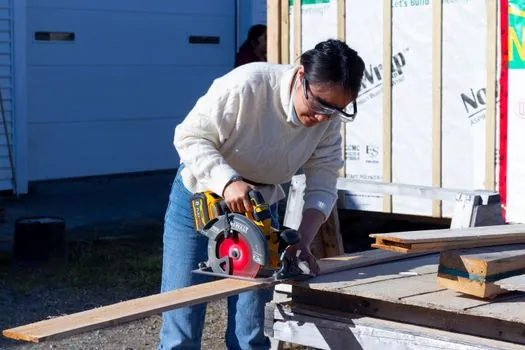
Selmach's published break-in protocol for a new or re-sharpened blade is to run it idle for 5 minutes, then operate at roughly 40 percent of rated speed for 15 minutes before pushing to full cut parameters, a procedure that seats the tooth geometry and reduces early-chip loss [S1]. For shops running heavy structural-steel cutting through saws, press brakes, and rollers, the same discipline shows up across the equipment line; an overview of compatible construction machinery and equipment choices is useful when a circular saw sits in a larger fabrication cell. Beyond break-in, two operating rules dominate blade life: never cut oversize material that exceeds the blade's rated capacity, and keep the safety guards in place so a jammed workpiece does not transfer shock back through the arbor [S2].
Decision matrix: sharpen, clean, or scrap
The first response to a dulling symptom is not always replacement: carbide and steel blades frequently only need a soak in all-purpose cleaner and a stiff brush to recover edge quality, because resin and pitch buildup mimics dulling [S4]. If cleaning does not restore cut quality, sharpening is the second option: steel-tipped blades resharpen easily with a hand file or mechanical sharpener, while carbide-tipped teeth require a diamond wheel and precise angle control, which is why most production shops send them out [S4]. Scrap is the right call when the diamond matrix has glazed, when the steel disc shows cracking, or when the tooth count has been lost to chipping; in each of those cases continued use damages the workpiece and the spindle bearings in parallel [S2][S4].
Service intervals that push the 10-year mark

Anton Saws documents three, six, and twelve month service tiers for industrial circular and band saws, with the core mechanical items being arbor bearings, gearbox lubricant, blade alignment, and guard interlock verification [S2]. Extol's maintenance checklist layers daily and weekly tasks on top: brush-cleaning air vents, checking the cord and brushes on corded units, and inspecting the shoe plate for square seating against the workpiece, all of which reduce side-load on the spindle [S5]. On the cutting-floor side, shops that run circular saws alongside structural fabrication equipment benefit from reading the hydraulic cylinder demand and sizing guide to understand how adjacent machine life cycles are budgeted, since a 10-year circular saw often shares a cell with 8-12 year hydraulic actuators.
Failure modes and what they cost the saw
Continuing to push a dull blade is not a free option: extra motor load draws higher current, heats the windings, and accelerates brush wear on corded models, while cordless units see their pack cycle count consumed on no-progress cuts [S3]. Cracked blades and fractured tooth segments are a safety event, not a maintenance event, and the saw should be locked out until the disc is replaced, because a thrown tooth segment will defeat the lower guard [S2]. For shops that also run diamond blades on masonry, a glazed bond that is ignored past the binding stage will overheat the steel core and warp the disc, at which point the only fix is full replacement rather than re-dressing [S4]. The shop takeaway, repeated across the service guides, is that a $20-$100 blade replaced on symptom is cheaper than a $400-$2000 motor rewind triggered by running it dull.
Track three signals over the next quarter: (1) hours of continuous cut logged per blade family, benchmarked against the 12-120 hour band; (2) the ratio of cleaning interventions to sharpenings to replacements, where a healthy mix is roughly 4:2:1 for carbide and 1:1:3 for diamond; (3) motor amp draw at the start of cut versus at 80 percent blade life, a rise above 10-15 percent being the early warning that a blade change is overdue.
Spec-level background on the components involved: linear guide.