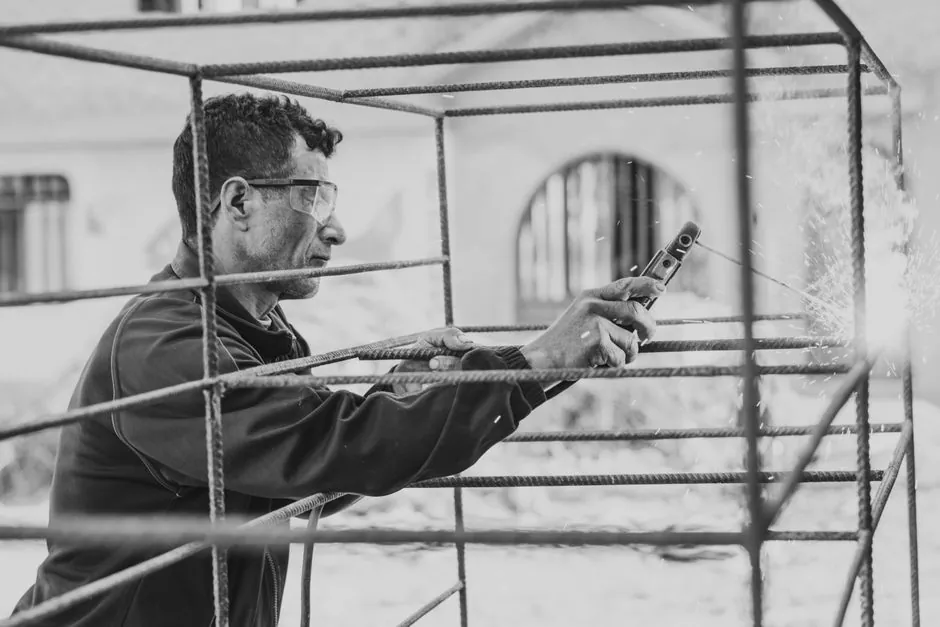
For demolition contractors cutting, splicing, and re-installing column rebar on shoring towers, an electroslag pressure welder is the tool that joins 16-40 mm vertical bars end-to-end inside a flux-filled mold, runs at 200-650 A and 35-45 V arc voltage on a 380 V three-phase supply, and leaves a visible weld collar that is later ground flush before concrete placement [S1][S3].
The rebar EPW (electroslag pressure welding) process is the dominant vertical-bar splice method on Chinese demolition-and-rebuild sites and on US retrofit bridge piers, distinguished from the plate ESW variant by the axial upset stroke that forges the joint and expels slag as a collar [S2][S3]. On demolition shoring cages the welding head and clamp are light enough for one or two workers to carry up the column cage, while the heavier power source stays on the deck connected by control and welding cables [S3][S4].
Process Envelope and Why EPW Fits Demolition Shoring
EPW joins diameters from 16 mm to 40 mm without a separate filler wire on vertical or near-vertical bars within roughly a 4:1 gradient, and the slag pool reaches the 1500-2000 degrees Celsius band needed to bring both bar ends to a plastic state before the upper bar is forced downward under upset pressure [S1][S2]. The cycle is three stages: high no-load voltage (70-90 V) strikes an arc that melts granular flux into a conductive slag pool, current then flows through the slag by resistance rather than through an arc, and finally the welder drives the upper bar down to forge the joint and expel slag and oxides as a visible collar [S2][S4].
On demolition work the EPW path is the relevant code line: JGJ 18-2012 governs in China, AWS D1.4/D1.4M governs in the US, and the analogous plate process ESW is restricted on US fracture-critical bridge members under FHWA Notice N 5040.23 dated 1977-02-16, which removed plate ESW from main tension members after brittle fractures on an I-79 plate girder [S1]. The same logic, "spec the rebar code path before the head is ordered, not after the bars arrive on site", is the rule a demolition foreman with one rebar shipment already staged cannot afford to skip [S1].
Selection Criteria: Power Source, Welding Head, Upset Force
Four specifications must be locked before quoting a 2026 EPW rig for demolition shoring: maximum bar diameter the welding head accepts (commonly 16, 20, 25, 32, 40 mm), welding current rating and duty cycle of the power source, the axial upset force the head can deliver, and the control sequencing of the arc, electroslag, and upset stages [S1][S3]. A representative ZX7-630 class inverter datasheet lists 200-650 A welding current, 35-45 V arc voltage, 16-32 mm bar capacity, 380 V supply, and FOB/CFR/CIF terms out of Qingdao [S7].
Above 32 mm bar a 1,000 A source is required to heat the largest joint quickly enough to avoid lack of fusion, and a hydraulic upset head rather than a manual clamp is needed to keep weld-collar geometry inside JGJ 18-2012 limits on axial offset and bar-diameter mismatch [S2][S8]. No-load voltage of 70-90 V is required to strike the arc through HJ431-type granular flux, well above a general arc welder, and welding current plus time both rise with bar diameter per JGJ 18-2012 table 4.6.6 [S2]. For demolition crews that already own portable cutting tools, the same procedural logic of clamp, control sequencing, and per-diameter parameter window tracks a stud welder's working pattern, which is documented on the stud welder reference page [S2].
Comparison of Rig Classes a Demolition Buyer Faces
Three rig classes cover the realistic option set for demolition rebar work in 2026. A manual-clamp AC transformer welder with a 16-32 mm single-bar range and 7-16 kg head is the lowest first cost and lightest package, suited to small pier-column shoring where operator skill drives collar quality and the arc-to-upset timing is hand-judged [S5]. A manual-clamp inverter DC welder with a 16-40 mm range and a programmable arc-to-upset timer (12-18 kg head) costs more up front but produces more repeatable collars, and is preferred on tall pier lifts where the worker climbs with the head and needs consistent timing between welds [S3][S5].
A semi-automatic dual-operator rig with a 25-50 mm range and hydraulic upset (25-35 kg head plus a separate power source) gives the best collar consistency on large-diameter bars but is heavier and needs a small hoist or two workers to lift, which a demolition shoring tower can usually accommodate but a tunnel heading cannot [S3][S5]. On the criteria that matter for demolition, cost vs repeatability vs bar range vs head weight, the manual AC transformer wins on cost and head weight, the inverter DC rig wins on collar repeatability, and the semi-automatic hydraulic rig wins on bar range and weld quality above 32 mm [S4][S5].
EPW vs Couplers vs Lap Splices for Shoring Cages
EPW is one of three rebar joining options on a demolition shoring cage, and the decision is set by bar density, cycle time, and code path [S3]. EPW runs a single 30-40 second vertical-bar cycle with no separate filler wire and a visible weld collar, which is faster than manual electric-arc lap welding on labor and material cost when column heights run above roughly 3 m [S1][S3]. Mechanical couplers carry higher piece cost and slower per-joint cycle but are bar-diameter tolerant and not bound to the JGJ 18-2012 or AWS D1.4 collar-geometry limits [S3].
Lap splicing is the cheapest material option but adds rebar congestion that can violate ACI 318 cover and spacing rules, and ACI 318 requires that any welded or mechanical splice develop at least 125% of the bar yield force in tension or compression, which the EPW process is engineered to meet on vertical column bars in the 16-40 mm range [S4]. For demolition shoring where the cage will see re-stress cycles as the structure above is removed, the EPW collar geometry limits and the 125% yield check are the two numbers that decide the spec [S4].
Failure Modes and Field Constraints on Demolition Sites

EPW fails in three repeatable ways on a demolition site: lack of fusion when the arc-to-electroslag transition is mis-timed (current too low or transition too early), axial offset of the upper bar past the JGJ 18-2012 limit, and bar-diameter mismatch beyond the code window [S2][S8]. All three are operator- and equipment-timed, which is the engineering reason an inverter DC rig with a programmable arc-to-upset timer is preferred over a manual AC unit on tall column lifts [S3][S4].
For demolition crews that also run chipping hammers to break the surrounding concrete before splicing, the same air-supply and vibration-isolation discipline that governs a demolition hammer applies to the EPW head's pneumatic or hydraulic upset line on larger rigs [S4]. Plate ESW is mechanically impractical for rebar demolition work because it uses water-cooled copper shoes and a consumable guide tube, and is restricted on US fracture-critical members, so the rebar EPW path is the only ESW-family process that belongs on a shoring tower [S1][S3].
Procurement Signals and Trackable Updates for 2026
Current 2026 production EPW units cluster at 200-650 A welding current, 35-45 V arc voltage, 16-32 mm (and on larger heads 16-40 mm) bar capacity, with the ZX7-630 class inverter datasheet as the published reference baseline out of Qingdao with FOB/CFR/CIF terms [S4][S7]. For specialized structural-steel demolition where the column being cut is an H-beam rather than rebar, the Iking electroslag pressure welding machine for H-beam manufacturing documents the air-cooled continuous-duty path with customization available and a separate cooling-water envelope from the rebar EPW rig [S6].
Trackable signals for demolition buyers through the rest of 2026 are JGJ 18-2012 collar-quality compliance data on 36-40 mm bar splices above 650 A, AWS D1.4/D1.4M revisions on programmable arc-to-upset timer validation, and any change to FHWA N 5040.23 that re-opens plate ESW on fracture-critical members; a verified 1,000 A source above 32 mm bar and a hydraulic upset head are the two hardware tracks to watch [S1][S2][S8]. For site setup rules, a demolition hammer selection map and the electroslag pressure welder encyclopedia entry are the cross-reference points a foreman should lock before the next cage lift.
For related coverage, see Impact Drill Failure Modes: Chipping, Drift, and Jam Fixes.