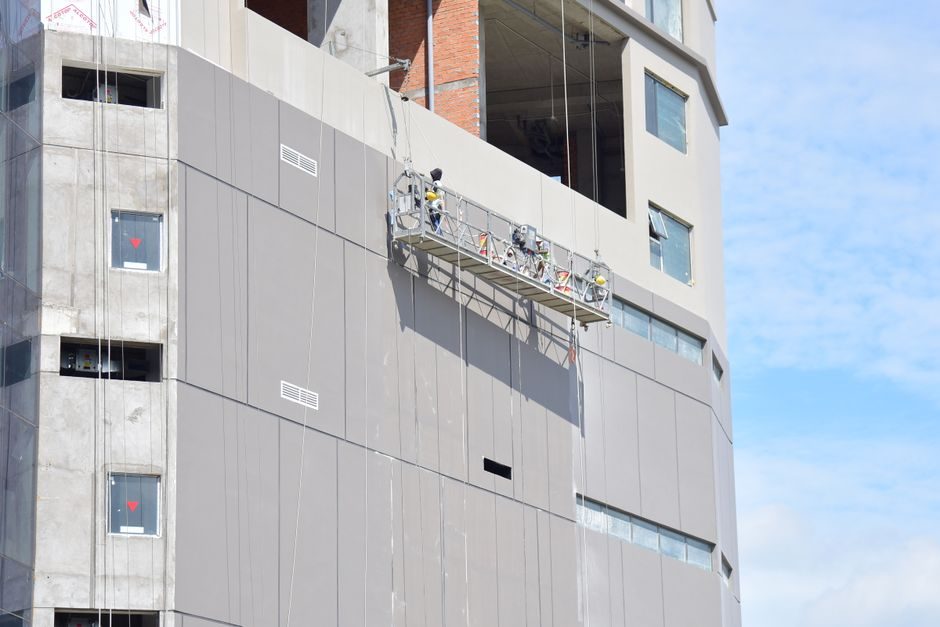
Climbing formwork is a guided platform-and-panel assembly that re-positions vertically between concrete pours, typically 3-5 m per lift, to build core walls, bridge pylons, and dam shafts without a full external scaffold wrap [S1][S4]. On a 30+ storey core-wall pour, the decision between crane-climbed and self-climbed (automatic) systems is the single biggest cycle-time and crane-hour driver, so it is also the first thing procurement has to lock in before mobilizing a crew.
Suppliers active in the segment span European hydraulic specialists — Faresin Building S.p.A. with the SCREEN hydraulic climbing unit [S1] — and Chinese civil-engineering fabricators such as Beijing Yunhai Construction Hardware Co. (YUNHAI), with 101-200 employees and main export markets in North America, South America, and Eastern Europe [S2]. Yangjiang-based kitsen markets a rail-fixed self-climbing support system for vertical elements [S5], and Okorder-listed Chinese mills offer timber-beam table formwork with ring-lock support and 6061-T6 aluminum auto-climbing systems at MOQ 1,000 m² and 500,000 m²/month supply capability [S3][S4].
System Types and When Each One Fits
Crane-climbed (crane-jumped) formwork is the legacy choice for core walls under roughly 80 m height where a tower crane is already on the critical path and cycle time per lift is acceptable at 1.5-2 days. Self-climbing (automatic / ACS) formwork, by contrast, climbs on its own hydraulic or rack-and-pinion rails without a crane pick, which is the dominant specification for cores above 100 m and for bridge pylons above 60 m [S1][S5].
Material selection further splits the market: 6061-T6 aluminum alloy auto-climbing systems (e.g., for core walls, cooling towers, tunnels, dam and pier shafts) are preferred when panel weight and single-worker handling matter [S4], while Q235 cold-rolled steel adjustable slab/column formwork suits heavy civil applications such as railway and highway bridge piers [S2]. The general rule — aluminum for tall-building cores where panel weight limits cycle pace, steel for bridge/dam pylons where pour pressure and rebar congestion dominate — maps cleanly onto what YUNHAI and kitsen both publish as their core product lines [S2][S5].
Component Stack and Pre-Install Checks
A complete climbing package has six functional groups: (1) the formwork panel itself (steel-plywood, all-aluminum, or timber-beam with ring-lock support [S3]); (2) a working/scaffolding platform with guard-rails; (3) a climbing unit — hydraulic cylinders on the SCREEN-style system [S1] or a rack-and-pinion / rail-climbing shoe on ACS units [S5]; (4) suspension anchors or brackets left in the previously poured lift; (5) a wind-bracing / lateral-stability frame; and (6) the access system (stair tower, material hoist interface).
Pre-assembly accuracy checks are non-negotiable. Aluminum climbing systems should be pre-assembled on the ground to verify panel flatness, waler alignment, and tie-rod positioning before the first lift is hung [S4]. For timber-beam table formwork with ring-lock support, verify the ring-lock node spacing against the table's listed load class and confirm the H20 timber-beam camber matches the spec sheet before stacking [S3]. On the structural-anchor side, every climbing shoe must bear on an anchor that has been pulled-tested to the design uplift load; untested anchors are the single most common cause of climbing-system near-misses on high-rise cores.
First-Cycle Installation Procedure (Symptom → Cause → Fix)
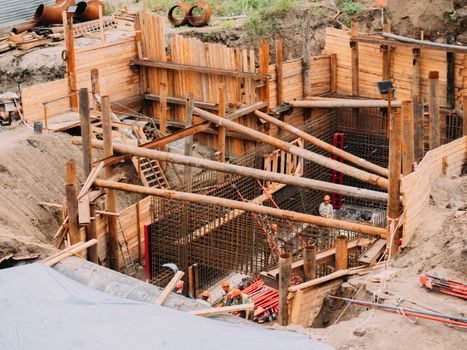
Symptom: the first panel refuses to align with the starter-bar cage, or plumb偏差 exceeds 10 mm over the panel height. Cause: starter-bar cage is shifted, or the kicker / blinding concrete at the base was poured out-of-plumb, so the formwork is being asked to compensate for a geometry that the panel was not designed to absorb. Fix: re-survey the kicker, shim the panel base with steel wedges only (never wood on a hydraulic climbing system — wood creeps under panel self-weight and the next lift inherits the lean), and re-pull plumb before tightening the first row of ties. [S1]
Symptom: climbing unit stalls or climbs unevenly. Cause: the climbing rail is fouled by concrete droppings, the rack-and-pinion gear is starved of grease, or the anchor shoe is bearing on a void. Fix: clean the rail full-height, re-grease per the OEM interval (typical hydraulic climbing systems call for grease every 2-3 lifts [S1]), and verify with a torque wrench that every anchor in the load path is at spec — anchors that read below the design preload are pulled and re-set, not "snugged" past the click. Acceptance: the panel must climb a full stroke and re-plumb to within ±5 mm of design offset before concrete placement resumes.
Symptom: formwork deflection during pour is excessive. Cause: tie-rod spacing is too wide for the pour rate, or the waler/strongback layout is under-spec for the hydrostatic head. Fix: add a tie row at mid-panel and re-tighten to the rated tie load before the next lift; if deflection persists, the panel is wrong for the wall thickness and the spec, not the field adjustment, has to change. Acceptance: deflection at maximum pour rate stays inside the OEM-published limit (typically L/360 of the unsupported span for vertical panels), measured with a laser plummet from a fixed reference point on the structure.
Comparison: Crane-Climbed vs Self-Climbed vs Table-Formwork
Lining the three families up against the criteria that actually drive a project decision — crane dependency, cycle time, labor content, and structure type — gives a clean selection map. Crane-climbed formwork has the lowest unit cost and the simplest hydraulics, but every lift ties up the tower crane for 1-2 hours and adds 0.5-1 day to the cycle [S1]. Self-climbing (ACS) systems remove the crane from the cycle entirely, which on a 40+ lift core can save 40-80 crane-hours, but the system itself costs more and demands a stricter anchor-pull-test regime [S5].
Table formwork with ring-lock support and H20 timber beams is in a different category: it is a horizontal-slab cycling system, not a vertical climbing system, but it often rides on the same ring-lock support towers and shares the same MOQ/supply chain — Okorder publishes a 1,000 m² MOQ and 500,000 m²/month supply capability on this configuration [S3], which is the spec signal that mid-size contractors use to size a tender bid. Aluminum auto-climbing (6061-T6) is the lightweight variant for core walls, cooling towers, tunnel liners, dam and pier shafts [S4]; steel Q235 variants take over when the structure is heavy civil and rebar density rules out aluminum walers [S2].
Failure Modes, Reject Limits, and When to Stop the Lift
Three reject limits are universal across the published product data. (1) Plumb: a panel that climbs more than ±10 mm out of plumb in a single lift must be re-plumbed before the next pour — YUNHAI's published procedure for civil-engineering climbing formwork is the reference for this tolerance [S2]. (2) Anchor preload: any anchor that does not hold the design uplift load on the pull test is rejected and re-set; "snug" is not acceptable on a climbing shoe. (3) Panel deflection: a deflection reading greater than the OEM limit at design pour rate is a stop-work; adding ties mid-pour is not a fix, the panel re-spec is.
For aluminum 6061-T6 systems specifically, surface abrasion at the rail-to-panel interface is a wear item that has to be measured every 5-7 lifts [S4]; for hydraulic systems like the Faresin SCREEN, the climbing-cylinder seal is the scheduled-replacement item and the OEM service interval (in lifts, not in months) is the only credible benchmark [S1]. When a failure mode repeats on the same component twice in three lifts, the component is replaced, not repaired — climbing systems have a low tolerance for "almost right."
Sourcing, Standards, and Field Acceptance
Procurement should anchor the spec to three verifiable inputs: the OEM-published lift-cycle procedure and pre-assembly checklist [S1][S4], the supplier's published MOQ and supply capability (1,000 m² MOQ at 500,000 m²/month is a representative data point for timber-beam / aluminum auto-climbing systems on Okorder [S3][S4]), and a field-acceptance plan that includes the plumb, anchor-preload, and deflection limits above. Sourcing options cluster in two regions: European hydraulic-climbing specialists (Faresin Building S.p.A. for the SCREEN system [S1]) and Chinese civil-engineering fabricators (Beijing YUNHAI [S2], kitsen [S5], and Okorder-listed aluminum/steel mills [S3][S4]) — with North America, South America, and Eastern Europe as the dominant export lanes for the Chinese supply base [S2].
For a worked example of a tiered field-acceptance procedure on a different but structurally similar install — window-and-door systems with a six-stage field procedure and acceptance specs — see this six-stage field procedure and acceptance spec walkthrough. For background on how a climbing formwork platform relates to the broader scaffolding category (tie rules, system types, and field acceptance), the scaffolding installation reference lays out the tie-pattern and lateral-stability logic that climbing-formwork brackets inherit. The vertical-element logic also parallels high-rise facade work; a trade-off map for glass curtain wall system types is a useful comparator when the climbing formwork is also serving as the perimeter working platform on a tall core.
Trackable signals over the next quarter: any new OEM publication of a climb-cycle interval (in lifts, not in months) for hydraulic systems [S1], any change to the 6061-T6 aluminum climbing-system MOQ or supply capability on the major Chinese B2B channels [S3][S4], and any new rail-climbing shoe design from the Chinese self-climbing suppliers that targets a higher anchor-pull-test load class [S2][S5]. For a working reference on the formwork category itself, the climbing formwork encyclopedia entry is the entry point; the related linear guide and crossed-roller guide pages cover the slide-bearing logic that several rail-climbing shoes use to handle lateral wind load on tall cores.