
The global collaborative robot (cobot) market is sized at USD 2.9B in 2025, projected to reach USD 4.0B in 2026 and USD 17.2B by 2033 at a 23.1% CAGR (2026–2033) [S2]. Independent trackers publish materially different endpoints: IndustryArc values the cobot market at USD 7.67B by 2030 at 25.60% CAGR [S1], Allied Market Research at USD 27.4B by 2032 at 36.3% CAGR [S6], and IDTechEx at a 20-year automotive-segment CAGR of 22% [S3]. The spread is the spec point — forecast dispersion is wider than for industrial robots as a whole, where the broader market sits at USD 38B (2020) to USD 163B (2032) at 12.6% CAGR [S4].
This article treats 2026 as the procurement decision year, not the headline year. The actionable numbers are the 2026 base (USD 4.0B [S2]), the payload split (up to 5 kg, up to 10 kg, above 10 kg) [S2], and the four functional cobot classes defined by ISO/TS 15066 — power-and-force-limiting, safety-monitored stop, speed-and-separation, hand-guiding [S1]. Specifiers who anchor on those axes avoid the 3–4× forecast variance between the four sources.
2026 Market Size and the Four-Tracker Forecast Spread
Grand View Research pegs 2025 actual revenue at USD 2.9B, 2026 estimate at USD 4.0B, and 2033 forecast at USD 17.2B at 23.1% CAGR [S2]. IndustryArc reports a 2030 endpoint of USD 7.67B at 25.60% CAGR across 2024–2030 [S1]. Allied Market Research extends further out to USD 27.4B by 2032 at 36.3% CAGR across 2023–2032 [S6]. The Daedal Research 2026 study puts the 2021 base near USD 0.5B and traces the trajectory through the post-pandemic recovery [S7]. The widest delta between trackers — Grand View's USD 17.2B vs Allied's USD 27.4B — reflects different payload definitions, different inclusion of end-effectors and software, and different end-vertical counting rules, not contradicting data points.
For a 2026 capital-equipment plan, the most defensible inputs are the 2026 base figure of USD 4.0B [S2] and the 23.1% CAGR through 2033 [S2], with IndustryArc's 25.60% CAGR [S1] as a higher-side sanity check. Industrial-automation procurement teams who also size adjacent capex — for example the AI accelerator upstream and downstream value chain — should expect cobot line items to outpace general industrial-robot growth (12.6% CAGR [S4]) by roughly 2× over the same horizon.
Payload Capacity Segmentation: The Real Selection Axis
Grand View Research segments the market into three payload bands: up to 5 kg, up to 10 kg, and above 10 kg [S2]. IndustryArc segments the market by four functional types — power-and-force-limiting, safety-monitored stop, speed-and-separation, and hand-guiding [S1]. These two cuts are orthogonal: a 6 kg SCARA robot arm running a hand-guiding application is a different procurement decision than a 16 kg articulated robot running a power-and-force-limited palletizing cell, even at the same site.
Power-and-force-limiting cobots are projected to reach a USD 1.00B sub-segment size by 2026 [S1] — the dominant functional class because they require no external scanner, no light curtain, and no fenced cell when the risk assessment supports that conclusion. Speed-and-separation monitoring cobots use on-arm or area scanners to maintain a protective separation distance from the human operator and are typically specified when the payload or reach precludes pure power-and-force-limiting. Hand-guiding cobots are specified for teach-by-demonstration tasks in low-volume, high-mix work. Safety-monitored-stop cobots halt on human entry and resume on exit — the simplest safety model, used when the cobot's working envelope is a partial shared workspace, not a fully shared one.
Application and End-Use Vertical Reality
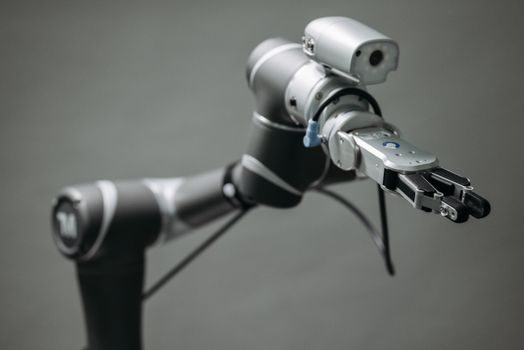
Across all four trackers, the dominant 2026 application mix converges on handling, pick-and-place, and assembly [S2][S1]. IndustryArc's vertical split as of 2020 placed automotive at 23% revenue share and healthcare at 16% revenue share [S1]. IDTechEx's automotive-segment CAGR forecast of 22% over the next 20 years [S3] is the most granular long-tail number in the source set, and it is consistent with the volume pressure IDTechEx documents: a Tesla Model 3 build cycle of approximately 90 minutes at the Fremont factory, where a few hours of production-line downtime from an industrial-robot fault translates into material lost output [S3]. That downtime math is the engineering case for retrofitting or reconstructing legacy lines with cobots that allow safe human entry without full line shutdown.
Secondary verticals cited across the reports include electronics, semiconductor, plastics and polymer, food and beverage, and metals and machining [S1]. IDTechEx extends the application list to surface polishing, screwing, injection molding, PC processor inspection, phone chip inspection, phone assembly, wearable-device assembly, PCB assembly, packaging, palletizing, and Li-ion battery industry tasks [S3]. For procurement teams sourcing adjacent equipment — say, a labeling machine line — cobot palletizing and case-packing cells are now a standard line item rather than a custom integration.
Standards, Safety Limits, and Risk-Assessment Discipline
The governing technical document for cobot deployment is ISO/TS 15066, which sits under ISO 10218-1 and ISO 10218-2 and specifies the four collaborative operation modes — power-and-force-limiting, safety-rated monitored stop, speed-and-separation, and hand-guiding — and the biomechanical force and pressure limits that a power-and-force-limiting cell must demonstrate through a documented risk assessment [S1]. The risk-assessment requirement is not optional: per IndustryArc, "it requires an extensive risk assessment because the operator can remain within reach of the cobot" [S1]. A cell that passes the force and pressure limits in the spec sheet still requires a documented application-level risk assessment for the specific end-effector, workpiece, and fixture combination.
Power-and-force-limiting cobots are built without sharp corners, exposed motors, or pinch points, and have sensitive collision monitors integrated into the joint-level feedback loop [S1]. For facilities also deploying AGV robot fleets or AMR robot traffic, the cobot safety case must be evaluated jointly with the mobile-platform safety case, because a moving cobot base inside a shared workspace is a different engineering problem than a stationary one. End-effector selection — gripper force, vacuum pressure, tool weight — must be folded into the power-and-force-limiting calculation, because the limit values in ISO/TS 15066 are applied at the tool center point and the workpiece interface, not just at the joint.
Adjacent-Market Spec Signals Relevant to 2026 Cobot Sourcing

Cobot selection in 2026 is increasingly a multi-vendor spec problem, not a single-arm purchase. The joint actuator choice drives duty cycle, repeatability, and mean-time-between-failure; the frameless brushless DC motor market — which supplies the high-torque-density direct-drive and harmonic-drive stages inside cobot joints — is projected at USD 140.4B in 2026 and USD 204.2B by 2033 at 5.5% CAGR [S8]. That figure aggregates robotics, medical, and industrial automation, but the robotics share is the driver: manufacturers are "prioritizing compact, high-torque-density solutions that eliminate traditional housings and bearings" [S8].
Warehouse robotics — the parallel category where cobots are increasingly deployed for piece-pick, induction, and packout — is a separately tracked USD-billion market with a 2026-published 150-page forecast from The Business Research Company covering parallel robots, mobile robots, and gantry robots across e-commerce, automotive, food and beverage, electronics, and metals end-uses [S9]. For spec teams building a brownfield cell, the warehouse-robotics data set is the relevant comparable for throughput, footprint, and integrator lead-time, even though the cobot category itself is a sub-segment of the broader industrial-robotics USD 38B-to-USD 163B 2032 trajectory at 12.6% CAGR [S4]. Buyers evaluating top humanoid robot companies for adjacent fixed-route handling work should note that 6-axis cobots remain the higher-ROI choice for sub-16 kg payload work in 2026, while humanoids are still pre-ROIC for most industrial procurement plans.
Procurement Criteria: Payload vs Reach vs Repeatability vs Integration Risk
For a 2026 capex decision, the four-line comparison that fits on one procurement page is payload, reach, repeatability, and integrator lead-time. Payload bands of up to 5 kg, up to 10 kg, and above 10 kg [S2] are the market-research segmentation, but the engineering cut is finer — sub-3 kg for electronics sub-assembly, 3–8 kg for machine tending and screw-driving, 8–16 kg for palletizing and case-packing, and above 16 kg for heavy-parts handling where the cobot class competes with small industrial articulated robot arms. Repeatability specs in the cobot class are typically ±0.02 mm to ±0.1 mm depending on model and payload, with the lower end of that range adequate for semiconductor and phone-chip handling [S3].
Integration risk dominates total cost of ownership. The unit price gap between competing cobots in the same payload band is narrow — IndustryArc notes "almost all the companies have a competing robot for the same payload category with similar performances, thus giving power to customers to choose from any integrator suiting their budget and application requirements" [S1]. The real delta is end-effector engineering, conveyor and fixture integration, vision-system tuning, and the ISO/TS 15066 risk-assessment deliverable. For 2026 planning, a defensible budget model uses the 23.1% CAGR as the volume-decline proxy for $/unit (assuming flat dollar market growth in line with unit growth), and treats integrator services as a 1.5–3× multiple of arm cost depending on cell complexity.
Trackable signals to watch over the next two quarters: revised 2026 base-year revenue from Grand View Research and IndustryArc as Q3 and Q4 2026 actuals come in, the next ISO/TS 15066 amendment cycle, and any second-half 2026 capacity announcement from Chinese cobot suppliers given China's manufacturing-sector growth trajectory flagged by IndustryArc [S1].