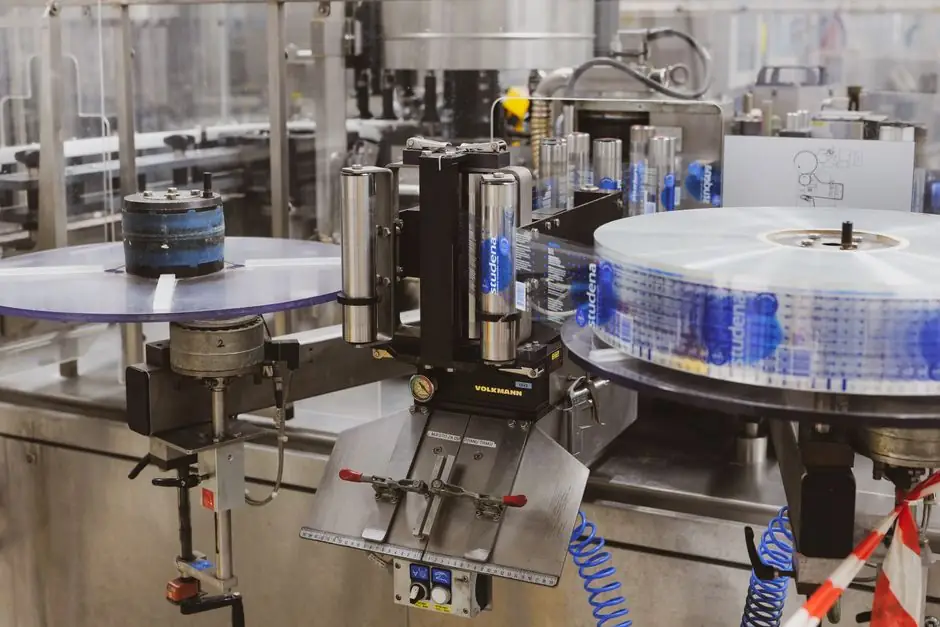
A cold-chain labeling line has to clear three hardware gates before any print-quality discussion: operation at -30°C ambient, condensation-proof IP65+ enclosure rating, and print-and-apply accuracy of +/-0.2mm to hold label position on frost-prone surfaces [S2][S1]. Pharmapack's LFLB-3220 front-and-back labeler is one of the few catalogued pharma models engineered for that envelope, with closed-loop servo control and a label dispenser rated to 60 m/min [S1].
Specifying a standard ambient labeler into a freezer aisle is the most common reason cold-chain operations see labels detach or scannability collapse below +5°C: standard acrylic adhesives harden, paper face stock absorbs condensation, and barcode contrast drops within minutes of transfer [S5]. The labeling machine class covers a wide range of architectures, and only a subset is cold-rated.
Sub-Zero Operating Envelope and Adhesive Pairing
Industrial Labelling Systems (ILS) publishes cold-store pallet labelers engineered for sustained operation as low as -30°C without heated enclosures, twin-motor tamp applicators delivering GS1 SSCC-compliant placement, and a FlexWipe module for high-speed multi-side pallet labelling [S2]. That -30°C figure is the practical floor cited across the cold-storage labelling segment, and it sets the reference for hardware decisions independent of insulation upgrades at the line [S2][S8].
Adhesive and face-stock choice has to be specified in lockstep with machine hardware. Standard general-purpose acrylics lose flexibility below +5°C and turn glassy, while deep-freeze hotmelt or acrylic adhesives retain tack down to -20°C to -40°C on PP or PE synthetic face stock [S5]. Application temperature (the air at the moment of label dispense) and service temperature (the storage air after application) are two different numbers, and the colder of the two drives the adhesive grade; cryogenic labels with aggressive tack are mandatory when the applicator itself sits inside the freezer [S5].
Condensation, Washdown, and Enclosure Rating
Condensation forms the instant warm product enters a cold cell or cold product leaves for dispatch, and water film on the package face destroys paper labels within minutes: they pulp, tear, and detach [S5]. That makes IP65+ a baseline, not an aspiration, for any labeler mounted inside or immediately adjacent to a cold room, and stainless frames with minimal moving parts are the prevailing build for chilled/wet food lines [S2][S4].
The coding side of the line shares the same physics. A sister spec map on coding machines for cold chain lays out the matching envelope: IP65+ enclosures, CIJ ink qualified to -25°C, laser marking to -40°C, and washdown-grade stainless housings that survive daily sanitisation cycles [S6]. Food-side hygiene audits (BRCGS, retailer-specific food-safety standards) generally require stainless contact frames, IP-rated enclosures, and verifiable print/audit trails, all of which feed back into the logistics packaging line design [S4].
Throughput Tiers: Semi-Auto, Automatic, and Inline
Throughput on a cold-chain labeler is constrained by the slowest of three gates: the conveyor's tolerance for frost, the applicator's cycle time at sub-zero viscosity, and the operator's tolerance for cold exposure if any manual step remains. ZONESUN's buyer guide tiers the architectural options cleanly: semi-automatic units run 10-30 units/min and need one operator per unit, fully automatic machines hit 20-60 units/min with one operator per machine, and inline systems reach 60-300+ units/min with monitoring-only labour [S7]. Upfront cost tracks that order of magnitude: roughly $100-$1,500 for semi-auto, $800-$12,000 for automatic, and $5,000-$60,000+ for inline [S7].
For a single-shift pharma cold store, 20-60 units/min on an automatic front-and-back labeler like the Pharmapack LFLB-3220 covers most vial-and-box runs, while a 60 m/min dispenser head lets the same line clear pallet-label bursts when upstream packaging spikes [S1]. For pallet SSCC labelling, ILS reports continuous in-motion pallet labelling at sub-zero, no stop-on-conveyor, with twin-motor applicator arms removing the need for guarding [S2]. That removes operator cold-exposure time, which is the single biggest labour cost on a manual cold-store labelling bench.
Print Engine and Verification: Thermal Transfer vs Other
On the print side, thermal transfer is the dominant cold-chain technology because the ribbon fuses ink into the synthetic face stock rather than sitting on top of it. The iDPRT iX4P industrial thermal transfer printer outputs up to 14 ips at 203 dpi (8 ips at 300 dpi, 4 ips at 600 dpi) with 4.1" (104mm) max print width, and prints on freezer-grade paper, polypropylene, polyester, and similar stocks when paired with the correct ribbon [S3]. A 256 MB flash / 512 MB RAM buffer is sufficient for variable batch data, GS1-128 carton marks, and SSCC pallet labels without host-side re-render delays [S3].
In-line print verification (barcode grading to ISO/IEC 15416, OCR confidence on lot/expiry) is a separate gate that should be specified at RFQ: degraded ribbons and condensation-driven contrast loss both show up as grade drops before they show up as scan failures, and a verifier at the applicator exit is the cheapest way to catch a dying ribbon before an entire pallet goes out with unreadable codes [S4]. The matched chain belt conveyor and divider architecture for cold lines typically adds its own derating, since standard lubricants thicken and greases migrate below -20°C.
Selection Criteria Comparison by Application
Three sub-zero labeling archetypes cover almost every cold-chain brief, and they line up against four decision criteria: temperature floor, throughput, container range, and label format. Print-and-apply pallet systems (ILS FlexWipe class) hit -30°C, run in-motion on full pallet loads, and apply one/two/three-side SSCC labels [S2]. Pharma-specific front-and-back labelers (Pharmapack LFLB-3220) target condensation-prone vials and boxes with +/-0.2mm accuracy at 60 m/min dispenser speed [S1]. Industrial thermal transfer print engines (iDPRT iX4P and iK4-R600 class) sit at the print-quality apex, outputting verifiable barcodes on PP/PE/polyester freezer stocks at 14 ips [S3].
Across those four criteria, the shortlist is: pallet print-and-apply for -30°C warehouses with high SKU turnover; pharma front-and-back labelers for vial/ampoule lines where placement accuracy gates regulatory batch records; and industrial thermal transfer printers where in-house label conversion and variable data dominate the workload. Mixing the three on a single line is normal: pallet labels printed and applied at the cold-store dock, with carton/barcode labels generated and verified at the warm-side packaging line before the product enters the cold cell.
Who This Is (and Isn't) For
A sub-zero-rated, condensation-proof labeling system is for any operation that runs a labeling step inside or directly adjacent to a freezer or chilled cell: third-party cold-chain logistics, frozen food manufacturing, vaccine and biologic distribution, fresh produce pack-houses, and dairy/juice cold-store operations [S2][S3]. It is not for ambient-temperature lines where the product enters cold storage already labeled; a standard automatic or inline labeler with freezer-grade adhesive and PP/PE face stock is sufficient, and the -30°C enclosure premium is wasted. It is also not for one-off pilot batches; the cost floor of a cold-rated print-and-apply pallet system sits well above $5,000, and break-even is reached only at sustained pallet volumes [S7].
For broader industrial context on how this fits with adjacent line equipment, the capping and sealing machine selection spec map for retail distribution covers the matching closure-stage envelope, including the washdown and IP ratings that mirror cold-chain labeling requirements. The chemical-shipping capping and sealing spec map covers the harsher hazmat/cryogenic end of the temperature spectrum, where labeler integration is the next gate beyond closure integrity.
Failure Modes and What to Watch at Commissioning

Three failure modes dominate cold-chain labeler commissioning. First, adhesive-grade mismatch: a label qualified for +5°C service fails within an hour below the dew point on a frosted carton, and the failure reads as a "machine problem" when the root cause is the label stock [S5]. Second, ribbon/face-stock mismatch on thermal transfer: a wax ribbon on a polyester freezer-grade stock smears under condensation; a wax-resin or resin ribbon is mandatory for sub-zero durability [S3]. Third, enclosure derating: a labeler rated IP54 on a warm side, moved into a washdown or condensation zone, will see drive electronics fail within months; IP65+ with stainless frames and sealed cable glands is the floor, not the ceiling [S2][S4].
At commissioning, validate four numbers: applicator accuracy against the +/-0.2mm spec on a frosted test surface, ribbon-on-stock scuff resistance after 24h at -25°C, barcode grade at the conveyor exit (target ISO/IEC 15416 grade C or better for carton labels, B or better for pallet SSCC), and cycle time at the line's actual ambient, not at room temperature [S1][S2][S3]. Trackable signals to monitor over the next two quarters include wider availability of -40°C-rated applicator arms beyond the ILS-class solutions, and broader catalog coverage of pharma front-and-back labelers with verified condensation-rated dispenser heads from second-source OEMs.