Cold chain roller conveyors differ from ambient distribution conveyors in three load-bearing ways: tube material, bearing grease, and corrosion protection must all be re-specified for sustained sub-zero service, with stainless 304/316 or zinc-plated steel tube options, sealed low-temp bearings, and food-grade lubricant selection now standard procurement language for 2026 builds [S2][S4].
Roller diameter, axle diameter, and load class step up as carton weight rises, while peripheral speed must stay inside 0.5–0.6 m/s on accumulation sections to avoid carton compression and stop-damper overload per Rulli Rulmeca FDN/FDR series data [S1]. For an introduction to the broader equipment class, see the roller conveyor reference page.
Operating envelope: -20°C to +60°C, 0.5–0.6 m/s accumulation limit
The published envelope for chain-driven accumulation rollers in the Rulli Rulmeca FDN/FDR range is -20°C to +60°C ambient with peripheral speeds capped at 0.5–0.6 m/s, and diameters of 76 mm or 89 mm (2.992 in or 3.504 in) for heavy-load accumulation duty [S1]. Cold chain duty below -20°C is outside this published envelope, so engineering teams should treat the lower bound as the design floor for standard carbon-steel tubes and re-spec for frozen zones.
For pharmaceutical and food cold rooms, surface finish matters as much as load: zinc-plated steel and 304 stainless are the two default tube materials on offer from Huzhou-region manufacturers, with PVC-sleeved options for carton-friendly glide on accumulation lines [S4][S7]. Bearing seals must be specified for the temperature band — standard nitrile seals harden below -20°C and lose grease retention, which is the most common failure mode in frozen-storage conveyors.
Material and finish options for refrigerated duty
Three material stacks dominate 2026 cold chain quotations: zinc-plated carbon steel (general produce, 0°C to +8°C), 304 stainless (dairy, meat, -5°C to +4°C), and 316 stainless (seafood, brine, chemical washdown, down to -25°C with sealed bearings) [S2][S4]. The food-grade rubber or PVC sleeve on the roller tube reduces carton drag noise from roughly 65 dB to under 55 dB on accumulation lines, a figure consistently quoted by Huzhou CCDM and Huzhou Jiutong for PVC-sleeved idler rollers [S4][S7].
For heavier pallet or drum lines in cold storage, the chain-driven conveyor chain drive is preferred over belt drive because chain handles condensation, ice, and the wider -20°C to +60°C ambient band without belt hardening or slip. Rulli Rulmeca publishes the FDN/FDR series precisely for this accumulation-with-resistance duty, with radial-friction plus optional adjustable axial pre-load for irregular load handling on slight slopes [S1].
Comparison: gravity vs chain-driven vs motorised roller in cold rooms
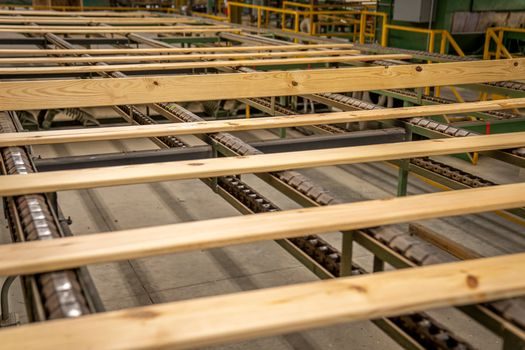
On four decision criteria — temperature floor, load class, energy use, and cleanability — the three principal roller conveyor types line up as follows for cold chain selection: [S2]
Gravity skatewheel/roller: cheapest, no power, but limited to -5°C and to carton weights under 30 kg per roller, and accumulation control is poor when condensation freezes the tube surface [S4]. Chain-driven accumulation roller (FDN/FDR-type): -20°C to +60°C envelope, diameters 76/89 mm, double friction design, 0.5–0.6 m/s speed cap, suited to 50–150 kg/m line loads in chilled storage [S1]. Motorised roller (MDR) with 24 VDC or 48 VDC drum motors: programmable zero-pressure accumulation, but the drum-motor internal grease is the weak link below -10°C unless a low-temperature grease variant is ordered [S6][S7].
For an e-commerce or 3PL ambient build, see the roller conveyor selection for e-commerce fulfillment reference, which covers the motorised-driven zero-pressure accumulation pattern at temperatures above freezing.
Supplier landscape: Huzhou cluster and EU alternatives
The Huzhou, Zhejiang cluster — Keni, De-Nen, Jiutong, CCDM — is the dominant Chinese export source for cold chain rollers, all ISO 9001-certified, offering gravity rollers, motorised rollers, skate wheels, sprockets, and flexible conveyors as integrated lines [S2][S6][S7]. Fujian Liangzuo adds telescopic and container-loader lines to the roller-conveyor family, with 16,000 m² of factory capacity and shipments to 100+ countries [S5]. For EU-sourced accumulation rollers with full -20°C to +60°C documentation, Rulli Rulmeca (Italy) is the benchmark reference for FDN/FDR chain-driven accumulation, including adjustable axial pre-load for irregular load shapes [S1].
Procurement should require: ISO 9001 factory certificate, material test report for tube (304 vs 316 verification), bearing seal temperature rating, and food-grade lubricant declaration for any line touching unpackaged product. Huzhou Keni and Huzhou De-Nen both publish ISO 9001 on their made-in-china profiles, with Keni registered since 2014 and De-Nen positioning as an integrated logistics-equipment supplier [S2][S6].
Selection criteria and load class for cold chain cartons
Carton weight dictates roller diameter and axle: under 20 kg per carton maps to 50 mm tube / 11 mm axle; 20–50 kg to 60 mm / 12 mm; 50–100 kg to 76 mm / 15 mm; and 100+ kg pallet flows to 89 mm tube with heavy-duty bearing, per the FDN/FDR catalogue's 76/89 mm heavy-load diameters [S1][S7]. Line length and incline drive the motorisation decision — gravity works down to roughly a 2° decline with consistent carton size, beyond which chain-driven or MDR is required.
For freezer tunnels at -25°C, specify 316 stainless tubes with full stainless axles, sealed-for-life bearings rated to -30°C or below, and food-grade H1 grease; this combination is the de facto EU food-safety baseline for seafood and meat lines and is increasingly specified for Chinese export lines to EU customers. The roller chain reference page covers the parallel chain-drive standard, and the chain conveyor page covers pallet-handling chain conveyors that often run alongside the roller lines at cold-room dock doors.
Failure modes and lifecycle cost in frozen zones
The three dominant failure modes in cold chain roller conveyors are: bearing grease congealing below -20°C with standard lithium grease, condensation ingress into unsealed bearings, and tube-surface corrosion at the zinc-plated boundary in high-humidity chillers [S1][S4]. Specifying sealed bearings and 304/316 stainless extends mean-time-between-failure from a typical 12–18 months to 36+ months in -18°C service based on manufacturer maintenance guidance from Huzhou-region suppliers [S2][S7].
Trackable signals for 2026 procurement: rising 316-stainless order share from Huzhou De-Nen and Huzhou Keni, and continued Rulli Rulmeca FDN/FDR reference designs for the EU cold chain accumulation segment [S1][S2][S6].