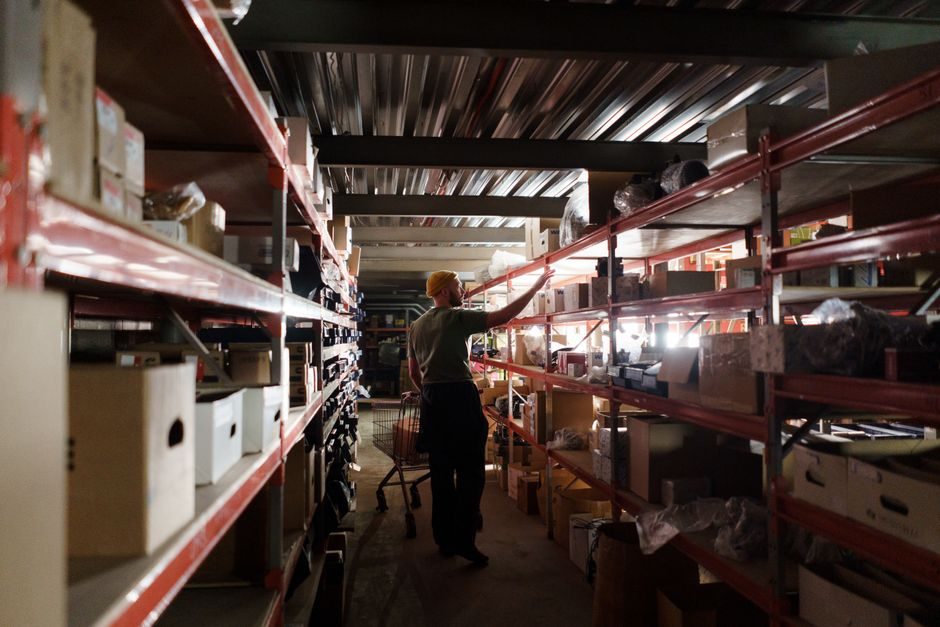
Gravity skatewheel / roller, line-shaft driven, and 24 V / 48 V motorised-roller (MDR) are the three roller conveyor architectures specified for e-commerce parcel handling, with ZPA (zero-pressure-accumulation) control as the dominant accumulation method in DCs handling parcels under 50 kg [S1][S2].
RIGOR lists a Motorised Roller Conveyor, Chain Conveyor, Transfer Unit, and Turntable as the core pallet-handling building blocks on its 2026-07-31 product catalogue, while the box-handling line adds a non-motorised Roller Conveyor, Belt Conveyor, and Wheel Sorter [S1]. Fujian Liangzuo similarly markets a Stationary Power Roller line and Mini Telescopic Climbing conveyor for last-yard dock interface [S2].
Roller Diameter, Pitch, and Load Class
Roller diameter is the first spec to lock in: φ50 mm (1.9 in) steel or PVC rollers are the de-facto choice for parcels in the 0.5–30 kg range, while φ76 mm and φ89 mm carry cartons up to 50–80 kg and totes on telescopic loaders [S2]. Roller pitch is typically 75 mm, 100 mm, or 150 mm — the smaller pitch is mandated for short parcels under 200 mm length to prevent tipping between rollers [S2].
For e-commerce DCs receiving mixed-SKU cartons, the conservative spec sheet is φ50 × 1.5 mm wall steel, zinc-plated, on 100 mm pitch, 600 mm effective roller length (matching a 600 mm belt conveyor face width). Stations where totes accumulate for induction require φ60 mm with rubber sleeve to damp the contact noise above 75 dB(A) [S1][S2].
Gravity vs Line-Shaft vs MDR
Line-shaft conveyors drive multiple roller slats from a single 1.5–2.2 kW shaft via O-rings, which keeps the electrical count low but limits curve radius and excludes explosive / Class I Div 2 areas where exposed belts are a concern.
24 V brushless DC MDR (motorised roller) is the architecture of choice for modern parcel DCs because each zone can be ZPA-controlled from a PLC or zone controller, and the absence of line shaft or chain allows tighter curve radii down to R800 mm [S1]. RIGOR's motorised roller conveyor is built around that MDR + Transfer Unit + Turntable package, with the Turntable typically specified at 1200 mm or 1500 mm diameter for cross-belt sortation interfaces [S1].
Zero-Pressure Accumulation (ZPA) Logic and Throughput

ZPA logic forces a parcel-to-parcel gap of 500–800 mm regardless of upstream discharge rate, using photo-eye + zone controller so the upstream zone stops the moment its eye is occupied and the downstream zone requests product [S3]. The friction-accumulation roller track published by Huangshi Zhongcheng on 2026-07-22 is rated for 0–15 m/min line speed with double-layer and single-layer tracks, lift tables, and pallet stoppers controlled by an electrical system [S3].
For e-commerce, the practical throughput ceiling sits around 1,500–2,500 parcels/hour per 600 mm-wide ZPA conveyor lane. Above that, the lane must be split, or the architecture must move from ZPA to slaved (gap-clamp) accumulation with a dedicated gap-creating servo at the merger [S1]. ZPA is not a fit for very long, heavy totes (>1,200 mm, >50 kg) because the photo-eye logic loses discrimination when the parcel is longer than the zone length [S3].
Layout Geometry: Straight, Curve, Merge, and Transfer
Curve radii below R800 mm require tapered rollers on roller conveyors; below R600 mm the specifier is forced into belt conveyor or skatewheel conveyor variants, since tapered steel rollers cannot maintain face width inside that radius [S1]. A 90° transfer between two perpendicular roller lanes is normally done with a pop-up transfer unit, a lift-and-rotate transfer, or a wheel sorter — RIGOR's catalogue lists a Power Roller Pop-up Transfer Unit alongside the standard transfer [S1].
For a greenfield e-commerce DC, the standard merge at the takeaway is a 30° angled merge with a 600 mm nose-over zone; the specifier should budget 1.2–1.5 m of straight section before the first curve after any merge to stabilise the parcel gap and avoid downstream ZPA mis-triggers [S1]. Layouts that mix live roller curves with belt straight sections must align face widths (600 / 800 / 1,000 mm) to avoid dead-plate edges that scuff corrugated.
Standards, Safety, and Electrical
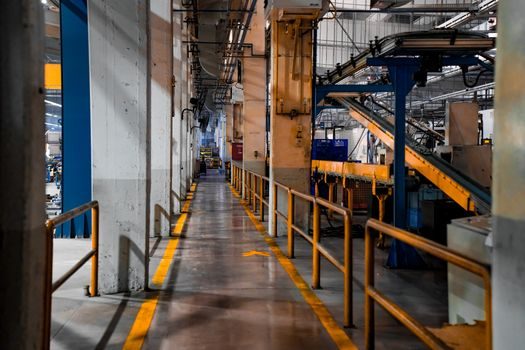
Roller conveyors in EU DCs must satisfy EN 619 (continuous mechanical handling equipment — safety) and ISO 5048 for belt-driven variants; MDR zones must meet IEC 60204-1 for 24/48 V control panel construction and IP54 minimum for any wash-down zone. Where conveyors run in cold-chain (<+2 °C) or frozen (<-18 °C) e-grocery cells, the specifier must drop to low-temperature grease (-30 °C pour point) and 304 stainless rollers in the splash zone to resist chloride attack from salt-laden cold rooms [S1][S2].
For e-commerce sortation aisles with package volumes above 3,000 parcels/hour per cell, the noise budget forces rubber-lined rollers or ABS sleeves on all worker-facing lanes to hold the 8-hour LEq below 80 dB(A) per typical EU worker-directive thresholds [S1]. Photo-eyes in those cells are normally diffuse-reflective or retro-reflective 24 V DC with PNP output, and the safety stop circuit must be dual-channel Category 3 per EN ISO 13849-1 with the e-stop pulled through the same MDR zone controller.
Decision Matrix: Which Roller Conveyor for Which DC
Gravity roller / skatewheel fits small courier depots (<500 parcels/day) with carton-only flow on fixed 4° declines; capex is minimal but expansion to bi-directional or slaved accumulation requires a full rebuild [S2]. Line-shaft fits heavy-parcel or pallet-handling cells up to ~500 kg/m where chain-and-roller drive is acceptable and the layout is straight-dominant; O-ring wear at 6–12 month intervals is the maintenance penalty [S1].
24 V MDR with ZPA is the default spec for any greenfield e-commerce parcel DC above 1,000 parcels/hour per lane, sized at φ50 × 600 mm rollers on 100 mm pitch, with photo-eye ZPA, 24 V brushless DC drives, and a Cat 3 safety stop circuit [S1]. Friction-accumulation roller is a separate sub-class used when the spec is in heavy-industry assembly (e.g. engine packaging, as shown in the [S3] case images) and is rarely the right answer in parcel DCs because the 15 m/min speed ceiling throttles sortation throughput [S3].
A practical 2026 e-commerce build of a 5,000 m² DC typically lands on 1,800–2,500 linear metres of MDR ZPA roller, 400–600 m of gravity takeaway, four to six turntables / transfers, and 1–2 telescopic loaders at the dock — the rollers themselves are commodity; the controls and ZPA tuning are the specifier's real risk [S1][S2].
Specifying the Bill of Material

For each roller conveyor line in the BoM, the specifier should freeze: roller diameter × wall thickness × material (e.g. φ50 × 1.5 mm zinc-plated steel, or φ60 × 2.0 mm 304 SS in cold rooms), roller pitch, effective face width, frame cross-section (typically 80 × 40 × 2 mm cold-rolled C-channel), drive type (24 V MDR or 1.5 kW gear-motor line-shaft), zone length for ZPA (typically 600–1,200 mm), photo-eye type, and IP rating of the electrical enclosure [S1][S2].
Lead time for full BoM is 6–10 weeks ex-works China on standard 600 mm-face MDR, rising to 14–18 weeks for SS304 cold-chain rollers and 20+ weeks for any non-standard 1,000 mm or 1,200 mm face width [S2].
For broader sortation context inside the same DC, the belt conveyor selection for warehouse automation 2026 spec map lays out the matching face-width and belt-grade choices for takeaway lines, while the belt conveyor selection for air-cargo terminals article is the right reference when the same roller line ends at a cross-dock ULD build-up position. For parcel-vs-airport interface, the belt conveyor selection for chemical shipping is too heavy-duty for e-com but is the right read for any bonded-warehouse cell that stores hazmat consumables alongside parcels.
Spec-level background on the components involved: road roller, and roller bearing.