
Guangdong-based Huayan Robotics lists 6-axis Elfin, Elfin-Pro, S heavy-payload, Elfin-Ex explosion-proof, and STAR mobile manipulator lines, with 17 named application cells including welding, CNC, palletizing, and grinding, as of 2026-07 [S3][S6].
Henan Boy Machinery (Luoyang) is an audited Diamond Member since 2020 exporting 40 collaborative-robot SKUs to Europe and Southeast Asia/Mideast, with 5 supply-chain partners, MOQ 1 pc, and an average response time ≤9.4 h [S1]. Techman Robot markets a vision-built-in 6-axis cobot (TKM-1000) for CNC processing with integrated camera [S4].
ISO/TS 15066:2016 sets the four collaborative-operation modes that define the supply chain
ISO/TS 15066:2016 is the governing technical specification for collaborative industrial robot systems, listing four collaborative operations: safety-rated monitored stop, hand guiding, speed and separation monitoring, and power and force limiting [S2]. Section 5.5 of the document defines the protective measures, stopping functions, and enabling-device requirements that suppliers must document for each cell [S2]. Annex A supplies the quasi-static and transient contact limits that drive force-limiting finger, palm, and back-of-hand thresholds cited in cobot risk assessments [S2]. Buyers in the EU typically reject a cobot that cannot demonstrate traceability to this annex, even when the arm itself carries a CE mark under ISO 10218-1/-2 [S2].
Hand-guiding cells with a 6-axis arm and force-torque wrist are a common Huayan Elfin / Elfin-Pro configuration; palletizing cells that exceed 16 kg typically step up to the S Heavy Payload line [S3]. For buyers who need a collaborative robot on a machine-tool tending cell, the supply chain must carry the vision module, gripper, force sensor, and safety scanner as separately warrantable items, not bundled SKUs.
Selection criteria: payload, reach, repeatability, IP rating, and zone classification
Cobot selection is dominated by four numeric axes that map directly to the spec sheet: payload (typically 3 / 5 / 8 / 12 / 16 / 20+ kg), reach (600–1300 mm for 6-axis arms), repeatability (±0.02 to ±0.05 mm), and IP rating (commonly IP54 for Elfin series, IP65+ for washdown) [S3]. The fifth axis — area classification — is the divider between a standard arm and an Elfin-Ex explosion-proof model for Zone 1/21 dust and gas environments [S3]. Buyers should reject any supplier who cannot quote a PFL threshold (N) per ISO/TS 15066 Annex A table for the relevant body region (finger, palm, back of hand) [S2].
For a CNC-tending cell, the Techman TKM-1000 ships with built-in vision to localize fixtures without an external camera bracket, reducing integration hours but locking the buyer into the vendor's vision stack [S4]. Palletizing end-of-line cells more often rely on external 3D cameras and conveyor encoders feeding back through conveyor chain or chain conveyor speed signals into the cobot controller.
Who this is for, and who it is not for
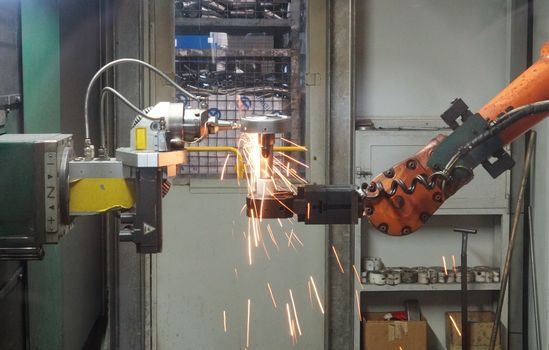
Collaborative robots fit 3C electronics assembly, light-payload CNC tending, screw-driving, polishing, and lab-handling cells where the human stays inside the same envelope and a safety-rated monitored stop is acceptable [S3]. They also fit short-cycle palletizing with payloads ≤16 kg, where speed-and-separation monitoring outperforms a fully fenced industrial robot on footprint [S3]. They are not for heavy welding of thick steel, high-speed press tending, foundries with abrasive debris, or any cell where the throughput math requires a robot to move faster than the PFL thresholds in ISO/TS 15066 Annex A will allow [S2].
Plants running 24/7 lights-out operations on automotive body-in-white should stay with traditional industrial robots in a fenced cell — a cobot's force-limited joint torques will throttle cycle time and the risk assessment will reject PFL at the required cycle rate [S2]. A humanoid robot is the only path that retains the cobot's collaborative envelope while raising payload, and is the adjacent supply chain to map alongside.
Vendor and region cut: Guangdong vs Henan vs Taiwan ecosystem
The 2026 cobot supply chain splits cleanly by region: Guangdong (Shenzhen/Dongguan) is the application-cell hub — Huayan, Han's, and a cluster of welding and CNC-tending integrators list 17+ application cells and an Elfin-Ex explosion-proof line [S3][S6]. Henan (Luoyang, Zhengzhou) is the heavy-machinery and machine-tool spares hub — Henan Boy Machinery cross-sells cobots alongside flameproof wound-rotor crane motors and CNC machine tools to Europe and Mideast buyers [S1]. Taiwan (Hsinchu) is the vision-integrated cobot origin — Techman Robot builds the TKM-1000 with built-in camera for CNC processing [S4].
Supply-chain-partner counts are low at the trading-company layer: Henan Boy declares 5 partners, MOQ 1 pc, and a ≤9.4 h response time, indicating an integrator that assembles cells rather than a tier-1 OEM [S1]. Guangdong application hubs list 8 product families and a full channel-partner program, indicating a deeper tier-2/3 vendor base [S3]. Buyers running welding robot cells should weight the welding-application cells more heavily than the generic cobot SKU count.
Integration risk and supply-chain failure modes

Three failure modes dominate 2026 cobot returns. First, gripper and EOAT obsolescence — the cobot arm has a 10-year service life, but the vacuum gripper, force sensor, and end-camera typically refresh every 3–5 years, so the supply contract must lock firmware versions and spare-part pricing. Second, PFL certification drift — buyers that pass risk assessment on ISO/TS 15066 Annex A limits must re-assess after any payload, tool mass, or robot speed change, which makes "plug-and-play" grippers a documented risk under section 5 of the standard [S2]. Third, vision-stack lock-in — the Techman TKM-1000's built-in camera and vision software is a single-vendor stack, and a buyer who later needs 3D bin picking must verify the controller exposes an open API before commissioning [S4].
For power conditioning on the cobot cabinet — especially in 3C fabs with dirty mains — spec a switching power supply for the 24 VDC logic rail and an industrial UPS for the safety-controller holding the monitored stop. Plants that already use DC power supply DIN-rail modules for the cell can reuse the same panel footprint.
Standards, documentation, and sourcing checks
Any 2026 cobot sourcing checklist should hard-require four documents: ISO/TS 15066:2016 conformance statement with Annex A PFL table values, ISO 10218-1/-2 declaration, CE / UKCA technical file, and a risk-assessment report per ISO 12100 referencing the specific application cell [S2]. For Zone-classified cells, the Elfin-Ex line carries an explosion-proof rating that should be cross-referenced to the regional scheme (ATEX 2014/34/EU in EU, GB/T 3836 in China, IECEx for international projects) — buyers should not accept a "factory explosion-proof" claim without a notified-body certificate number on the nameplate [S3].
Henan Boy's audit trail (Diamond Member since 2020, audited supplier, ≤9.4 h response, 5 named supply-chain partners) is the type of trading-company disclosure a European or Mideast buyer can verify before issuing a PO [S1]. SourceForge's 2026 listing of supply-chain-planning software in China is the upstream planning layer — a cobot cell that joins a smart factory will need a planning tool that ingests cycle-time, EOAT changeover, and vision-fail-rate telemetry, not just MRP [S5].
Two trackable signals for the next 90 days: (1) ISO/TS 15066 revision activity — the 2016 edition is still the cited technical specification as of 2026-07, and any draft amendment will reset the Annex A PFL thresholds every cell relies on [S2]; (2) Guangdong integrators adding ISO 13485 or GMP-compliant cells for the medical-device and lab-handling segments — Huayan's healthcare and pharmaceutical application pages already list ophthalmic imaging, COVID-19 sampling, and detection-kit handling, which is a leading indicator of where cobot spec will be written into regulated cleanroom tenders [S3].